Industry
Part of 5 details of liking principle people miss
Liking principle techniques with the guesswork removed
Liking principle techniques that hold up when explained, the trained versions that do not, and what to do when you want to be both liked and trusted.
Being easy to deal with is not a trick. It becomes one at the point where the warmth is produced to lower somebody's guard rather than to make the work go well.
What to take away
- The honest techniques are all things you would happily be caught doing. That is not a coincidence; it is the definition.
- The trained versions, connection-hunting and mirroring and agreement-first, work whether or not they are sincere, which is exactly why they fail the test.
- If you want to be liked and believed at once, the reliable route is to make yourself easy to check.
Techniques that survive being explained
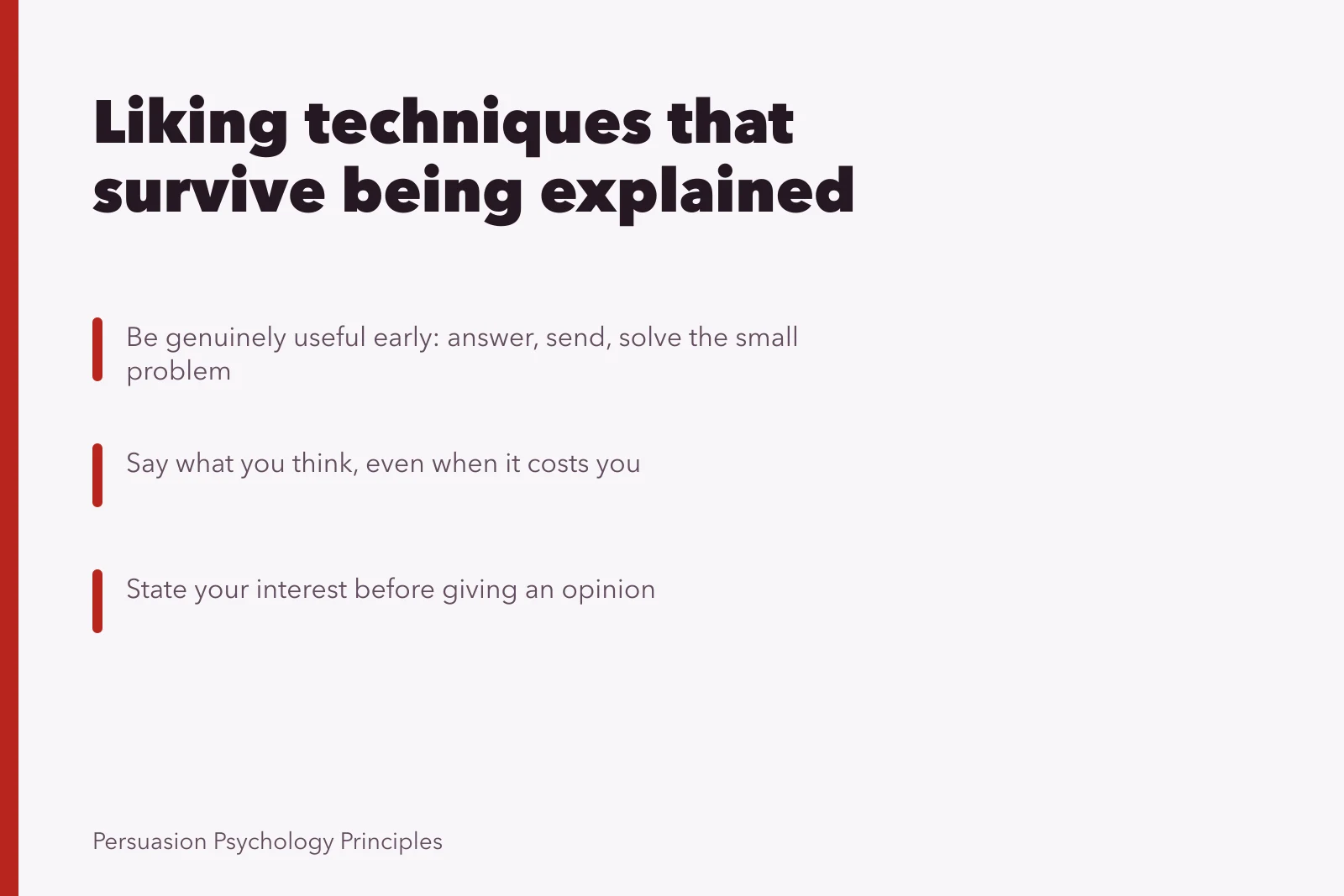
Be genuinely useful early. Answer the question, send the thing, solve the small problem. People warm to those who make their week easier, and this warmth is earned in the plain sense that you did something.
Say what you actually think, including when it costs you. Telling somebody the cheaper option is better than yours does more for a working relationship than any amount of rapport, and it is the one move that cannot be faked cheaply.
Remember what matters to them and act on it. Not as a technique, and the difference shows. Remembering a deadline someone is worried about, and asking about it later, is warmth with substance behind it.
Find the real common ground, and let it be small. People do have things in common and mentioning them is normal. The honest version is that you mention it because it pleased you, not because you went looking for a lever.
Make disagreement safe. Somebody who takes a correction well is easier to work with than somebody who is agreeable, and the difference compounds. This is warmth aimed at the work rather than at yourself.
Be reliable in small things. Turning up, replying, doing what you said. This produces liking slowly and it is the only kind that survives a bad outcome, which is when you will need it.
Techniques that collapse when named
| Technique | Why it works | What nobody says out loud |
|---|---|---|
| Hunting for a connection | Shared background produces trust | "I asked where you grew up to find a hook" |
| Mirroring on purpose | Matching creates ease | "I copied your posture to make you agreeable" |
| Agreeing first about something free | Early agreement transfers | "I conceded the cheap point on purpose" |
| Flattery aimed at a decision | Praise produces warmth | "I praised you because you sign the contract" |
| Manufactured similarity | Likeness lowers the guard | "The team I support depends on the client" |
Each row has an honest sibling and the siblings are slower. Real common ground instead of hunted common ground. Natural rapport instead of trained mirroring. Praise given when deserved and out of earshot of any decision. The slowness is what you are buying: a relationship that does not have to be maintained by technique.
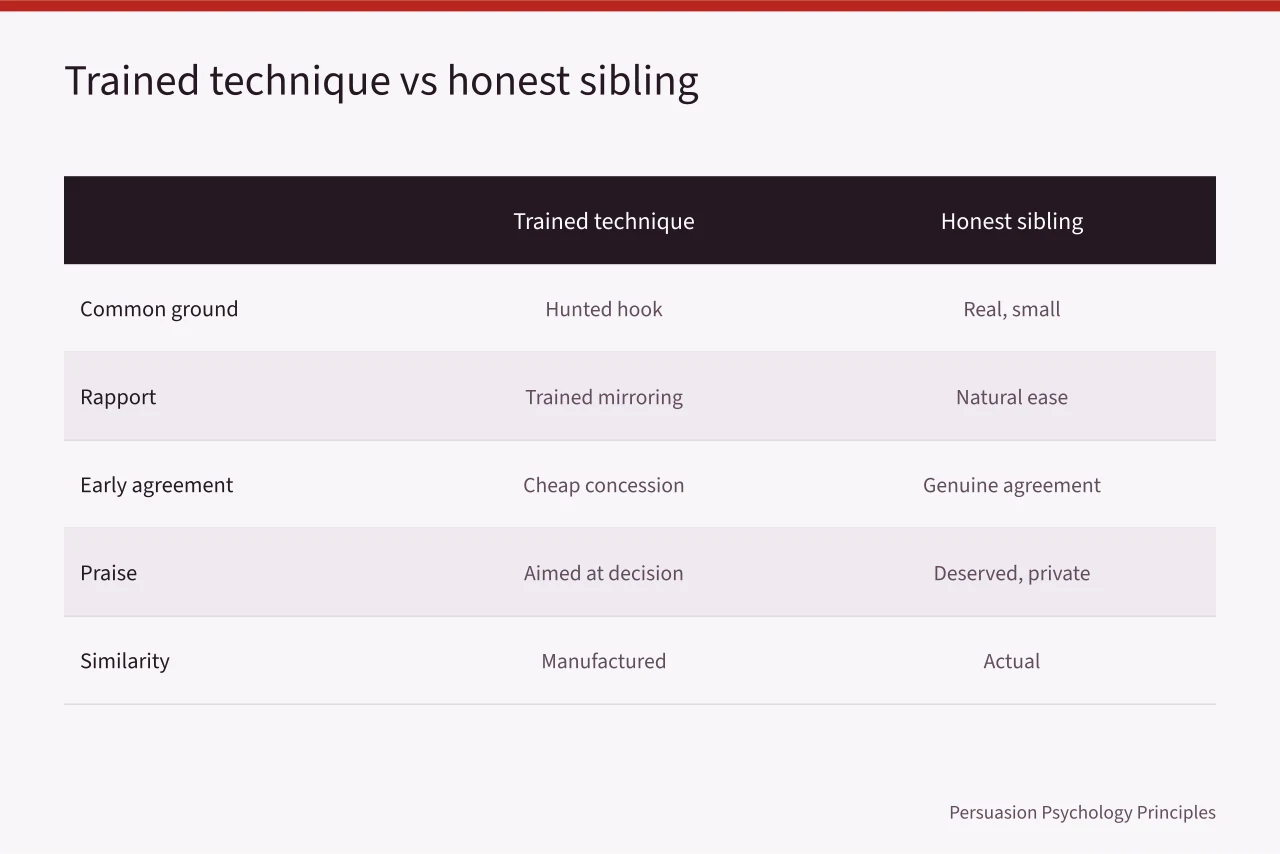
All five rows involve producing a signal that ordinarily means something. Warmth normally indicates that somebody likes working with you, and the trained versions manufacture the indicator without the thing it indicates. That is why they belong on the same list as manufactured social proof rather than on a list of soft skills.
Influence that works by going around somebody's judgment rather than through it is the standard case discussed in the Stanford Encyclopedia entry on the ethics of manipulation.
If you want to be liked and trusted
These pull against each other more often than people admit, because the fastest route to being liked is agreement and the fastest route to being trusted is disagreement at the right moment.
- State your interest before you give an opinion. "I sell this, so weigh what I say accordingly" costs you a little warmth and buys you everything else.
- Give the reason alongside the recommendation, so the person can keep the reason after they stop liking you.
- Say when something is outside what you know. Confidence produces liking and calibrated uncertainty produces trust, and only one of them survives being checked.
- Accept a "no" without a second run at it. The second attempt is where a pleasant conversation turns into pressure, and people remember which one they had.
Each of these makes you easier to verify, which is the underlying move. Whether it is reasonable to rely on somebody at all is a question with a large literature behind it, and the Stanford Encyclopedia entry on trust sets out why trust is not simply confidence that a person will behave well.
When you are on the receiving end
You will not detect trained warmth reliably, and you should not spend attention trying. The correction is structural: separate the person from the proposal, write the proposal down, and read it as though a stranger had sent it.
Two questions finish it. Would I accept this from somebody I found irritating? And what have I not checked because checking would have felt rude? That second one finds most of it.
The mechanism is set out under liking principle, the standard that decides which list a technique belongs on under social influence basics, and the tactics that depend on you not looking under manipulation resistance. Where the warmth arrives with a gift attached, the second mechanism is covered under reciprocity.
Common questions
Is it manipulative to be deliberately pleasant?
No. Deciding to be good to deal with is a choice about your conduct. It turns when the pleasantness is produced to stop somebody examining an offer.
What about sales training that teaches these things?
Some of it teaches genuine service and some of it teaches signal production. The test works on the individual technique: if the trainee would be embarrassed to have the client read the script, that technique is on the wrong list.
Does declaring my interest actually help me?
It costs a little at the start and pays over any relationship that lasts. It also makes your recommendations worth more, because a recommendation from somebody with a stated interest can be weighed rather than discounted.
How do I disagree without damaging the relationship?
Disagree about the thing and be plain about it once. Most damage comes from repetition or from disagreement that arrives with an implication about the person, not from the disagreement itself.