Features
Part of Authority compared with expertise: what actually earns deference
Authority signs and the details that decide it
Eleven authority signs that a credential is standing in for an argument, sorted by where they show up, each with the plain question that tests it.
Expertise is real and deferring to it is usually right. What is worth noticing is the moment when the symbol of expertise starts doing the work the reasoning should be doing.
What to take away
- These signs are about the shape of the appeal, not about the person. A genuine expert can produce several of them on a bad day.
- Sort them by where they show upin the claim, in the credential, or in the room. Each location has its own check.
- One sign is noise. Three at once, on a decision you cannot easily reverse, is a reason to ask for the reasoning.
Signs in the claim
1. The conclusion arrives without the reason. You are told what to do and not why. An expert who cannot compress the reason into a sentence usually can, and has chosen not to.
2. The certainty does not match the question. A genuinely open question answered without hedging. Experts inside their field are often more cautious than outsiders expect, because they know where the edges are.
3. The claim has drifted out of the field. The credential is in one subject and the assertion is about the next one over. This is the single most common failure and it is committed most often by people who are genuinely expert about something.
4. There is no answer to "what would change your mind?" A position with no conditions attached is not being held by evidence, whatever qualifications sit behind it.
5. Disagreement is treated as a status problem. A question about the reasoning is answered with a restatement of the credential. That substitution is the defining move of the appeal to authority as a fallacy, which is a fallacy only in this specific form and not whenever an expert is cited.
Signs in the credential
6. The awarding body cannot be found. A certification, seal or membership that does not resolve to an organization you can look up. Real credentials have an issuer and the issuer has a standard.
7. The title is doing work the training does not cover. A qualification in one discipline used to license opinions in another. The title is real; the transfer is not.
8. The credential is old and the field has moved. A standard met once, years ago, in an area where practice has changed. This one is uncomfortable because nothing dishonest has happened, and the certification is still evidence about a floor that has since risen.
9. The signals are stacked rather than checkable. A wall of logos, awards and affiliations, none of which can be verified individually. Quantity here is a substitute for a single credential you could look up, and the design tactics built on unverifiable trust marks are cataloged in the Federal Trade Commission's staff report Bringing Dark Patterns to Light.
Signs in the room
10. Nobody asked a question. Silence after an expert speaks is often read as agreement and usually means the cost of asking was too high. A room that never questions an expert has stopped being a check on anything.
11. The expert is paid by the answer. Not merely paid, which is normal and fine, but paid more if the conclusion goes one way. The payment does not disqualify the expertise, and it does mean the two facts have to be weighed together rather than the first canceling the second.
The question that tests each sign
| The sign | The question |
|---|---|
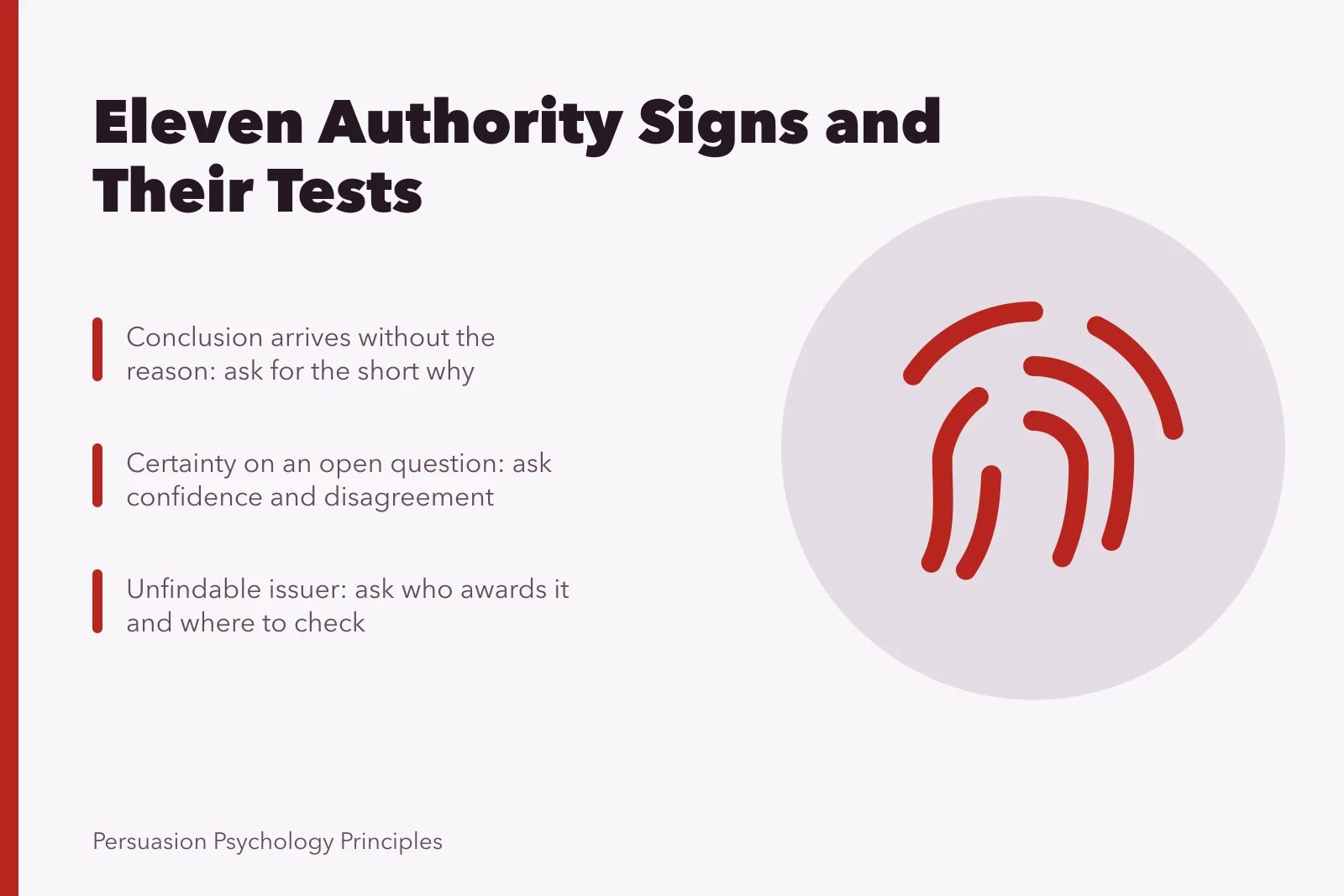
| Conclusion without a reason | Can you give me the short version of why? |
| Certainty on an open question | How confident are you, and what is the disagreement about? |
| Drifted claim | Is this the thing you trained in? |
| No change condition | What would make you think differently? |
| Unfindable issuer | Who awards that, and where would I check it? |
| Stacked signals | Which one of these would you like me to verify? |
| Payment tied to the answer | How are you paid on this decision? |
Every question in that column can be asked pleasantly and out loud. That is the point of them. A genuine expert finds these ordinary and answers in a sentence, and somebody relying on the symbol finds them irritating, which is itself the information you were looking for.
Questions That Test Each Sign
- Conclusion without a reasonCan you give the short version of why?
- Certainty on an open questionHow confident are you, and what is the disagreement about?
- Drifted claimIs this the thing you trained in?
- No change conditionWhat would make you think differently?
- Unfindable issuerWho awards that, and where would I check it?
- Stacked signalsWhich one of these would you like me to verify?
- Payment tied to the answerHow are you paid on this decision?
What these signs are not
They are not a reason to distrust expertise generally. Most deference is correct, most credentials mean roughly what they claim, and a person who treats every professional as a suspect will make far worse decisions than one who defers by default. The conditions under which deferring is the right move are set out under authority.
They also do not tell you the claim is wrong. An expert who leads with a credential may still be right, and the sign tells you that you have not been given a reason rather than that the conclusion is false.
And they will not, on their own, resolve a disagreement between two qualified people. When the experts differ, the useful move is to find out what they differ about, since that is usually a smaller and more tractable question than the one you started with.
Where a claim moves you because somebody knows more than you do, that channel is informational influence. Where a chorus of credentials is assembled by an interested party, it works like manufactured social proof, and the tactics that depend on you not asking are collected under manipulation resistance. The general framework is social influence basics.
Common questions
How many signs before I should push back?
Three at once on something you cannot easily undo is a workable personal rule. Any threshold is arbitrary, and its job is to trigger the question rather than to be accurate.
Is it rude to ask an expert how they are paid?
It is a plain question and most professionals expect it. A practitioner who is offended by it has answered something more useful than the question itself.
What if I cannot evaluate the reasoning even when I get it?
Then ask for a second opinion from somebody with no connection to the first. You are not checking the argument; you are checking whether two independent people arrive at the same place.
Does a strong credential ever settle a question by itself?
Inside its field, on a settled matter, effectively yes. The work is establishing that both of those conditions hold, and that is what the questions above are for.