Reviews
Part of 5 things that decide commitment and consistency
Commitment and consistency meaning, tested against experience
Commitment and consistency meaning, defined against integrity, stubbornness and sunk cost, with the one question that tells you which of them you are acting on.
Consistency is the pressure to keep matching what you have already said or done. It is useful, it is mostly automatic, and it does not know the difference between a good position and an old one.
What to take away
- The class is self-directed pressure. The difference is that it answers to your past behavior rather than to the current evidence.
- Integrity is consistency with your reasons. Stubbornness is consistency with your position. The two look identical from outside and behave completely differently.
- The question that separates them is whether new evidence would change your answer, asked before the evidence arrives.
The definition, in one sentence
Commitment and consistency is the tendency to act in line with a position you have already taken, because you took it.
The last three words carry everything. If you hold a view because the reasons still stand, that is not consistency doing the work. It becomes consistency at the point where the position outlives your ability to say why you hold it.
Class and difference
What it shares
- Integrity
- Behavior lines up over time
- Stubbornness
- Refusal to move
- Sunk cost
- Past investment shapes the choice
- A promise
- Binds your later self
- A habit
- Repeats past behavior
- A commitment device
- Deliberately limits your options
How it differs
- Integrity
- It tracks the reasons, and changes when they do
- Stubbornness
- It is consistency defended after the reasons have gone
- Sunk cost
- The past spend is money and time, not a stated position
- A promise
- It was undertaken to someone, and they can release you
- A habit
- It runs without any position having been stated
- A commitment device
- You built it on purpose, and you knew why
The interesting row is the last one. A commitment device uses this mechanism deliberately and openly: you restrict your own future choices because you expect your future self to be weaker or busier. That is consistency working for you rather than on you, and it is the only version that survives being described without embarrassment.
Consistency vs nearby ideas
Consistency
- Integrity
- Tracks reasons
- Stubbornness
- Reasons gone
- Sunk cost
- Stated position
- A promise
- No releaser
- A habit
- Position stated
- Commitment device
- Built on purpose
Nearby idea
- Integrity
- Lines up over time
- Stubbornness
- Refuses to move
- Sunk cost
- Money and time
- A promise
- Someone can release
- A habit
- Runs without position
- Commitment device
- Limits options
Why the mechanism exists
Being predictable is worth a great deal socially. People who change position constantly are difficult to work with, hard to plan around, and eventually not believed. Matching your own past statements is what makes you a person others can rely on.
The cost of that arrangement is a bias toward whatever you happened to say first. Once a view has been stated, especially in public and in writing, defending it becomes a separate interest from getting the answer right, and the two are then in competition.
That is why the small first step matters. A tiny agreement is cheap to give and makes you someone who has taken a position.
The next request is not addressed to the person you were before. That mechanism is set out under commitment and consistency.
The question that separates the versions
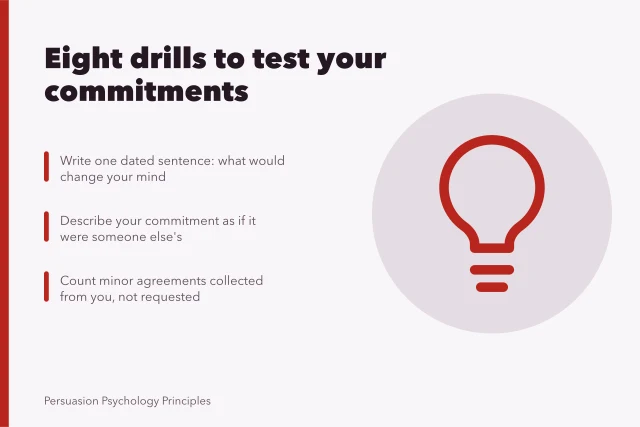
Ask, in advance: what would change my mind? Write the answer down.
What would change my mind?
Ask: what would change my mind?
holding position for reasons
no way to find out
Do this before a decision, not during an argument. In an argument, the argument generates the answer.
This practical reasoning, committing your future self to a rule, is worked over in the Stanford Encyclopedia entry on practical reason. The everyday version is as described: decide the conditions first, because you will not be neutral later.
What it is not
It is not sunk cost, though the two travel together.
Sunk cost is resources already spent, while consistency is identity already claimed.
You can have one without the other, and the fix differs: ask what you would do starting today for sunk cost, or whether you would take the position now for the first time for consistency.
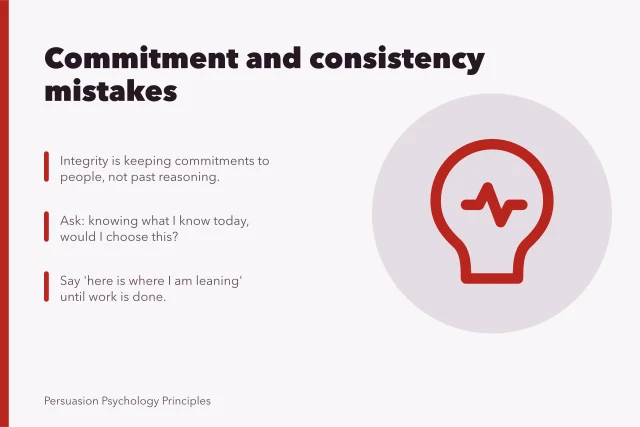
It is not integrity, and treating it as though it were is the most expensive mistake in this area. Refusing to update is not a virtue, and dressing it as one is how people end up defending views they no longer hold in private.
And it is not a promise. A promise creates an obligation to someone who can release you, and usually there is a person you can talk to.
A commitment to a position has no such person, which makes it harder to get out of. The obligations a genuine promise creates are separate, treated in the Stanford Encyclopedia entry on promises.
Someone else building your commitment, step by step, is the engineered version. The field guide is under manipulation resistance.
The standard that separates a commitment you would defend out loud from one built on you is under social influence basics. How a stated position hardens once other people have witnessed it is covered under normative influence.
Common questions
Is being consistent a good thing or a bad thing?
Both, in the same way that a reflex is. It buys you reliability and costs you accuracy, and knowing which one you need in a given decision is the whole skill.
How do I change my mind without looking unreliable?
Say what changed. "I thought X, then this happened, so now I think Y" is a sentence that increases confidence in you rather than reducing it, and it works because it shows the reasoning is still running.
Does writing a view down make it harder to update?
Writing the position down does. Writing down what would change your mind does the opposite, and the second habit is worth more than the first is expensive.
Is a public commitment stronger than a private one?
Generally yes, and that cuts both ways: it holds you to good intentions and to bad positions equally well. Choose which ones you make public with that in mind.