Maintenance
Part of 5 things that decide commitment and consistency
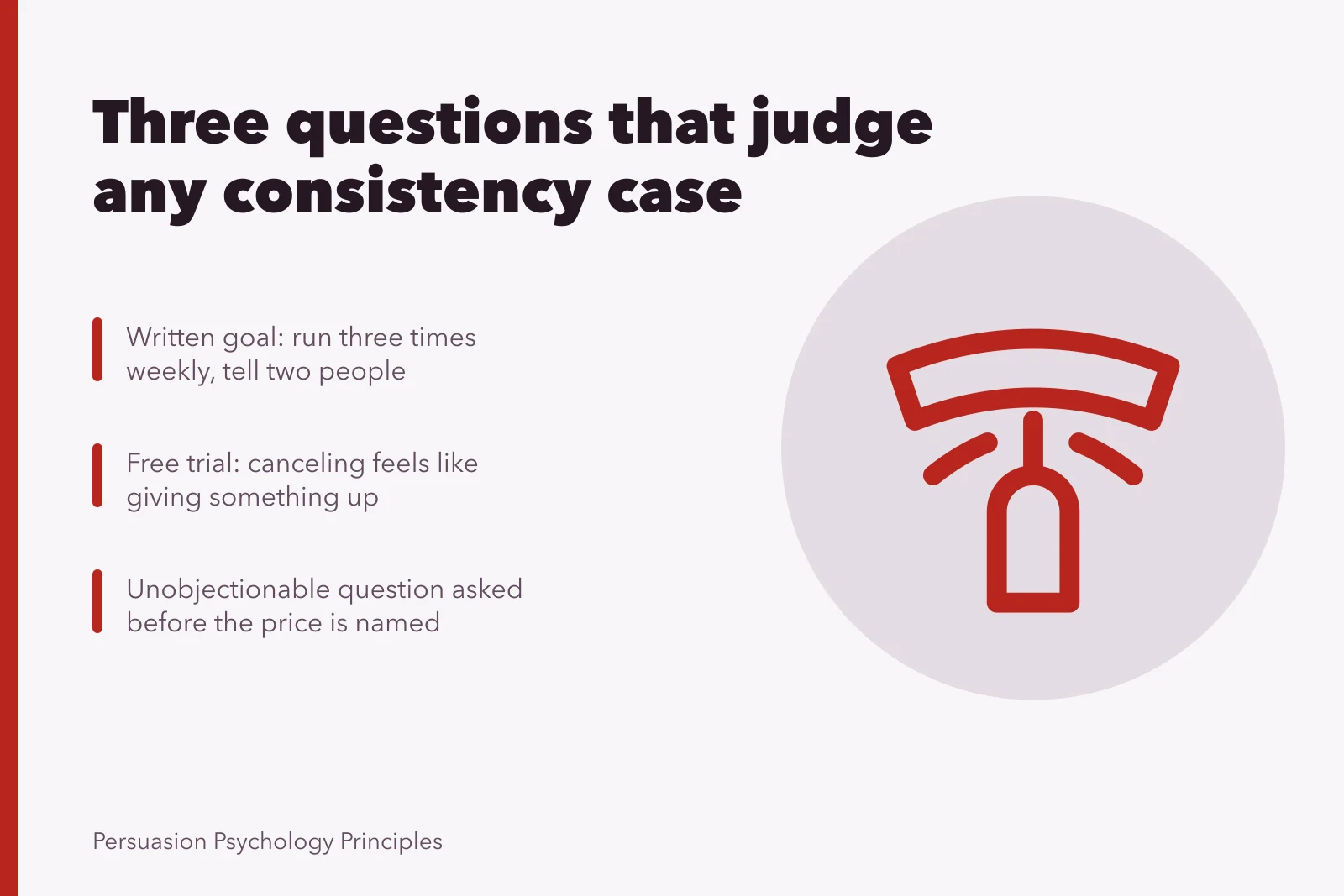
Three questions that judge any consistency case in a hurry
Commitment and consistency examples sorted by who built the commitment, what each one holds you to, and the three questions that read any case quickly.
Once you have said something, you are more likely to keep saying it. Once you have started something, you are more likely to finish it. This is not a defect. Being predictable is most of what makes you trustworthy, and re-deciding everything continuously would be unliveable.
The interesting cases are where that useful default is turned into a lever. Below are worked examples in three groups: commitments you set up for yourself, commitments other people set up in you honestly, and commitments engineered to hold after you would otherwise have walked away.
Each one carries the same test at the end. If the other person learned exactly how this worked, would it still stand?
What to take away
- Once you have started something, you are more likely to finish it.
- Being predictable is most of what makes you trustworthy, and re-deciding everything continuously would be unliveable.
- The interesting cases are where that useful default is turned into a lever.
Commitments you build for yourself
The written goal. You write down that you will run three times a week and tell two people. Now the run has two reasons behind it: the original one, plus not being someone who said a thing and did not do it. The second reason is weaker but it is available on the mornings the first one is not.
Survives disclosure completely. You can explain the whole mechanism to yourself and it keeps working, which is unusual and worth noticing.
The pre-commitment with teeth. You cancel the subscription in advance, hand your card to someone, delete the app before the trip. You are not trusting future-you and you are being honest about it. Again nothing is concealed, and again it works anyway.
The stated position that keeps you steady. A team publishes its decision criteria before it sees the bids. The point is to bind the version of you that will later have a favorite. This one has a cost: you have made changing your mind more expensive, including when you should, so the criteria should include what would justify revisiting them.
Commitments other people build, honestly
The free trial with a stated end. You sign up, you use it, you get accustomed to it, and canceling now feels like giving something up rather than declining to buy it. That is a real psychological asymmetry and the seller knows it.
Whether this is legitimate rests entirely on one thing: were you told plainly what happens on the last day, in the place you were looking, without hunting for it? If yes, the mechanism is disclosed and you took the deal knowing. If the end date was technically present and practically invisible, the same mechanism is doing quiet work.
The small first request that leads somewhere. A volunteer asks you to sign a petition and later asks you to give an afternoon. If the campaign said at the outset that this is how it escalates, you have simply been recruited, and being recruited by degrees is how most volunteering starts.
The meeting where you state a view early. You say what you think in the first ten minutes. For the remaining fifty, arguing against yourself now costs face as well as effort, so you defend the position rather than examine it. No one did this to you. It is a structural feature of speaking aloud, which is why collecting written views before discussion changes what meetings conclude.
The deposit. You put money down. The money is doing two jobs: it holds inventory, and it makes you a person who has already begun. The first job is legitimate on its own. The second comes free, and honest sellers do not lean on it: the tell is a deposit that is easy to place and disproportionately hard to retrieve.
Commitments engineered to hold
The agreement extracted before the price. "Would you say you want the best
Recognize it by the shape: an unobjectionable question, asked by someone with something to sell, before the thing being sold has been named.
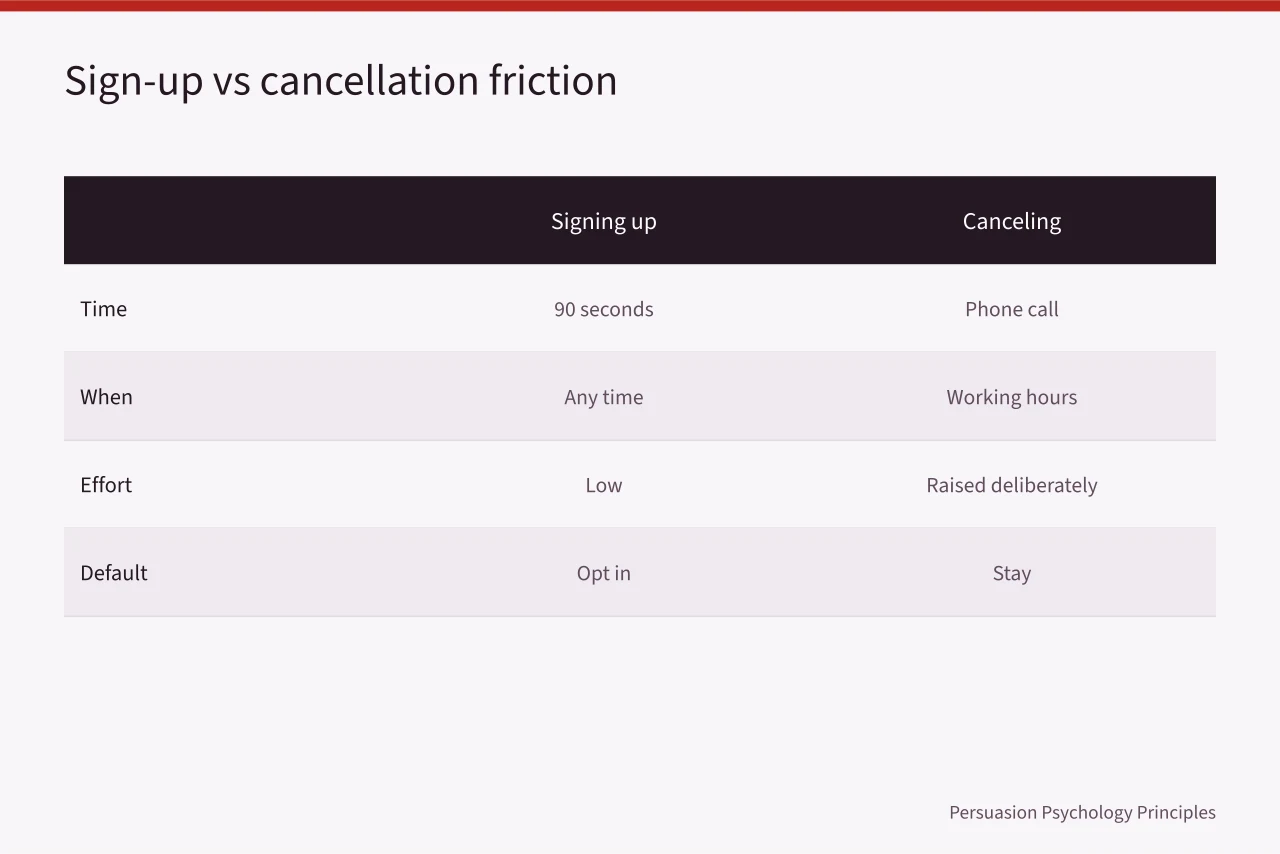
The renewal you did not cancel. Signing up took ninety seconds; leaving takes a phone call during working hours. This is consistency exploited through friction rather than persuasion: your default is to stay, and the effort of changing has been raised deliberately. The Federal Trade Commission's staff report Bringing Dark Patterns to Light documents this family of design in detail. Read the cancellation terms before the sign-up terms; the asymmetry between them is the whole story.
Escalation to justify what you already spent. The renovation is over budget and half done. Stopping means the money is wasted; continuing means it is merely spent. This is you doing it to yourself, and it is the single most expensive item on this page. The corrective question: if I arrived today, with this project at this stage and this remaining cost, would I start it?
The position that became an identity. You said publicly that this approach does not work. Evidence arrives that it does. Changing your mind is now not a revision but a self-contradiction, and the price is paid in front of people who remember. Identity is the strongest form of commitment and the hardest to notice from inside, because it does not feel like a commitment at all. It feels like being who you are.
The rushed yes. Someone gets your agreement under time pressure, and treats it as settled. It is not settled. A commitment obtained faster than the decision could reasonably be made is compliance, and it decays as soon as the pressure lifts. Sellers who rely on this get high close rates and high cancellation rates, which is the same fact reported twice.
Reading any case with three questions
Was I told, in advance and plainly, where the first step led? Did the person asking gain from my not noticing? And if I withdraw now, is the cost the real cost of withdrawal, or a cost that was added to keep me here?
Honest commitment-building is legible. It says: this gets harder to leave, here is how, and here is why you might want that. How far a present self can bind a future one is a genuine question rather than a rhetorical one, and the Stanford Encyclopedia entry on practical reason sets out why sensible people answer it differently.
Engineered commitment needs you not to look, which is why the reliable defense is simply to look, out loud, before you agree rather than after.
General framing is in commitment and consistency, and the errors it produces, including those you commit against yourself, are covered separately. When a stated position hardens because others heard it, that pressure is under normative influence.
When the first step was a favor, not an agreement, see reciprocity. The standard separating an honest commitment from an engineered one is under social influence basics.
Common questions
Is a free trial an engineered commitment?
Only if leaving is harder than joining. A trial you can end in the same number of clicks it took to start is a genuine offer to let you find out.
Should I make my goals public?
It depends on what the announcement does for you. Public commitments hold you to good intentions and to bad ones equally, and for some people the announcement itself substitutes for progress.
What if I want out of something I agreed to?
Say what changed and leave. Most of the cost you are anticipating is the cost of contradicting yourself in front of somebody, and it is smaller in practice than it is in prospect.
How do I build a commitment that helps rather than traps?
Choose the constraint yourself, write down what it is for, and set a date to review whether it still makes sense. A commitment with a review built in is one you can hold without defending.