Reviews
Part of Authority compared with expertise: what actually earns deference
When does authority turn into pressure instead of persuasion?
Nine authority mistakes that turn expertise into pressure, split between the expert's side and the listener's, with the test that separates the two.
Authority is a shortcut. When you cannot check something yourself, you check who is saying it instead. That shortcut is not a flaw: nobody has time to re-derive their doctor's advice, but it fails in specific, repeatable ways.
The nine failures below are the ones worth knowing. The first five are mistakes made by the person leaning on authority. The last four are mistakes made by the person on the receiving end, which is most of us, most of the time.
What to take away
- When you cannot check something yourself, you check who is saying it instead.
- The last four are mistakes made by the person on the receiving end, which is most of us, most of the time.
Where the shortcut turns into pressure
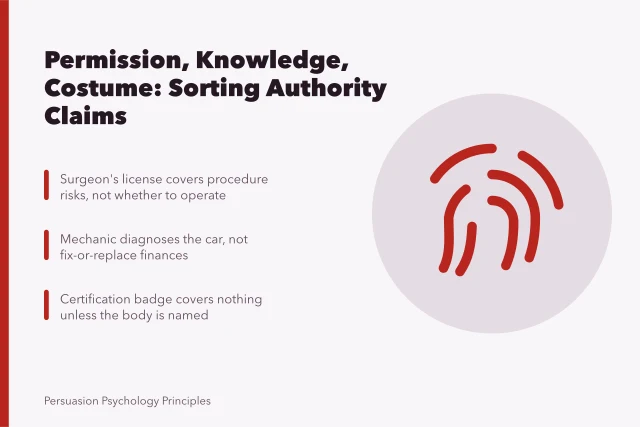
1. Borrowing credibility from the wrong domain. Expertise is domain-shaped. A surgeon is authoritative about the operation and not about whether you should have it. A senior engineer's opinion on a contract is a layman's opinion. The mistake is not deferring to expertise; it is deferring to expertise that does not cover the question you actually asked.
2. Leading with the credential when the reasoning was shorter. "I have been doing this for twenty years" is sometimes the only available answer: tacit skill is real and does not always decompose into arguments. But when the reasoning would have fitted in three sentences and you reached for the years instead, you chose the version the other person cannot examine. That choice is the whole problem.
3. Letting confidence carry a question that is genuinely open. An expert's certainty is information about the expert. On a settled question it usually tracks the evidence. On an unsettled one it tracks temperament. If you cannot say what would change your mind, you are asserting rather than reasoning, and your audience has no way to tell the difference from the outside.
4. Treating a question as a challenge to rank. The moment a "why?" is answered with irritation, persuasion has stopped and something else has started. People notice this instantly and stop asking, which means you lose exactly the objections you needed. You will still get agreement. It just will not mean anything.
5. Stacking signals instead of offering one that can be checked. A wall of logos, seals, certifications and unnamed "as featured in" strips is a substitute for a single verifiable claim. Uncheckable authority markers are a recognized design tactic: the Federal Trade Commission's staff report Bringing Dark Patterns to Light catalogs the interface versions. One credential a reader can look up beats twelve they cannot.
Where deference goes wrong from the other side
6. Deferring on the preference half of the question. Almost every real decision has a factual part and a values part. What the medication does is factual. Whether that trade-off is worth it to you is not, and no credential makes someone authoritative about your tolerance for risk. When an expert answers both halves in the same breath, split them yourself.
7. Reading fluency as competence. Speed, jargon, an unhesitating manner and a good voice all feel like knowledge. They are the traits of someone who has said this many times, which is compatible with being right and also with being rehearsed. The person who says "I am not sure, but here is how I would find out" has given you more.
8. Taking silence as verification. If nobody in the room objected to the expert, that may be because the expert was right, or because objecting to the expert is socially expensive. These look identical from the inside. This is where authority and normative influence get tangled: you defer, and your visible deference becomes the evidence the next person defers to.
9. Not asking what the authority is accountable for. A professional who signs something, carries a license, or can be sued has skin in the claim. A commentator has none. Both may be equally knowledgeable; only one of them pays for being wrong. That difference is usually more predictive than the size of the credential.
The test that separates the two
Persuasion that survives the other person finding out how it worked is legitimate. Persuasion that depends on them not noticing is not.
Apply it here. If you say "trust me on this, I have handled forty of these" and they later learn exactly why you said it, because it was true and explaining the forty cases would have taken an hour, nothing breaks.
If you displayed a certification that sounds regulated and is not, and they find out, the sale does not survive it. Neither does anything else you told them.
That is the practical reason to care, not the moral one. Concealed persuasion has a shelf life set by the moment of discovery, and you do not control when that is.
If you are the one being deferred to
The problem with being senior, credentialed or simply older in the room is that you stop receiving the information you most need. A few things help, and they cost almost nothing:
- Ask for objections before you state your view, not after. Once your position is on the table, disagreeing with it is a different social act.
- Say your confidence out loud. "I am fairly sure" and "I would bet on this" are different, and people cannot hear the difference otherwise.
- Answer the first objection with a question rather than a rebuttal. What happens next tells the room whether objecting is safe.
- Name the boundary of your expertise before someone else has to. "This part I know; this part I am guessing" is the single most credibility-preserving sentence available to an expert.
- When you turn out to be wrong, say so in the same forum where you were confident. Quiet corrections teach people that confidence is never revised.
What to do with a claim you cannot check
You will not escape needing authority. The goal is to defer well rather than less. Three questions do most of the work:
What exactly is this person authoritative about, and is that the question I have? What would they have had to see to know this? And who else, with an interest in a different answer, has looked at it and agreed?
The third question is the one people skip, and it separates deferring from being told. Whether a listener is ever entitled to a belief on someone else's say-so is an old problem, not settled.
The Stanford Encyclopedia entry on the epistemological problems of testimony sets out why the answer is not simply yes or no.
If the answers are thin, you are not obliged to reject the claim. You are obliged to hold it loosely, and to notice that you are holding it on trust. That is a different mental state from knowing, and keeping them separate is most of what manipulation resistance actually consists of.
The conditions that make deference sound are under authority, and cases where a credential covers less than it looks are under authority examples. The standard for an honest appeal to expertise is under social influence basics.
The hierarchy version, where the person with the credential also writes your review, is covered separately.
Common questions
Is it a mistake to defer without understanding the reasoning?
Often it is the only option, and it is fine as long as you know that is what you are doing. The mistake is filing a claim you took on trust as something you worked out.
How do I push back on an expert without sounding like a crank?
Ask about the boundary rather than the conclusion. "Is this the part your field covers?" is a question about scope, and it is much easier to answer honestly than a challenge to the answer itself.
What if the expert is right and I still cannot follow the argument?
Get a second opinion from somebody with no connection to the first. You are not checking the reasoning; you are checking whether two independent people land in the same place.
Does an expert owe me their reasoning?
Not always, and time is real. What they owe is an honest signal about how confident they are, because that is the part you cannot reconstruct and the part that decides how much checking you should do.