Costs
Part of Authority compared with expertise: what actually earns deference
Getting authority research right the first time
Authority research: what is not seriously in doubt, what is genuinely disputed, and how to read the next claim that begins with the words research shows.
There are no numbers on this page, and that is deliberate.
Social psychology has spent the last fifteen years finding that many published results fail when others try to repeat them. The effects that survive are smaller and more conditional than the famous ones.
Obedience and deference are among the most dramatic and most retold parts of that literature. That combination should make you cautious.
A page called "authority research" has a choice.
It can give you a percentage that sounds authoritative and may be wrong, a slightly funny way to fail. Or it can tell you what is genuinely solid, what is genuinely disputed, and how to read the next confident claim. This is the second one.
What to take away
- The interesting open problems are not about how far people will go.
- You do not need a literature to run the check.
What is not seriously in doubt
These are observations rather than findings. You can check them against your own week, which is why they do not need a citation:
Checking is expensive, so people delegate it. You do not verify the structural engineering of the bridge you drive over. Deference is not irrationality; it is the only way a complex society functions at all.
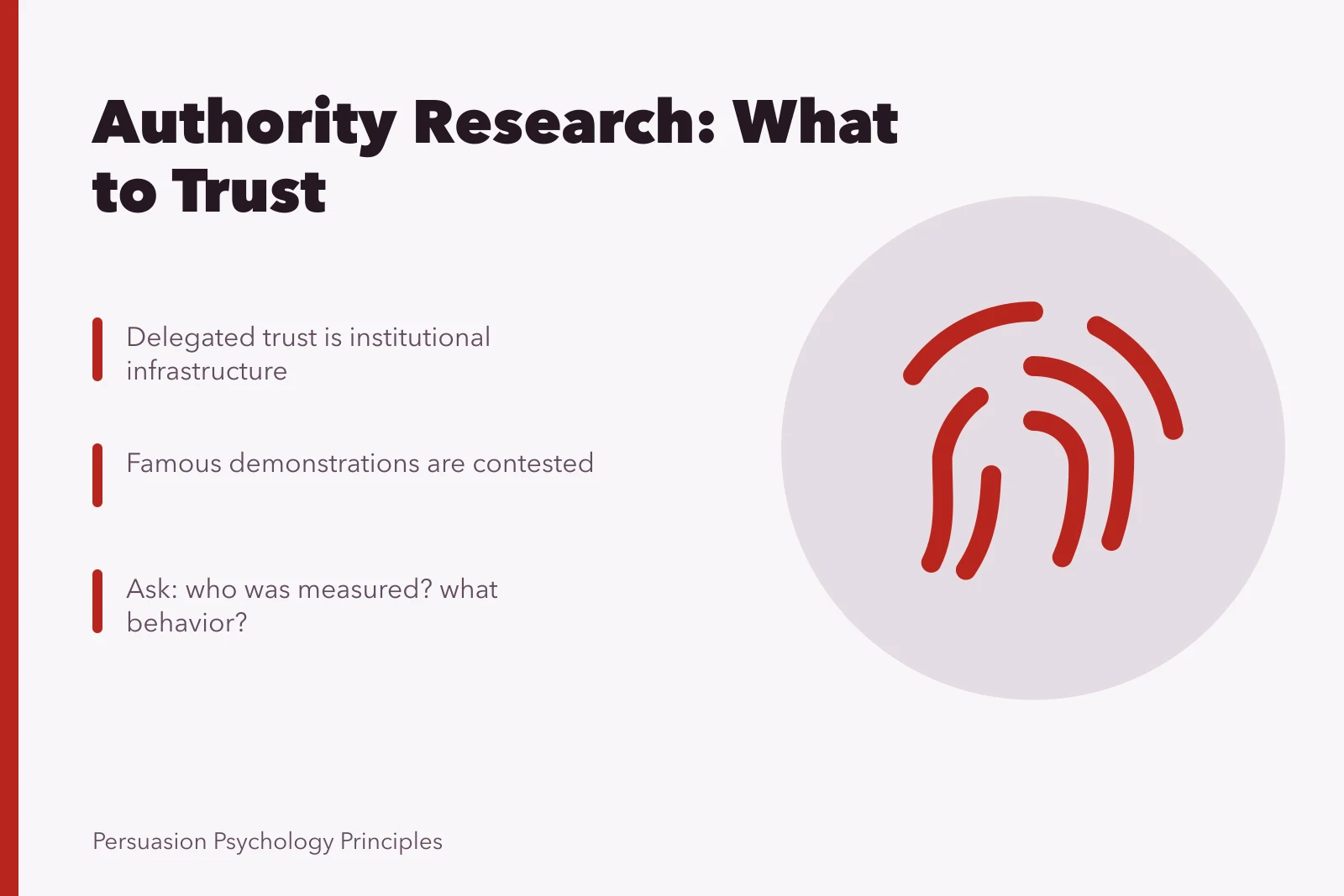
Delegated trust is institutional infrastructure. Licensing, professional registers, accreditation and liability all exist because societies concluded that individuals cannot evaluate individual practitioners. That is a fact about how the world is built, not a lab result.
The signals of authority can be produced without the substance. Counterfeit credentials, fake seals and borrowed institutional language exist and are commercially worthwhile. Regulators document the practice: the FTC's staff report Bringing Dark Patterns to Light is one such catalog. The existence of a market in fake authority markers is strong evidence that real ones do work.
Deference and agreement look identical from outside. A person who defers because they are convinced and a person who defers because objecting is expensive produce the same nod. This is why organizations are so bad at knowing what their own staff think.
Notice that all four are structural. None of them requires you to believe any particular experiment.
What is genuinely disputed
How strong the effect is. Almost every quantitative claim you have heard about obedience or expert deference is argued about: the size, the conditions under which it appears, and whether the original measurements captured what they were said to capture.
Whether the famous demonstrations mean what they are used to mean. Assume that any dramatic study you can name from this area is contested. The most memorable work in mid-century social psychology was designed to be striking, often ran on small and unrepresentative groups, and has since been re-examined by researchers who reached different conclusions from the same material. A result being famous is not evidence it is sound; if anything, the selection process runs the other way, because striking results travel further.
What is actually happening when someone complies. At least three different mechanisms get bundled together: believing the instruction is correct, believing the instructor has the right to give it, and calculating the cost of refusal. These are different psychological states with different remedies, and teasing them apart in a real setting is hard.
How much of it transfers. Findings from one culture, one decade, one institution and one type of participant are routinely reported as claims about human beings. Whether authority operates the same way across those boundaries is an open question rather than a settled one.
How to read the next "research shows"
When you meet a confident claim in this area, six questions will tell you most of what you need:
- Who was measured? Students, employees, online panel participants and patients behave differently, and the population is often quietly generalized away in the retelling.
- What behavior was actually recorded? There is a large gap between what people do and what people say they would do. Self-report and observed behavior should never be merged.
- What was the setting? A laboratory removes the things that normally constrain behavior: reputation, consequences, the ability to leave, the ability to talk to someone first.
- Has anyone hostile repeated it? A result confirmed only by the people who found it is a hypothesis with good publicity. Replication by researchers who expected a different answer is the signal worth waiting for.
- Is the headline number an average over a wide spread? An effect that is large for a few people and absent for most gets reported as a fact about everyone.
- Who benefits from the finding being true? Consultancies, training programs and books have a commercial interest in certain results. That does not make them false; it does mean the claim is being pushed rather than merely reported.
The questions still worth answering
The interesting open problems are not about how far people will go. They are about recovery and detection:
What causes someone to stop deferring? Everybody has a threshold; almost nothing useful is known about what moves it, and that is the practically important variable.
How can you tell, inside a real organization, whether agreement is genuine? Every method of asking is contaminated by the authority doing the asking.
What repairs trust after an authority has been wrong? Institutions face this constantly, and mostly guess.
And how does deference behave when the authority is a system rather than a person: a ranking, a model, an automated decision? A great deal of everyday deference has quietly moved in that direction, and the research has not caught up.
What you can do without any of it
You do not need literature to run the check. Before accepting a claim on authority, ask what the person is authoritative about, what they would have had to observe to know it, and what happens to them if they are wrong.
Then note you hold the claim on trust rather than on evidence. Keep the two labeled differently in your head.
That habit does not depend on any finding surviving replication, which is precisely why it is worth having. How much of a striking result should survive a failure to reproduce it is itself argued about rather than agreed, and the Stanford Encyclopedia entry on reproducibility of scientific results is a fair guide to the positions people take.
For concrete versions, see authority examples. The same reading discipline applies to claims about how people learn from each other. The mechanism is set out under authority.
When a chorus carries a claim rather than a credential, the relevant account is social proof. The standard for deciding whether any of it is honest is under social influence basics.
Common questions
Why will this page not quote the famous experiments?
Because their status is contested, and repeating a memorable number would give you confidence that the evidence does not currently support.
Does a disputed literature mean the effect is not real?
No. Direction and magnitude are separate claims. That people defer to apparent expertise is not in doubt; how much, under what conditions, and how far it generalizes are the open parts.
What should I look for in a summary of this research?
Whether it reports the setting and the uncertainty alongside the result. A summary that hands you a clean figure with no conditions has removed the part you needed to judge it.
Is deference to an automated system the same problem?
It looks similar and is studied much less. Treat a ranking or a model the way you would treat a confident stranger: ask what it was built to measure and what happens to it when it is wrong.