Maintenance
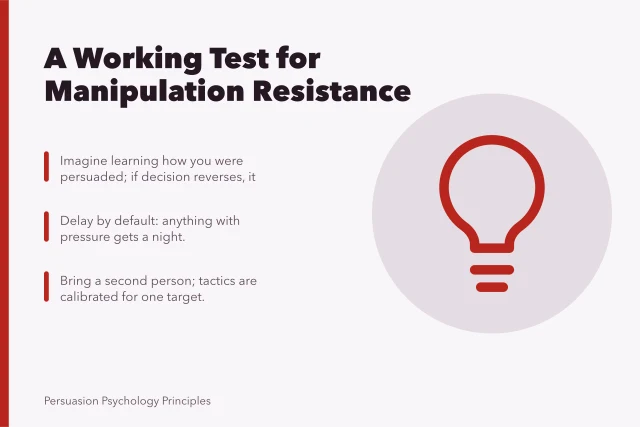
Part of A working test for manipulation resistance you can run today
Manipulation resistance meaning: why the test looks at method, not motive
Manipulation resistance meaning: what is being resisted, how it differs from persuasion and coercion, and why the test looks at method rather than motive.
Resistance here does not mean refusing to be moved. It means keeping the ability to see how you are being moved, so that agreeing stays a decision rather than an outcome.
What to take away
- The class is a defensive skill. The difference is that it is aimed at a method, not at a person or a conclusion.
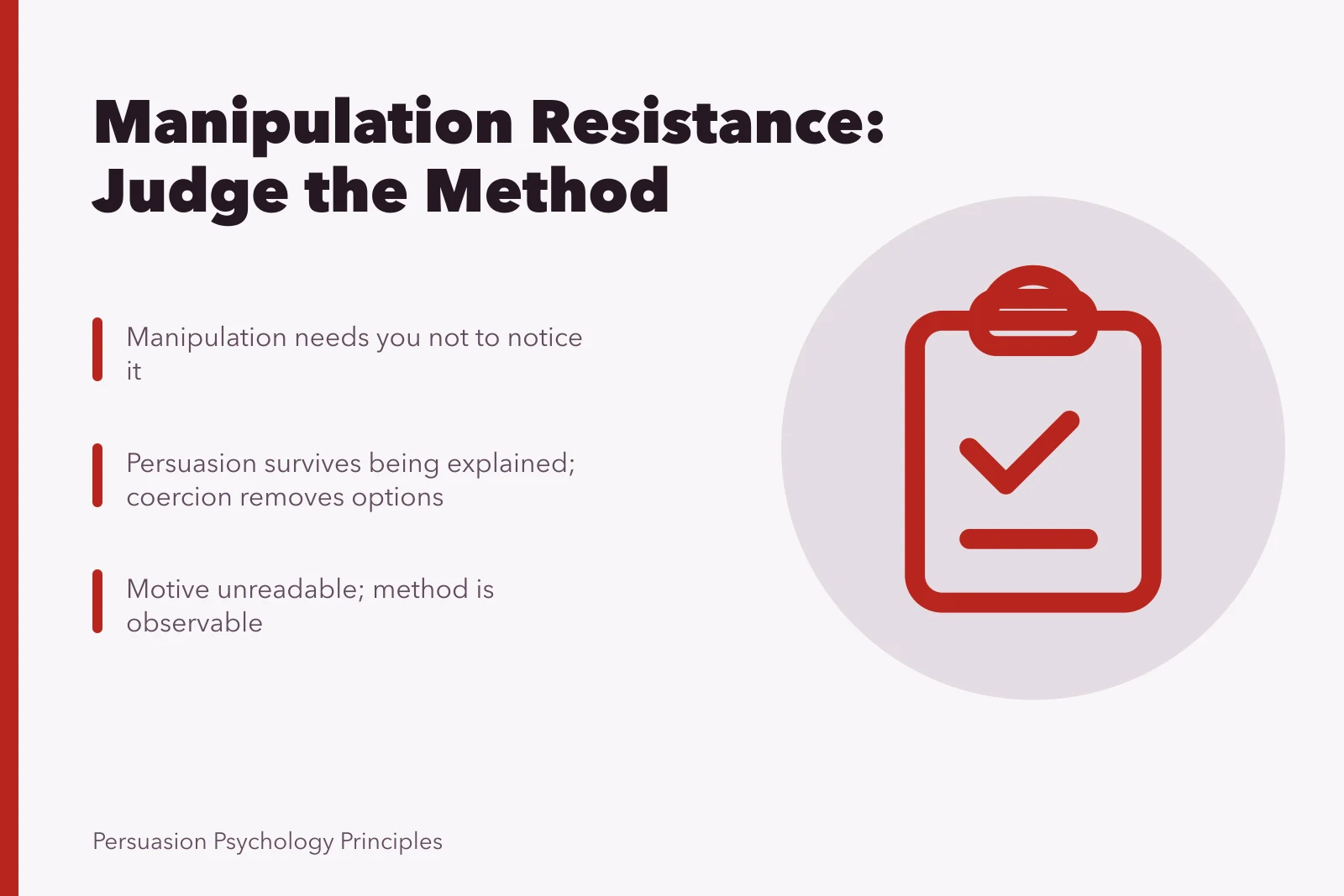
- Manipulation is influence that needs you not to notice it. That is the whole definition, and it is why the disclosure test works.
- Resisting well does not mean saying no more often. Most of the time it changes nothing except that you know why you said yes.
The definition, in one sentence
Manipulation resistance is the practice of keeping influence attempts visible to yourself, so that a decision is made on the merits rather than by a mechanism you did not see running.
Two things follow. It is not a personality trait, so it can be built. And it is not skepticism, since a person who refuses everything has not preserved their judgment; they have replaced it with a different reflex.
Class and difference
What it shares
- Persuasion
- Someone is trying to move you
- Coercion
- You end up doing what they want
- Deception
- The person is misled
- Negotiation
- Interests conflict openly
- Skepticism
- A defensive posture
- Assertiveness
- Holding a position under pressure
How it differs
- Persuasion
- It works through your judgment, and survives being explained
- Coercion
- It removes your options rather than shaping your perception
- Deception
- It requires a false belief; manipulation often needs none
- Negotiation
- Both sides know what is happening and say so
- Skepticism
- It doubts the claim, not the method, and doubts everything alike
- Assertiveness
- It is about voice, not about noticing
The third row is the one people find surprising. You can be manipulated without being lied to: a true statement timed to be misread, a real limit presented as a physical constraint, a genuine favor arranged so refusal feels rude. No false sentence is required, and that is exactly why "we never said anything untrue" is not a defense.
Manipulation vs nearby ideas
Nearby idea
- Persuasion
- Works through judgment
- Coercion
- Removes options
- Deception
- Requires false belief
- Negotiation
- Interests conflict openly
- Skepticism
- Doubts the claim
- Assertiveness
- About voice
How it differs
- Persuasion
- Survives explanation
- Coercion
- Not shaping perception
- Deception
- Manipulation often needs none
- Negotiation
- Both sides say so
- Skepticism
- Doubts everything alike
- Assertiveness
- Not about noticing
What is actually being resisted
Not the person, and not the conclusion. The method.
What resistance actually targets
- Influence that stops working when described
- Influence that borrows an unearned signal
- Influence that raises the price of leaving
- Askwould this work if I said how it worked?
Whether an attempt goes around somebody's rational agency rather than through it is the standing question in the Stanford Encyclopedia entry on the ethics of manipulation. The everyday version is the one you can actually run: would this still work if I said out loud how it worked?
Why the test is about method, not motive
Motive is unavailable. You cannot read it, people are unreliable about their own, and a sincere person using a concealment-dependent technique produces the same effect on you as a cynical one.
Method is observable. You can look at what the technique requires in order to function, and if it requires you not to notice, the requirement is a fact about the technique rather than a claim about anybody's character.
That distinction keeps this practical and keeps it fair. You are not accusing anyone. You are declining to let a mechanism do work that a reason should be doing, and the standard is set out in full under social influence basics.
What resistance is not
It is not suspicion. A person who treats every offer as an attack will make worse decisions than one who trusts by default and checks the expensive things, and will also be much less pleasant to deal with.
It is not immunity. Knowing how a technique works does not stop it working, in the same way that knowing about an optical illusion does not make it stop. The gain is not that you feel less; it is that you can name what you are feeling and decide separately.
And it is not a way of winning arguments. Naming a technique at somebody mid-conversation is usually a move rather than a defense, and it tends to produce a fight about whether they are manipulative instead of a decision about the thing.
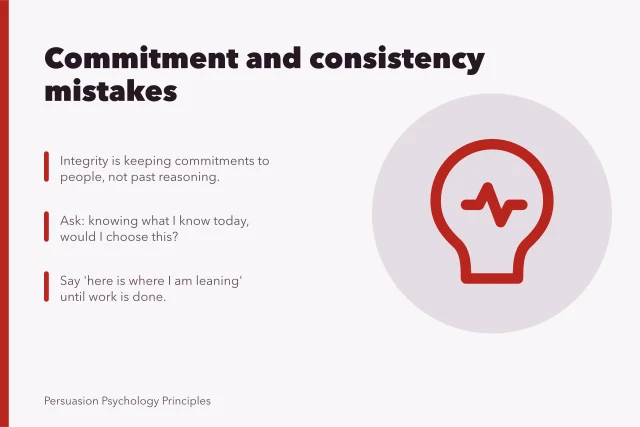
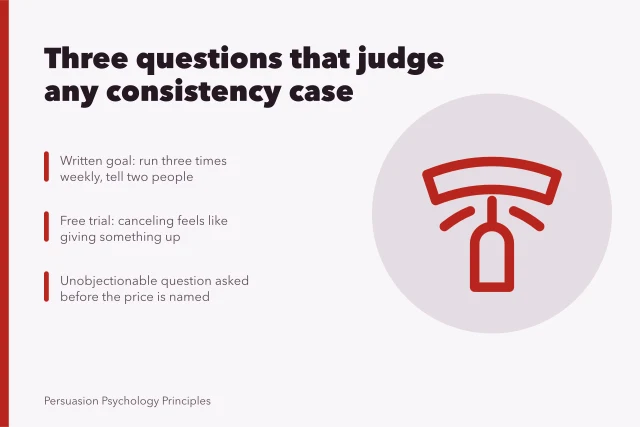
The workable habits, and the field guide to the common shapes, are set out under manipulation resistance. The individual mechanisms each have their own account: the debt opened by a gift under reciprocity, the pull of a stated position under commitment and consistency, and pressure from a limit under scarcity.
Common questions
Is manipulation always intentional?
No, and this is why the test looks at method. Plenty of concealment-dependent techniques are used by people who picked them up without thinking, and the effect on you is the same.
Can I tell in the moment whether I am being manipulated?
Sometimes, and not reliably. The structural fixes work better than in-the-moment detection: a delay, a written position, a second opinion from somebody with nothing at stake.
Does resisting mean I will buy less or agree less?
Usually not. It mostly changes which things you agree to, and it changes how often you can explain afterward why you did.
What if the person is not trying to manipulate me?
Then nothing you do here costs them anything. Every check on this site is one an honest counterpart is happy to answer, and that is deliberate.