Guides
A guide to Boston psychology labs studying persuasion and social influence
Boston psychology labs studying persuasion and social influence include Harvard, BU, Northeastern, MIT and Tufts, plus their experiments and consent rules.
What to take away
- Five Boston-area labs anchor this field: Banaji's implicit cognition group at Harvard, Morewedge at Boston University, DeSteno at Northeastern, Aral at MIT, and Sommers at Tufts.
- Each has one experiment worth reading in the original, from Langer's photocopier study to Muchnik and Aral's news aggregator trial.
- Deception is legal in this work only when the study's value justifies it, no alternative exists, and a debriefing follows. The APA code sets that test.
- Harvard's Committee on the Use of Human Subjects and MIT's COUHES are the named boards that approve local protocols.
- A finding describes one sample in one setting. Repeating it as a rule for everyday persuasion is where the field gets misread.
What a working lab leaves behind
A lab doing real work leaves a paper trail you can check without an affiliation. Recent papers with working links, a description of studies now running, and a named contact who answers questions about the data.
The participant pool tells you more than the reputation. Most Boston experiments run on undergraduates taking part for course credit, so any claim about compliance rests on people in their late teens and early twenties.
Shared materials are the strongest signal. When stimuli, questionnaires and analysis code are posted, you can see how a persuasion experiment was built and whether the effect hangs on one odd detail.
Every Boston-area university that accepts federal money for human subjects research holds a Federalwide Assurance with the Office for Human Research Protections. That assurance is what lets a campus board approve the work.
Where the money comes from
The National Institute of Mental Health, part of the National Institutes of Health, is the lead federal agency for research on mental disorders. Social psychology projects that touch behavior and mental health compete for that money alongside clinical work.
Applications follow the NIMH grant process. Investigators contact a program officer before submitting, apply through Grants.gov, then wait for a study section to score the proposal. Common mechanisms are the R01 for multi-year projects, the R21 for early stage work, and the F31 fellowship for graduate students.
Two NIH rules reach into study design. Applicants must justify their sample size and explain how the work will be reproducible. They must also address sex as a biological variable, or say why it does not apply. Funded labs tend to preregister hypotheses as a result.
The five labs, and what each studies
Harvard's psychology department sits in Cambridge, where Mahzarin Banaji's implicit cognition work shares space with Project Implicit, the testing operation she started with Anthony Greenwald and Brian Nosek in 1998. Non-medical protocols go to Harvard's Committee on the Use of Human Subjects.
Boston University runs social psychology through its Department of Psychological and Brain Sciences on Commonwealth Avenue. Carey Morewedge there studies ownership, value and consumer judgment. Behavioral protocols go to BU's Charles River Campus IRB.
Northeastern University hosts David DeSteno's Social Emotions and Intergroup Relations lab, which studies trust, cooperation and the emotions behind helping. Review runs through the Office of Human Subject Research Protection.
MIT's Sloan School and Media Lab study how people read signals from others, including the social influence experiments of Sinan Aral's group. MIT's Committee on the Use of Humans as Experimental Subjects, called COUHES, reviews behavioral studies on campus.
Tufts University, in Medford and Somerville, counts as Boston-area for research purposes. Sam Sommers there studies how group composition changes what people say. Boston College's Morality Lab asks how beliefs about intent shape moral judgment.
All of them draw participants from their own student bodies, which is the biggest limit on how far their findings travel. For the line of work that treats information rather than pressure as the mechanism, see this overview of informational influence research.
Published experiments and what they tested
| Lab | University | Published study | What it tested |
|---|---|---|---|
| Langer's social psychology group | Harvard | Langer, Blank and Chanowitz, Journal of Personality and Social Psychology, 1978 | Whether a weak reason raises compliance |
| Morewedge's lab | Boston University | Morewedge, Shu, Gilbert and Wilson, Journal of Experimental Social Psychology, 2009 | Whether ownership causes the endowment effect |
| Social Emotions and Intergroup Relations lab | Northeastern | Bartlett and DeSteno, Psychological Science, 2006 | Whether gratitude raises costly helping |
| Aral's group | MIT | Muchnik, Aral and Taylor, Science, 2013 | Whether an early upvote changes later ratings |
| Sommers's group | Tufts | Sommers, Journal of Personality and Social Psychology, 2006 | Whether jury diversity changes deliberation |
Langer's team asked people waiting for a photocopier to let them cut in. A request with a real reason won almost everyone over. A placebic reason, which restated the request instead of justifying it, still beat the bare request by a wide margin. The tested variable was wording.
Morewedge and his coauthors ran studies on why sellers ask more than buyers offer. Their results pointed to ownership rather than loss aversion as the cause, because owners valued the object differently. The paper is a claim about valuation, not about sales technique.
The gratitude experiments induced the emotion, then gave participants a chance to help someone at a cost to themselves. Grateful participants helped more often. One emotion and one behavior were measured in a laboratory.
Muchnik, Aral and Taylor manipulated the first vote a comment received on a news aggregator. An early upvote produced a positive herding effect later. An early downvote was partly corrected by other users, a result the popular write-ups leave out.
Sommers seated mock jurors in all-white or racially mixed groups. Diverse juries deliberated longer, discussed more evidence, and made fewer factual errors. The comparison was between group compositions, not between individual jurors.
Reciprocity belongs to the same family and often gets confused with it. The free-sample and door-in-the-face studies that popular writing credits to Boston came from other campuses, while the local labs work on ownership, emotion and conformity. This piece on reciprocity research sets out what that evidence can carry.
For the field notes on where these cues get used against people, see this piece on best social influence basics books 2027.
Consent, deception and debriefing in influence studies
Influence research often needs a cover story, and deception is where the rules bite. The American Psychological Association's Ethical Principles of Psychologists and Code of Conduct permits deception only when the study's value justifies it, no alternative exists, and debriefing follows.
Consent is the first checkpoint. The APA's guidance on informed consent in research requires that participants learn the purpose in general terms, the procedures, the risks, the right to withdraw, and how their data will be used.
Debriefing is the second. In a study that uses a confederate, the session ends with the researcher explaining the true purpose face to face. Project Implicit ends its online task with a written debriefing page that interprets the score and states plainly that the result is not a diagnosis.
Each campus routes protocols to its own board. Harvard's Committee on the Use of Human Subjects covers the Faculty of Arts and Sciences, so psychology studies go there rather than to the medical school's board. MIT requires everyone listed on a COUHES protocol to finish human subjects training first.
Northeastern's protection office and BU's Charles River Campus IRB run the same function elsewhere.
The American Association for Public Opinion Research keeps a plain-language page on Institutional Review Boards that explains what these committees review and why human subjects research needs them. If you are a participant, read the withdrawal clause before you sign.
What a participant is owed when the experiment itself is the intervention is a separate question, covered in this piece on informational influence ethics.
Reading a lab finding without overclaiming
A published experiment is a claim about a sample, a setting and a moment. Popular coverage turns that into a rule for everyday persuasion, and the turn is usually invisible.
Use this checklist before you repeat a finding:
- Does the paper name the sample size and the population?
- Is the outcome a behavior or only a self report?
- Has another lab replicated the result?
- Does the paper state its limits, and do you quote them?
- Are you describing the study or generalizing past it?
Here is the difference in practice. A Boston lab reports that participants who read a grateful message were more likely to help a colleague. In one experiment with undergraduates, a gratitude induction raised helping on a specific measure.
That is a finding. The indefensible summary is that gratitude makes people do what you want, which is a sales pitch in a lab coat.
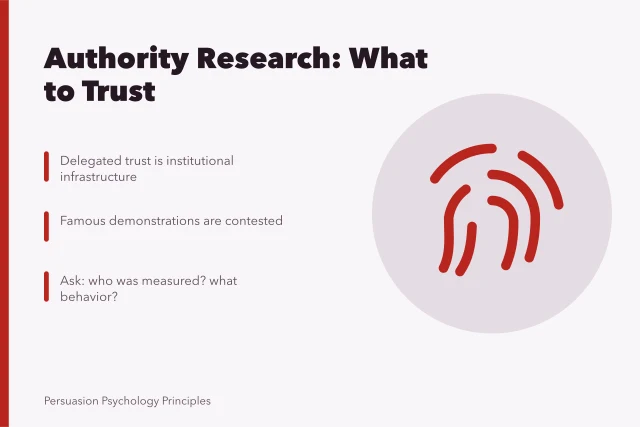
Authority is the cue most often stretched this way. Langer's photocopier study shows deference to a reason shaped like a reason, not deference to expertise. For the distinction, see this guide to inoculation theory persuasion.
Quote the sample and the effect size when you write about a study. When you cannot find them, say so. That habit separates a science writer from a content marketer.
Common questions
What separates persuasion from social influence in this literature?
Persuasion usually means a message aimed at an attitude or belief. Social influence is the wider category, covering conformity, compliance and obedience, including cases where no message is involved.
Do Boston labs study influence outside the university?
Some run field experiments online, as the MIT news aggregator study did. Most published work still comes from campus laboratories staffed by students.
Why do influence studies use deception?
Participants who know the exact hypothesis often change their behavior. Review boards allow deception only when it is necessary, limited in scope, and followed by debriefing.
How much of this work depends on NIMH money?
The mental health side depends on it heavily, since NIMH is the lead federal agency for that research. Work on consumer judgment and group behavior often draws on university and private funding instead.