Guides
Part of 5 things that decide commitment and consistency
A short guide to commitment and consistency books worth the shelf space
Best commitment and consistency books 2027: which of three jobs you want done, what each shelf slot delivers, and the warning signs on a bad one.
There is no shortage of books about how commitments get made and why they hold. There is a shortage of books that are honest about which parts are solid.
Before picking one, decide which of three jobs you want done, because the books that do them well are different books and the shelf mixes them up.
Job one: understand the mechanism. Why does a small first agreement change what you do next? Why is a position stated aloud harder to leave?
Job two: notice it happening to you. The mechanism is not interesting if you cannot see it in your own week.
Job three: design commitments that hold, for yourself, or in an agreement between people who both know what they are agreeing to.
Most disappointment with this shelf comes from buying a job-three book while wanting job two, and ending up with a manual for getting other people to commit when you wanted to understand your own gym membership.
What to take away
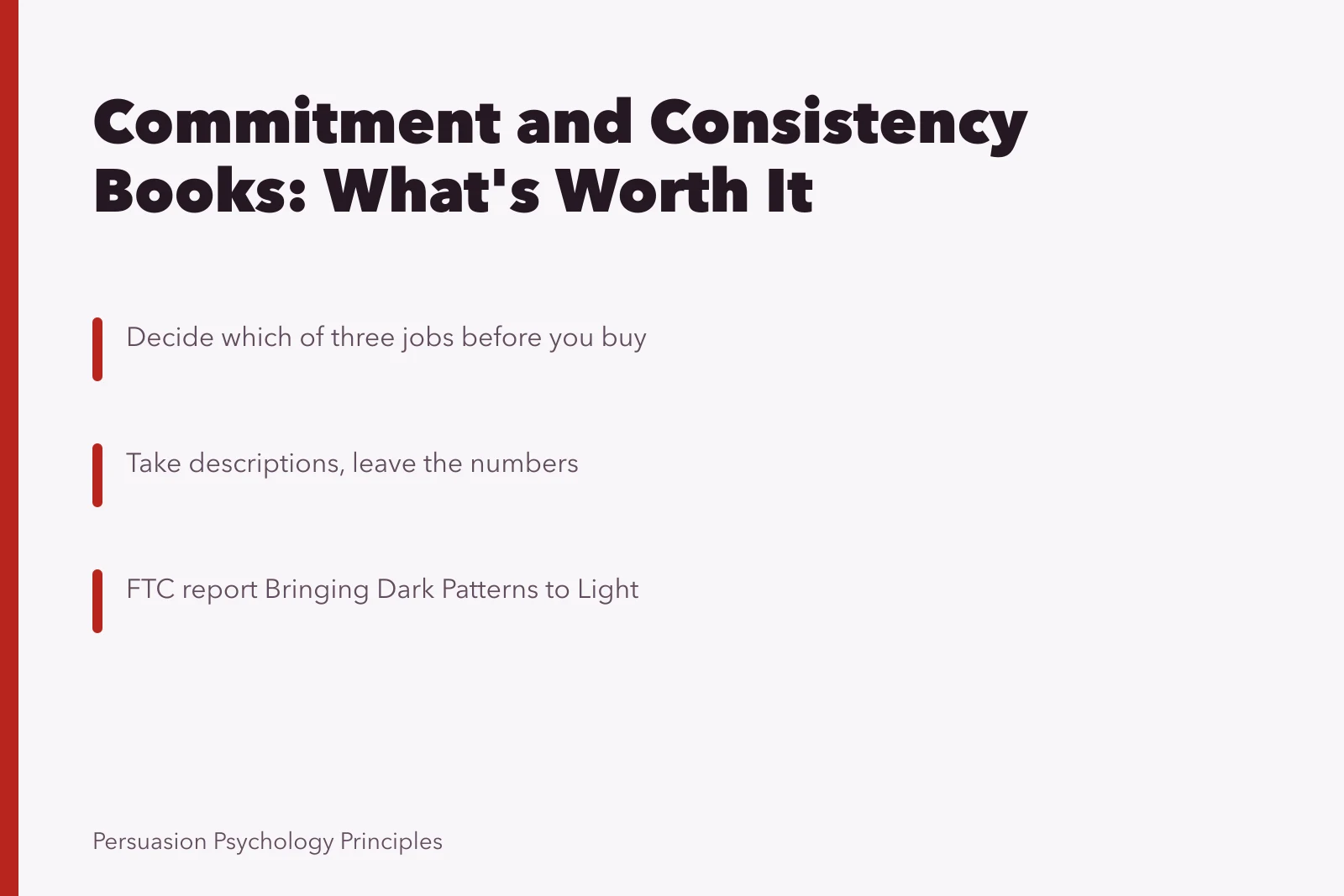
- Decide which of the three jobs you want before you buy. The books that do them well are different books and the shelf does not separate them.
- Take the descriptions and leave the numbers. The accounts of what people do have held up much better than the explanations of why.
- Half the value here is defensive, so a book that never once puts you on the receiving end is selling you a role rather than a subject.
What each part of the shelf is actually for
Worth it for
- The framework classics: the influence-principles books that named these patterns, above all Robert Cialdini's Influence
- Vocabulary. Having names for the patterns is genuinely useful and hard to get elsewhere
- Negotiation practitioners: Getting to Yes by Roger Fisher and William Ury, Never Split the Difference by Chris Voss
- Structure. How agreements are actually built, what a real objection means, what to do when positions harden
- Changing your own mind: Think Again by Adam Grant, The Scout Mindset by Julia Galef
- Job two, better than anything else on the shelf. The subject is your own attachment to positions you have taken
- Behavioral economics: Thinking, Fast and Slow by Daniel Kahneman, Nudge by Richard Thaler and Cass Sunstein
- Framing. Defaults, friction and how a choice is presented
- Sales and conversion manuals
- Reconnaissance. Read as documents about a practice, they tell you exactly what is being done to you
Bring your own skepticism to
- The framework classics: the influence-principles books that named these patterns, above all Robert Cialdini's Influence
- The evidence underneath. Much of it dates from an era of social psychology whose results are now argued about; read the descriptions, not the numbers
- Negotiation practitioners: Getting to Yes by Roger Fisher and William Ury, Never Split the Difference by Chris Voss
- Psychological explanation. These are strong field accounts and weaker as science; the explanation offered for why a move works is usually the author's theory
- Changing your own mind: Think Again by Adam Grant, The Scout Mindset by Julia Galef
- The optimism. Knowing about the trap and escaping it are different achievements
- Behavioral economics: Thinking, Fast and Slow by Daniel Kahneman, Nudge by Richard Thaler and Cass Sunstein
- Specific findings. Some of the literature these books drew on has been revised since publication, which their authors have generally been more candid about than their readers
- Sales and conversion manuals
- Everything else. These are written for the other side of the table and rarely pretend otherwise
Three questions to bring to any chapter
Which part is the observation and which is the theory? "People who state a
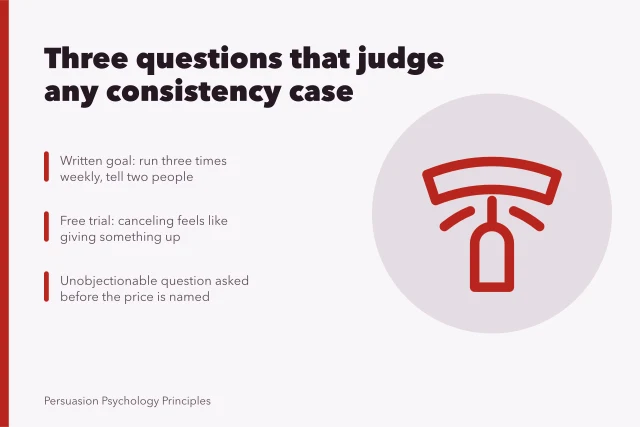
Three questions per chapter
- Which part is observation, which is theory?
- Would it work if they knew?
- What counts as a counterexample?
Would this still work if the other person knew you were doing it?
What would the author accept as a counterexample?
Warning signs on the shelf
- It hands you a script. Word-for-word phrasings to use on people are a strong signal that the mechanism is meant to operate below notice.
Warning signs on the shelf
- It hands you a script
- Every case study is unverifiable
- One lab result presented as law
- Reader is always the persuader
- Promises the effects are large
The free document worth more than most of the shelf
If you want to see engineered commitment written down concretely rather than theorized, read the Federal Trade Commission's staff report Bringing Dark Patterns to Light. It catalogs the design patterns that make agreements easy to enter and hard to leave: the sign-up that takes seconds against the cancellation that takes an afternoon, the pre-ticked box, the buried renewal term.
It is dry and specific. It describes practices, not findings, which in this subject is the more durable document.
Where an arrangement offers a benefit up front and a recurring charge afterward, the Negative Option Rule sets out what a seller is expected to make clear. Reading it will do more for your subscriptions than any chapter on willpower.
A stack is the wrong shape for this subject. Three books from the same slot add restatement, and the useful pile is one book per job, read in the order the sections above describe.
Where to start, honestly
If you have read nothing: start with one framework book for vocabulary, then one changing-your-mind book for the defensive half. Read them in that order.
Where to start reading
- Read nothing: framework book first
- Then a changing-your-mind book
- Already read framework: take negotiation shelf
- Skip a second principles book
- Read one thing for the other side
If you have read the framework book and want more, take the negotiation shelf, not another book of principles. That literature repeats itself; the second and third books add restatement, not substance.
And read at least one thing written for the other side. Nothing sharpens recognition like reading the instructions.
For the patterns themselves rather than the reading list, see commitment and consistency and commitment and consistency techniques. The defensive habits these books mostly skip are under manipulation resistance, and the standard that decides which side of the line a technique falls on is under social influence basics.
Common questions
How many books do I actually need from this shelf?
Two. One framework book for vocabulary and one changing-your-mind book for the defensive half. A third from either slot repeats the second.
Should I read a sales manual on purpose?
Once, yes. Read it as a document about a practice rather than as instruction, and it will sharpen recognition faster than a defensive book will.
What do I do about a book whose famous study has since been disputed?
Keep the description and drop the number. That the pattern exists is not usually what is contested; how large and how reliable it is usually is.
Is a book that gives me scripts always a bad sign?
For this subject, close to it. Word-for-word phrasings exist because the technique is meant to work below notice, which is exactly the property that puts it on the wrong list.