Rules
Part of A working test for manipulation resistance you can run today
Manipulation resistance mistakes worth avoiding early
Manipulation resistance mistakes that leave people worse off: over-suspicion, mistaken immunity and misfired accusations, with the correction for each.
The failures of resistance are not usually failures to notice. They are the things people do after they start paying attention, most of which cost more than the original problem.
What to take away
- The expensive mistake is treating everybody as an adversary. It degrades your decisions and your relationships at once, and it does not protect you.
- The second is believing that recognition equals immunity. Knowing how a technique works does not stop it working.
- Almost every correction on this page replaces a feeling of alertness with a structure that runs without you.
The mistakes
Treating suspicion as a defense. A person who distrusts every offer has not preserved their judgment; they have swapped one reflex for another. They will refuse good things, insult honest counterparts, and remain fully vulnerable to any technique that does not look like the ones they have read about. Correction: default to trust and check the expensive decisions. The cost of checking should scale with what you can lose, not with how you feel about the person.
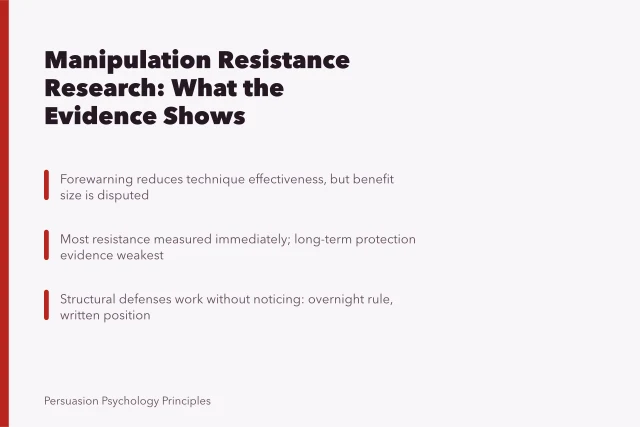
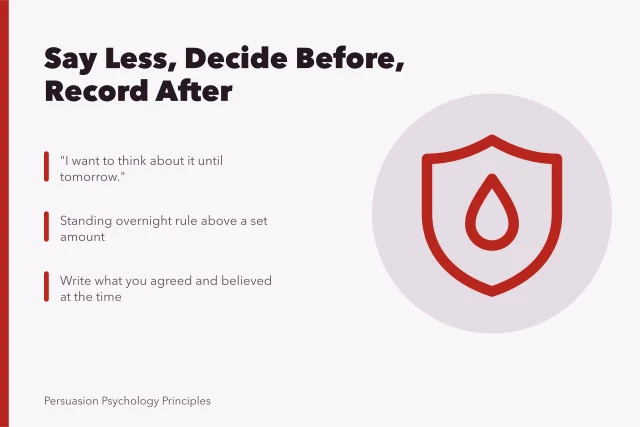
Believing that knowing about a mechanism disables it. Reading about a technique produces a strong feeling of having dealt with it. The feeling is not the protection, and any defense that depends on you detecting something in the moment will fail exactly when the pressure is real. Correction: build a structure. A standing overnight rule works whether or not you noticed anything.
Accusing somebody mid-conversation. Naming a technique at a person converts a decision about an offer into an argument about their character, and you will lose the second argument even when you are right about the first. Correction: ask the plain question instead. "What is the limit made of?" gets you the same information without the fight.
Confusing the method with the offer. A good product can be sold badly, and a bad one can be sold with perfect manners. Collapsing the two leads to refusing things you wanted and accepting things you did not. The wrongness of a technique lies in how it works rather than in what it sells, which is the position argued for in the Stanford Encyclopedia entry on the ethics of manipulation. Correction: judge the offer on paper and the seller separately, and let each answer for itself.
Resisting in the direction of doing nothing. Declining is not neutral. Staying put is a decision with its own cost, and a person who has learned to say no has not thereby learned to decide. Correction: write down what you will do instead, and price that too.
Reading pushback as proof. Once you are watching for pressure, you will find it, including in people who are simply enthusiastic. Correction: require a specific mechanism you can name. If you cannot say what technique is being used, you have noticed a feeling rather than a tactic.
Outsourcing the judgment to a checklist. A list of signs is a prompt to look, not a verdict. Several signs on any list appear in ordinary honest commerce, and treating a count as a conclusion produces confident errors. Correction: use a threshold to trigger a pause, then think.
Applying commercial defenses to personal relationships. The moves that work with a salesperson translate badly to a family. Naming techniques at people you love produces damage that no purchase decision would have justified. Correction: those situations need a different frame, and where somebody is being harmed the right step is help rather than analysis.
Assuming that having been caught once means you are unfit to decide. People frequently overcorrect after being taken in, and the overcorrection does more damage over a decade than the original loss. Correction: treat it as one data point about one mechanism in one setting, and write down what would have caught it.
What each mistake costs
| The mistake | What it feels like | What it actually produces |
|---|---|---|
| Blanket suspicion | Vigilance | Worse decisions and fewer good counterparts |
| Recognition as immunity | Preparedness | No defense when it counts |
| Mid-conversation accusation | Standing up for yourself | An argument you cannot win |
| Method confused with offer | Consistency | Refusing good things sold badly |
| Checklist as verdict | Rigor | Confident errors |
The right-hand column is the point of the page. Each item is a reasonable response to a real problem, but each solves the wrong part.
Mistake vs. reality
The mistake
- Blanket suspicion
- Worse decisions
- Recognition as immunity
- No defense when it counts
- Mid-conversation accusation
- An argument you cannot win
- Method confused with offer
- Refusing good things
- Checklist as verdict
- Confident errors
What it produces
- Blanket suspicion
- Recognition as immunity
- Mid-conversation accusation
- Method confused with offer
- Checklist as verdict
When the danger is genuinely fraud rather than pressure, the steps differ. Official guidance, such as the Federal Trade Commission's page on what to do if you were scammed, beats any habit here.
The correction that covers most of them
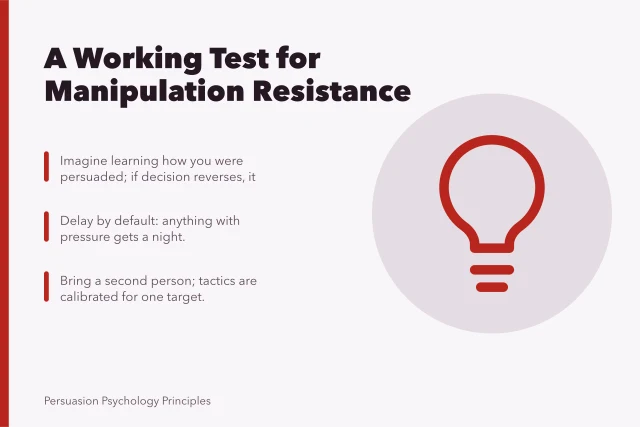
Move the defense out of your head. An overnight rule above a threshold you set, a written position before a conversation that matters, a second opinion from somebody with nothing at stake, a check on how to cancel before you sign up.
None of these requires you to detect anything, to distrust anybody, or to be alert at the wrong moment. That is the whole reason they work, and it is why they survive the fact that recognition is not protection.
They also cost the honest counterpart nothing. That is the quiet test underneath: a defense that only bothers people who rely on your not looking works everywhere without becoming unpleasant.
The full field guide is under manipulation resistance, and the standard for what belongs on it is under social influence basics. Individual mechanisms are under reciprocity, scarcity, commitment and consistency, and liking principle.
Common questions
Is there a way to be careful without becoming cynical?
Yes, and it is structural. Rules applied to categories of decision, rather than judgments applied to individual people, keep the caution and drop the cynicism.
What if I really am dealing with somebody dishonest?
End the interaction and check afterward with somebody who has nothing at stake. Winning the conversation is not a goal worth having.
How do I recover from having been taken in?
Write what happened, what would have caught it, and which structure you are adding. One structure is enough, and a general resolution to be more careful is not one.
Does any of this apply to how I influence other people?
It does. Every defense here is one an honest counterpart is happy to meet, so if a technique of yours is defeated by somebody asking a plain question, that is worth knowing about your technique.