Maintenance
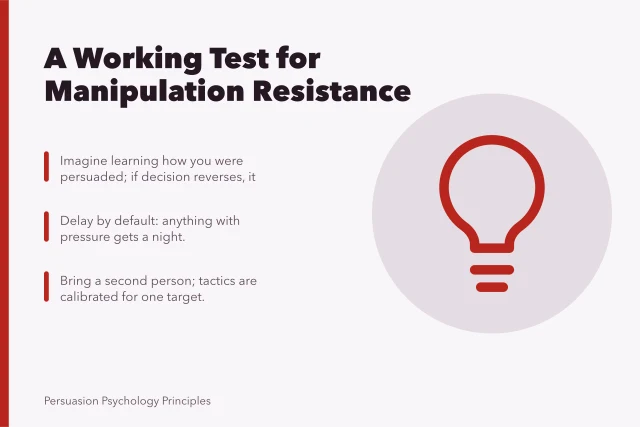
Part of A working test for manipulation resistance you can run today
Before you act on manipulation resistance exercises
Manipulation resistance exercises to run before you need them: seven drills, a four-week schedule, and an honest account of what practice cannot deliver.
Practicing under pressure is not practicing. These drills are all run when nothing is at stake, which is the only time the results mean anything.
What to take away
- Every drill builds a structure rather than a reflex, because reflexes fail under exactly the conditions you need them.
- The most useful is the cheapestsay a plain no to something harmless, once a week, and find out what actually happens.
- The drills produce a written record. That record, not a feeling of alertness, is the thing you are building.
The drills
1. The plain no
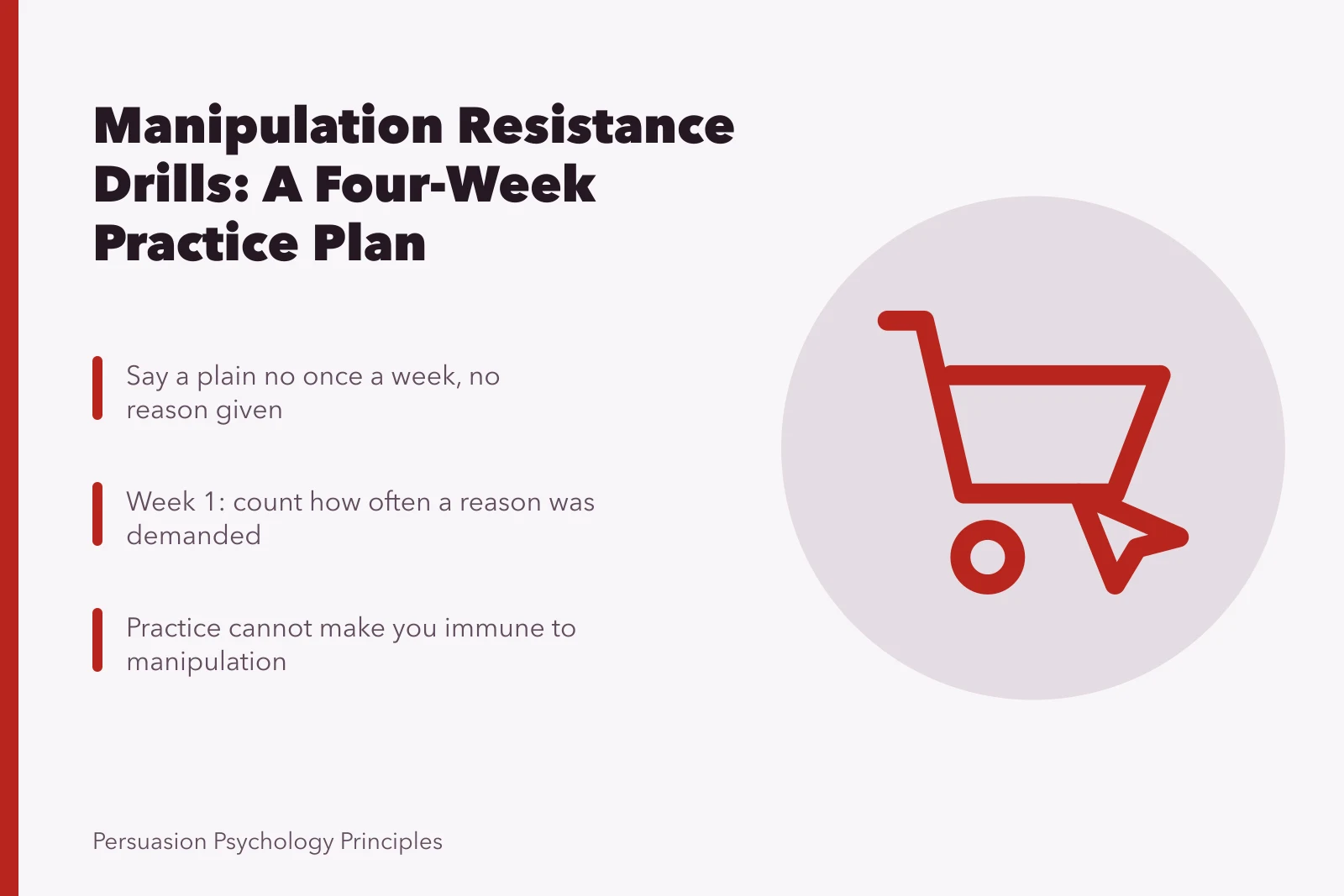
Once a week, decline something low-stakes without giving a reason. A free sample, a survey, an upgrade, an invitation you do not want.
Weekly manipulation resistance drills
- Plain nodecline low-stakes request, no reason
- Overnight testwait a night on wanted purchase
- Exit audittime how long canceling takes
- Limit questionask what a limit is made of
The point is not assertiveness. It is to find out how often a reason is demanded, and to make the sentence available without composition. Most people discover that the demand for a reason is rarer than they feared and the difficulty of the sentence is entirely in saying it the first time.
2. The overnight test on something you want
Pick something you have decided to buy and wait a night anyway. Record what you thought before and after.
Running this when you already intend to buy is what makes it informative. If the decision holds, you have evidence that your process is sound. If it does not, you have found a mechanism working on you under conditions where nothing was lost.
3. The exit audit
Once a week, before signing up for anything, find out how to cancel it. Time the answer.
You are calibrating a ratio: how long joining takes against how long leaving takes. Where the second is much longer, the arrangement has told you something, and the designs that work this way are cataloged in the Federal Trade Commission's staff report Bringing Dark Patterns to Light.
4. Ask what the limit is made of
Whenever something is running out, ask. Once a week is plenty. A shop, a website, a call.
The answer is not the finding. The shape of the answer is: a noun and a cause, or a repetition and a change of subject.
5. The written prior
Before any conversation where you expect to be asked for something, write one sentence about what you currently intend. Twenty seconds.
This is the only reliable way to detect drift, because memory reconstructs your earlier position to match your current one, and it does so without telling you.
6. Trace one source back
Once a week, take a claim somebody told you and find out where they got it. Two minutes.
The habit generalizes further than any other drill on this page, and it usually reveals that agreement between several people is a repetition of one source rather than corroboration, which is the mechanism described under informational influence.
7. The stranger's read
Take an offer you are considering and write it down with no person attached: the number, the scope, the timetable, what happens if it goes wrong. Read it as though it arrived by post.
This is the counter to warmth, authority and every borrowed signal at once, and it works because it removes the source rather than trying to discount it.
A four-week run
| Week | Running | What you should have at the end |
|---|---|---|
| 1 | The plain no, plus written priors | A count of how often a reason was demanded |
| 2 | Add the overnight test on one wanted purchase | One decision tested with nothing at stake |
| 3 | Add the limit question and the source trace | A sense of how many limits and agreements are real |
| 4 | Add the exit audit and one stranger's read | A ratio for joining against leaving |
Four weeks is long enough to collect cases and short enough to finish. The output is a small pile of notes, and the pile is the point: it is the only evidence you will have about which mechanisms actually work on you rather than which ones you have read about.
Four-week drill schedule
- Week 1Plain no plus written priors
- Week 2Add overnight test on wanted purchase
- Week 3Add limit question and source trace
- Week 4Add exit audit and stranger's read
What practice cannot do
It cannot make you immune. Knowing how a technique works does not switch it off, which is why every drill here builds a structure instead of a reflex.
What practice can and cannot do
Can do
- Immunity
- Build structure
- Real pressure
- Prepare in advance
- Money moved
- Catch mechanism
- Offer quality
- Show how moved
Cannot do
- Immunity
- Make you immune
- Real pressure
- Out-think in moment
- Money moved
- Recover funds
- Offer quality
- Judge if offer bad
It cannot help under real pressure with no preparation. A person facing an urgent, emotionally loaded, well-practiced approach will not out-think it in the moment. The honest advice for that situation is to end the interaction and check afterward with someone who has nothing at stake.
Where money has already moved, official guidance such as the Federal Trade Commission's page on what to do if you were scammed is a better starting point than anything a drill will have taught you.
A drill that catches a mechanism shows how you were moved, not whether the offer was bad or worth having. Those stay separate; collapsing them produces its own errors.
The full field guide is under manipulation resistance, the standard under social influence basics, and the mechanisms under reciprocity, commitment and consistency, and scarcity.
Common questions
Which drill should I start with?
The plain no. It costs nothing, needs no preparation, and it produces the fastest correction to an assumption most people are carrying about how refusal is received.
Is it dishonest to run the overnight test on something I have already decided to buy?
No. You are testing your own process, not deceiving anyone, and buying it the next day is a perfectly good outcome.
How long until this changes anything?
The record starts in week one. Whether your behavior under real pressure changes is slower and less certain, and anyone giving you a timeline for that is guessing.
Can I run these with somebody else?
The source trace and the stranger's read work well as a pair, since a second person is much better at reading your offer cold than you are.