Features
Part of Why scarcity and urgency are two different claims entirely
Which scarcity book survives the two-halves test?
The best scarcity books split into two halves, real resource shortage and manufactured urgency, and only one title survives both halves of the test.
What to take away
- The scarcity book that survives the two-halves test is Influence by Robert Cialdini. It treats scarcity as a real condition and scarcity as a costume as one mechanism seen from two sides.
- Scarcity by Sendhil Mullainathan and Eldar Shafir is the strongest book on real shortage. Its argument holds after you understand it, which is why it survives the first half.
- Poor Economics by Abhijit Banerjee and Esther Duflo is the corrective. It refuses the single-mechanism story that weaker scarcity books lean on.
- No book on this shelf teaches you to feel calm while a timer runs. That job belongs to a rule you set in advance.
- The Federal Trade Commission's staff report on dark patterns is free and current. It is better on faked urgency than any paid title here.
The test itself
A scarcity book survives if its central claim still holds once you have understood it. Real shortage survives explanation: knowing why a hall is booked on Saturday does not change what you should do. Manufactured urgency does not survive, because it stops working the moment you look at it.
Run that test on any title before you buy it. Most fail on the second half, and the failure is usually visible in the table of contents.
The books against the test
1. Scarcity: Why Having Too Little Means So Much, Sendhil Mullainathan and Eldar Shafir (2013). The book made the tunneling argument to a general audience. When money, time or attention runs short, the mind narrows. Long-term options drop out of view. Read it for the framing rather than the findings.
Parts of the underlying literature are now contested. The durable contribution is the reframing of attention under pressure, not any single effect size. It survives the first half because that reframing is still true when you can state it plainly. It has nothing to say about the second half.
2. Influence: The Psychology of Persuasion, Robert Cialdini (1984, revised since). This is the one title on this shelf that covers both halves. Scarcity is one of six principles. Cialdini explains why real limits change decisions and how the appearance of a limit is used to sell.
It survives because naming the mechanism does not disarm it. Knowing about scarcity as a lever does not stop the lever working on you. Pair it with social influence basics if you want the principles laid out in order.
3. Poor Economics, Abhijit Banerjee and Esther Duflo (2011). The grounded companion to Mullainathan and Shafir, and useful precisely because it refuses the easy story. Where a weaker scarcity book explains everything by one mechanism, this one tests competing explanations against field evidence.
It draws on randomized field experiments in development economics. Read it as a corrective to any title in this area that sounds too tidy.
4. Thinking, Fast and Slow, Daniel Kahneman (2011). Not a scarcity book, but the reference for the anchoring and loss-aversion machinery that urgency exploits. It survives the test in the same way Cialdini does: the effects persist after you learn their names.
Dated in places, and the priming chapters have drawn replication criticism. Treat the framing as more settled than the specific studies.
5. Bringing Dark Patterns to Light, Federal Trade Commission staff report (2022). Free, and the most durable document here. It catalogs the interface versions of faked scarcity: a timer that resets on reload, a stock counter that counts nothing, a decorative line about other people looking at the same page.
It describes practices rather than claiming psychological findings. That is exactly why it holds up. Read it at the FTC report page.
The verdict
Influence is the book that survives both halves. It is the only title here that treats real scarcity and faked scarcity as the same mechanism seen from two sides. Its central claim still holds when you can recite it.
Scarcity wins the first half outright and has nothing to say about the second. The FTC report wins the second half and was never trying to win the first. Buy Influence if you want one book. Buy Scarcity alongside it if you want the condition understood properly.
The deadline test
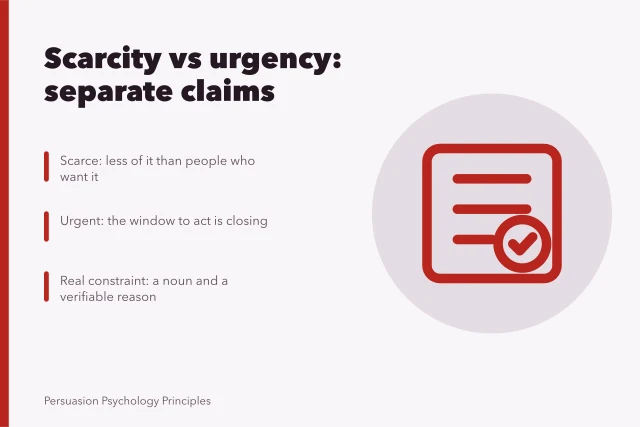
Most of the value of this subject compresses into one skill: telling a real constraint from a manufactured one. You can run it without any of the books.
Five checks for a deadline
- Ask what happens the day after
- Ask whether it has moved before
- Come back tomorrow and look again
- Ask who is constrained
- Separate the deadline from the decision
The last check is the one most often skipped, because urgency works by replacing 'is this right?' with 'will I lose it?'
Where the two halves meet
What it studies
- Scarcity as a condition
- What having too little does to attention and planning
- Scarcity as a technique
- How limits are asserted to sell
What it gives a reader
- Scarcity as a condition
- A reason to be slower about judging decisions made under pressure
- Scarcity as a technique
- A set of checks to run on a deadline
Best title
- Scarcity as a condition
- Scarcity
- Scarcity as a technique
- Influence, FTC report
Mixing the two is where readers go wrong. A book about the first half will not teach you to read a countdown. A book about the second has nothing to say about genuine shortage. The shelf label rarely distinguishes them.
Two halves of scarcity
Scarcity as a condition
- What it studies
- Too little and attention
- What it gives
- Slower judgement
- Best title
- Scarcity
Scarcity as a technique
- What it studies
- Limits asserted to sell
- What it gives
- Checks on a deadline
- Best title
- Influence, FTC report
What no book will give you
A way to feel calm while a timer runs. That is not available, and the honest advice is procedural: decide in advance that anything with a countdown attached gets slept on. Accept that you will occasionally lose a genuine offer.
Over a lifetime that trade is heavily in your favor, because genuine time-limited offers are rare and manufactured ones are constant.
The line worth holding
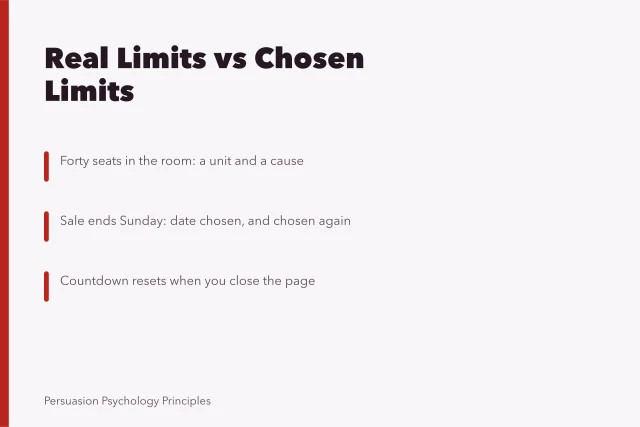
Real scarcity survives being explained. 'This ends Friday because the hall is booked on Saturday' loses nothing when you understand it. You can check it, and knowing why does not change what you should do.
Manufactured scarcity is the opposite, and it requires you not to look. A timer that resets, a stock number nobody is counting, a price rise announced with no reason behind it: each stops working the instant it is understood. That is the clearest signal about what kind of persuasion it was.
The same test applies to anyone selling you a book about it. A title that teaches you to write urgency you do not have is on the other side of the line, whatever the cover says.
For the mechanism behind real shortage, see what scarcity means in practice. For defensive habits generally, see manipulation resistance.
Where a limit arrives beside a crowd number, the two are separate claims, and the second falls under social proof.
Official consumer guidance also puts taking time first, which the Federal Trade Commission sets out on how to avoid a scam.
Common questions
Is there one book that covers both halves well?
Influence comes closest, because scarcity appears there as both a real condition and a lever. It is thinner on the experience of genuine shortage than Scarcity is, and thinner on interface detail than the FTC report. No single title is strong on all three.
Do the deadline checks work in a shop as well as online?
Better, because a person has to answer them out loud. The shape of the answer is the finding, and it is much easier to read in a conversation than on a page. Online, the reload test does most of the work on its own.
What if I lose a genuine offer by sleeping on it?
You will, occasionally. Genuine time-limited offers are rarer than manufactured ones, so the rule wins on average even though it will sometimes cost you. The cost of missing something you wanted is usually smaller than the cost of buying under pressure.
Are the condition books worth reading if I am not short of anything?
Yes, mainly as a corrective. They make you slower to read someone else's bad decision as a character flaw, which is worth more than most of the tactical material. Start with Scarcity, then Poor Economics if you want the evidence tested rather than asserted.