Rules
Liking principle research: what the studies actually show about warmth and compliance
Liking principle research: what similarity, praise, cooperation and familiarity studies show about compliance, and where warmth loses to authority cues.
What to take away
- Similarity, praise, cooperation and familiarity all raise liking in experiments, and liking does shift compliance, but effects in real transactions are usually small.
- Cooperation and familiarity have the steadiest evidence, while praise and first-name matching produce weaker and more contested results.
- Warmth loses ground to authority when the request carries real cost, and it shrinks again once the audience starts checking facts.
- Judge any warmth-based claim by the baseline rate, the setting where it was measured, and what the request asked people to give up.
The four liking levers and the studies behind them
Most research on liking splits the principle into similarity, praise, cooperation, familiarity, and physical attractiveness. The last one behaves like a separate channel. The other four are the ones asked about most often, and they are not supported equally.
The general claim is simple. People agree more readily with someone they feel positively about, as the standard overview of liking describes it. That claim hides a wide range of measured effects.
The four liking levers
| Lever | Representative study | Setting | Replication strength |
|---|---|---|---|
| Similarity | Aune and Basil (1994) | Live donation request | Mixed |
| Praise | Fogg and Nass (1997) | Laboratory, computer flattery | Limited |
| Cooperation | Sherif and colleagues (1954) | Summer camp groups | Strong for liking |
| Familiarity | Zajonc (1968); Moreland and Beach (1992) | Repeated exposure in labs and classrooms | Strong for liking |
The strength column matters more than the lever name. A lever with steady evidence across settings is a different bet from one that worked in a single laboratory.
Where the measured effects hold up
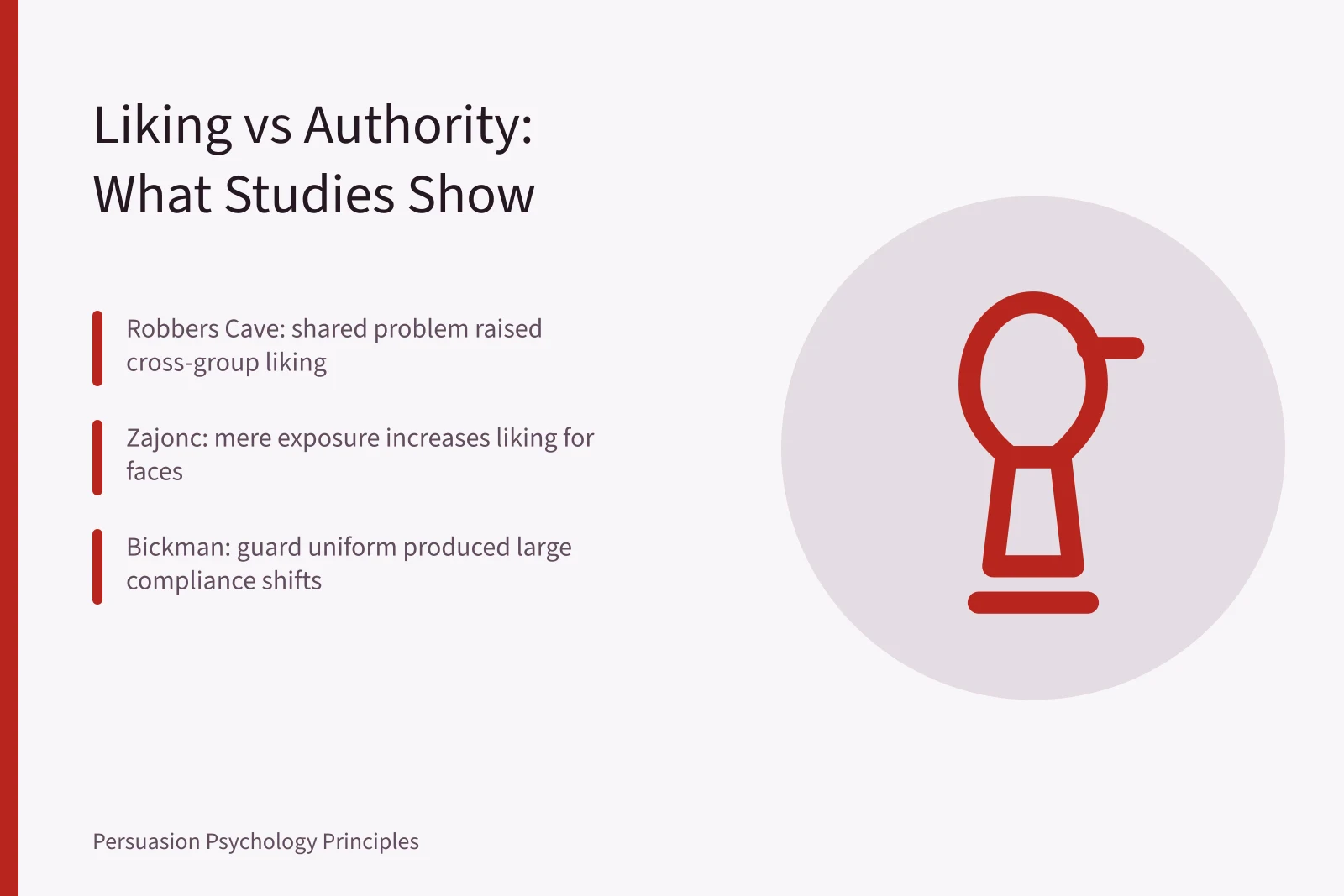
Cooperation has the best story. Sherif and colleagues ran the Robbers Cave experiments with boys at a summer camp. Rivalry between two groups dropped once both sides had to work on a shared problem, and cross-group liking rose.
Familiarity has a comparable record. Zajonc documented the mere exposure effect, where repeated contact with a face or a symbol increases liking. Moreland and Beach later had women attend a large class a varying number of times. Students rated the frequent attenders more favorably, even though they had never spoken to them.
Field evidence on similarity also exists. Frenzen and Davis studied restaurant tipping and found that perceived similarity and attractiveness tracked with larger tips.
Where the evidence gets thin
Praise is the weakest of the four. Fogg and Nass showed that a computer which flattered users raised liking even when the praise had nothing to do with performance. The effect looked more like mood and politeness than earned trust.
Name matching is also shakier than it first appears. Not every study of shared first names finds the same gain, and the size of the effect moves with the sample and the setting.
Before you act on any liking claim, check three things:
- What is the baseline rate without the liking cue?
- Was the effect measured in a lab or during a live purchase?
- What did the request cost the person in time, money or reputation?
For a fast read on warmth being used on you rather than measured in a study, the eleven cues gathered in liking principle signs show what to watch in the offer itself.
Liking versus authority in the same request
Liking and authority are often confused because both arrive as a feeling of trust. They behave differently. Authority cues such as uniforms and titles can produce large compliance shifts, as Bickman found when the same request was made in a guard's uniform.
Authority bias explains why a credible label can overpower warmth. When a real cost is attached to the request, the authority signal tends to carry. The parts of that evidence base that are settled and the parts still argued over are separated in authority research.
When warmth is bought and paid for
Warmth that is paid for is a different object. A familiar creator praising a product is a paid endorsement in most jurisdictions, and U.S. agencies must disclose, test and document the relationship before the claim ships. The steps are set out in the FTC endorsement guides walkthrough.
The FTC's native advertising guidance treats a paid relationship that is dressed as ordinary affection as a possible deceptive practice under Section 5 of the FTC Act. Warmth is not a loophole.
Example: a shared first name at a donation table
Aune and Basil had requesters approach strangers for a charity donation. When the requester shared the stranger's first name, more people gave. The gain was real but modest, and later work found it fades when the target suspects a script.
That pattern repeats across the liking literature. The strongest result you will read about is usually a low-cost request in a controlled setting. The weakest is a costly request from a stranger who has just met you.
When the audience starts checking facts instead of faces, deference moves to whoever knows more. That shift is the mechanism worked through in informational influence.