Rules
Social proof in U.S. retail: what store traffic data actually shows
Foot traffic counters, mobile location panels and POS data tested against social proof claims in U.S. stores, plus FTC disclosure rules and vendor questions.
What to take away
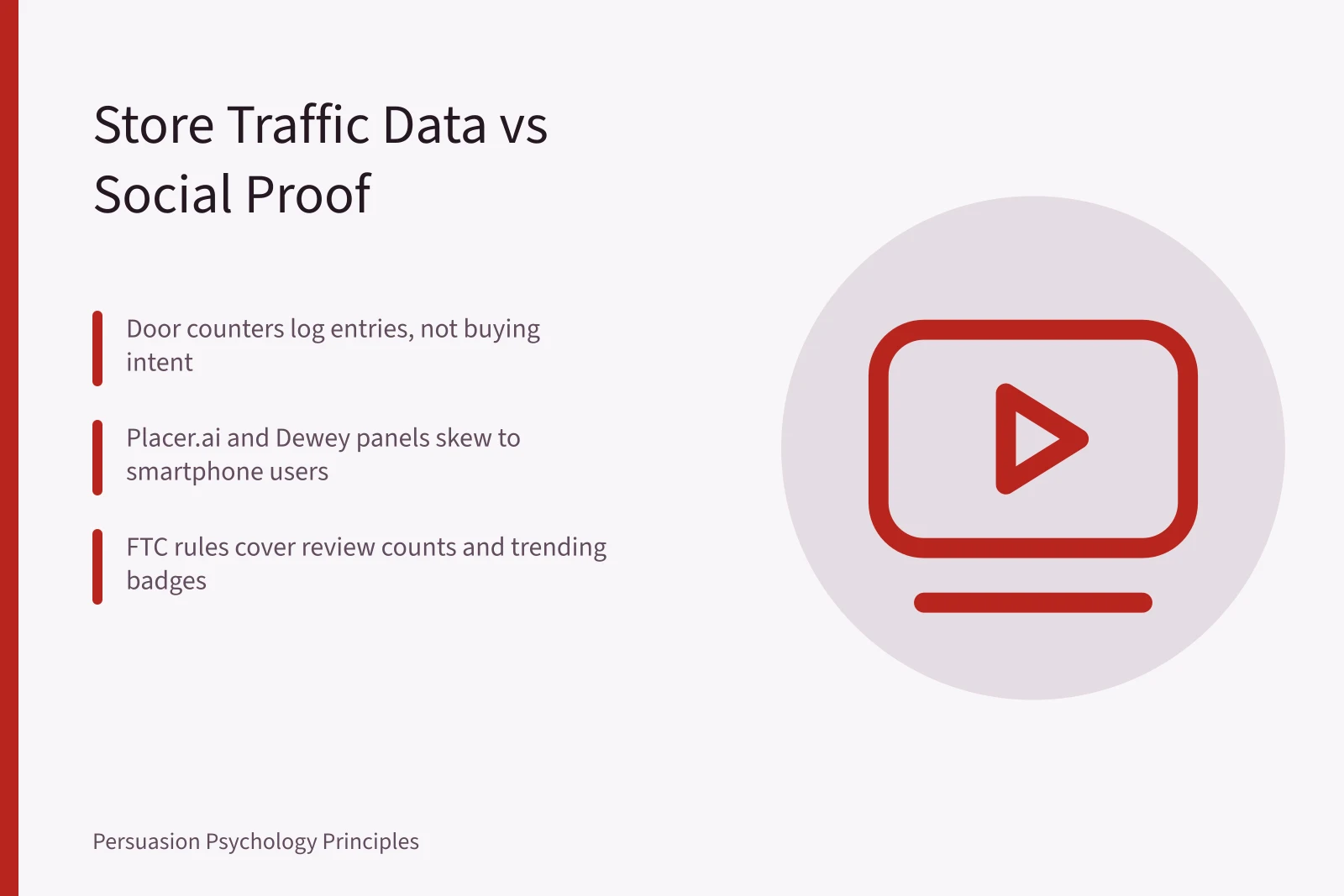
- Foot traffic data is measurable; influence is not. Door counts and phone panels record who showed up, not why anyone bought.
- Public claims about social proof in retail usually rest on vendor panels, review platforms or self-reported surveys, each with its own bias.
- Review counts, "trending" badges and testimonial ads fall under FTC endorsement and deception rules.
- A crowd only persuades when shoppers can see it or its traces, such as a queue, a full shelf or a review count.
- The cleanest test pairs traffic counts with register data over the same hours, before and after the cue appears.
How U.S. store traffic numbers get collected
Door counters from RetailNext, Sensormatic Solutions and FootfallCam use beam breaks or overhead cameras to log entries. They count people, not intent, and staff or deliveries can inflate the tally.
Mobile location panels from Placer.ai, Dewey (formerly SafeGraph), Veraset and Foursquare estimate visits from anonymized devices. The panel skews toward shoppers who keep location services on.
Google Business Profile Popular times is a modeled estimate built from opted-in location history. It gives a relative shape to a week, not a count.
The Census Bureau's Advance Monthly Retail Trade Survey reports dollars by category. It says nothing about how many people walked past a display.
Where the numbers come from
| Source | What it measures | Main limitation |
|---|---|---|
| Door counters (RetailNext, Sensormatic) | Entries and exits by hour | Staff and re-entry inflate totals |
| Mobile panels (Placer.ai, Dewey, Veraset) | Store visits from anonymized devices | Skews toward heavy smartphone users |
| Google Popular times | Relative busyness | A model, not a count |
| POS and loyalty files | Purchases tied to a customer ID | Blind to browsers who never buy |
What the data can and cannot prove
A traffic rise proves a crowd existed at a time and place. It cannot show that the crowd caused a purchase, because weather, promotion, staffing and payday all move with it.
Conversion rate, baskets per visitor and units per basket connect exposure to outcome. Ask any vendor for those, tied to the same store and the same hours.
Beware of averages. A mall anchor at 11 a.m. on a Saturday looks nothing like the same store at 7 p.m. on a Tuesday. Split the hours before you compare.
Example: testing a "popular today" sign
Run the test in matched conditions and let the register decide.
Testing a popular today sign
- Pick two comparable stores, or two comparable weeks in one store.
- Record baseline entries, conversion rate and average basket from the door counter and the POS.
- Add the cue in one location only. Keep price, staffing and signage identical.
- Compare conversion and basket size over the same hours, then repeat once before claiming a result.
- Note the sample size and the panel source, because a claim you cannot audit is a claim you cannot defend.
Studies that survive replication checks
The term social proof is most associated with Robert Cialdini's work on influence. The plain idea, set out in the standard overview of social proof, is that people treat the behavior of similar others as evidence about what is correct.
Asch's line experiments in the 1950s and the hotel towel studies by Goldstein, Cialdini and Griskevicius in 2008 both found that a specific, similar reference group moved behavior more than a general appeal.
Field effects are smaller than lab effects, and replication rates in social psychology are modest. Treat any single study as a hypothesis about your store rather than a forecast.
For the mechanism underneath, three channels of social influence explains how information, norms and identity travel, which is the layer traffic counts sit on. For the lab side, a guide to Boston psychology labs covers consent rules that retail panels never match.
Comparable populations: donors and jurors
Retail is not the only setting with auditable influence data. Public donor files are unusually complete, and FEC contribution data records who gave, how much and when, which makes it a rare test bed for persuasion claims.
Courts are the other extreme. The stakes are high and the rules are tight, and persuasion psychology shapes jury selection in U.S. trial advocacy through voir dire, peremptory strikes and closing argument.
Where the rules bite
The FTC treats deceptive endorsement practices as unfair or deceptive acts under Section 5 of the FTC Act, codified at 15 U.S. Code Section 45. A retailer that invents review counts or hides sponsored placement can face action under that section.
Disclosure expectations for ads built to resemble editorial content appear in the FTC's native advertising guide, which asks whether a reasonable consumer recognizes the content as advertising.
The same test applies to a "12 people are viewing this" badge. Is the number true, is it current, and would a shopper still trust it after learning how it was produced?