Rules
Unity principle at work: 6 belonging cues that change a US team's yes
Six belonging cues that shift a US team's yes, plus a 30-day test, real costs, common failure modes, and the diagnostic to run before you commit.
What to take away
- Unity persuasion works when a request reads as coming from "us" rather than from a job title.
- Six belonging cues carry most of the weightshared vocabulary, shared history, shared problem, shared ritual, visible sacrifice, and shared credit.
- Test one cue for 30 days and watch refusal rates, not just fast agreement.
- Staged cues decay once people compare notes, so check consent before you scale.
- Three questions gate the spendwho owns the cue, what failure looks like, and how fast you can stop it.
Belonging cues and the unity principle
The unity principle treats shared identity as the persuader. People move faster for someone they count as a member of their group. Standard accounts of persuasion place unity beside reciprocity and social proof. Social influence research treats identity as a channel rather than a trick, so the same request lands differently depending on who sends it.
In-group persuasion tactics work on the same machinery. People grant requests to members before they weigh the argument. A US team is a useful test bed because titles stay visible and tenure runs short.
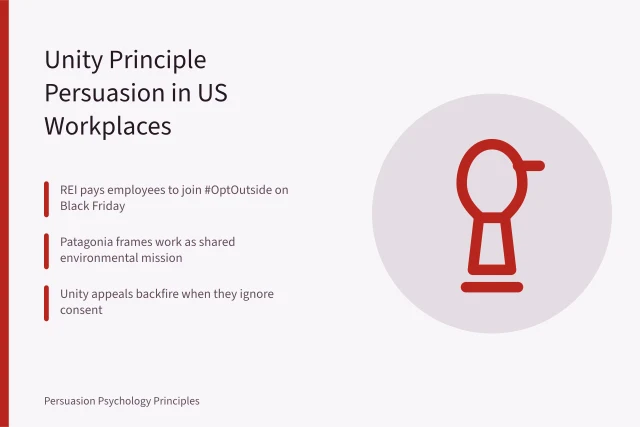
New hires form a membership judgment inside their first month. When your cues are weak, every request turns into a negotiation about authority. For a wider set of worked situations, the real-life unity examples show how this plays out across US workplaces.
Six belonging cues and how to test each
| Cue | What it looks like | How to test it | Cost and time |
|---|---|---|---|
| Shared vocabulary | The team names its own problems in its own words | Count how often new members reuse the terms by week three | None, two weeks |
| Shared history | A two minute story about a past fix, told at kickoff | Ask a new hire to retell it a week later | 20 minutes per hire |
| Shared problem | One named external blocker, never a colleague | Check whether complaints name the problem or a person | Free, needs a listening manager |
| Shared ritual | A Friday demo or a Monday risk list | Attendance plus voluntary sign ups | 30 minutes weekly |
| Visible sacrifice | A lead drops a deliverable to help another team | Ask the helped team to describe it unprompted | One delayed item |
| Shared credit | Names attached to wins in a public channel | Count names per announcement | 10 minutes weekly |
Costs, timelines, and common failures
Most belonging cues cost time rather than money. Shared vocabulary and shared credit run on ten minutes a week.
Rituals need a fixed calendar slot, and visible sacrifice costs a deliverable. Expect four to six weeks before refusals fall. The usual failure is naming a person as the shared problem, which turns unity into blame. Teams that overbuild often miss the light version that already works, and the six US workplace examples cover that gap.
A 30-day test sequence
- Pick one cue and one team. Write the behavior you expect in one sentence.
- Baseline for a week. Log requests, agreements, and refusals. Change nothing yet.
- Run the cue for three weeks. Hold every other habit steady.
- Compare refusal rates and voluntary participation. Refusals tell you more than quick yeses.
- Keep the cue or kill it. Publish the decision with the numbers behind it.
Keep the test narrow: one team, one cue, one month. If the cue needs a new budget line, it is a program rather than a belonging signal. Workplace social influence does not scale on slide decks.
Example: a 14-person support team
Picture a US support team that needs faster shift swaps. The manager skips the memo. She opens the Monday risk list with a two minute story about a past outage the team fixed together. She names the scheduler as the blocker, not a colleague.
She then asks two people to swap shifts and tracks who says no. Within a month, the team starts using its own shorthand for the swap process. Peer requests carry more weight than the manager's request did. Nothing was scripted, and nobody was told to feel loyal.
A short diagnostic before you commit
Belonging and persuasion at work meet in these five checks.
- Can a new member retell the shared story without notes?
- Does the cue name a problem rather than a person?
- Would the ritual survive a week without the manager?
- Can you end the cue in seven days without penalty?
- Do outsiders describe the group the same way insiders do?
If two or more boxes stay empty, fix the cue before you scale it.
Staged unity cues and their limits
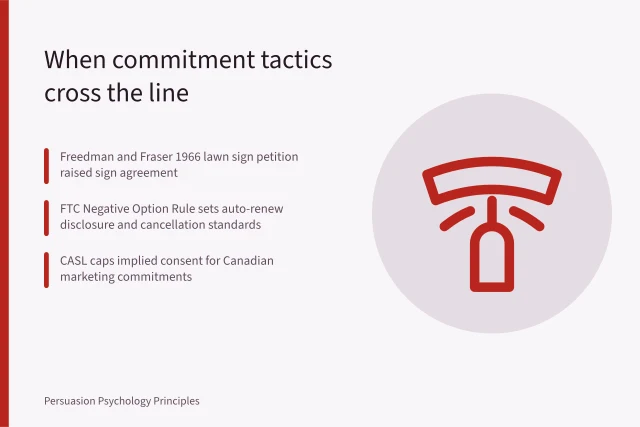
Manufactured identity shows cracks fast. People compare notes, and the gap between the slogan and the daily behavior becomes obvious. The commitment and consistency case studies show how escalation tactics break once consent thins.
Foot-in-the-door research explains why a small first ask feels harmless and then hardens into pressure. A unity principle case study from your own team is the safest evidence you will get. Log what people actually do, not what the kickoff slide promised.