Rules
Using social influence psychology in U.S. nonprofit fundraising under IRS rules
Persuasion psychology principles meet IRS 501(c)(3) fundraising rules: what charities may do, which donor techniques hold up, and where appeals cross the line.
What to take away
- Persuasion psychology principles work inside IRS limits: a 501(c)(3) may ask, thank, and inform, but may not trade donor benefits for gifts.
- Social proof, reciprocity, and normative influence are the best-supported donor appeals, and each carries a disclosure duty.
- The line between permitted and prohibited activity runs through private benefit, substantial lobbying, and campaign intervention.
- A written checklist before every appeal catches most compliance problems before the mail house does.
- State charitable solicitation registration is separate from IRS status and applies to appeals into those states.
What IRS rules allow a 501(c)(3) to do when fundraising
The IRS charities and nonprofits guidance is the starting document for any appeal. It describes what exempt organizations may do, what they must file, and how unrelated business income is treated. See the IRS charities and nonprofits guidance for the current position.
Development staff should read the sections on fundraising and political activity before writing copy, not after a complaint arrives.
A 501(c)(3) may solicit contributions, run special events, sell merchandise related to its mission, and acknowledge donors in annual reports. It may thank donors publicly with permission. It may not let a donor direct the charity's program in exchange for a gift, and it may not promise a return that functions like an investment.
Deductibility is the donor's question, not the charity's promise. A charity should state what portion of a payment is deductible when goods or services are received, because the donor needs that figure for Schedule A. The IRS publishes the rules; the charity should not guess at a percentage in an appeal letter.
Lobbying is permitted only in limited amounts. A 501(c)(3) may conduct some lobbying as long as it stays under the substantial part test or makes the 501(h) election. An appeal that asks donors to contact legislators about pending legislation is lobbying, and it counts against the limit even when framed as education.
Campaign intervention is prohibited outright. A charity may not endorse or oppose candidates, and it may not time appeals to favor one. Voter education that covers all candidates on equal terms is different from an appeal that names one favorably.
State registration is a separate layer. Most states require charities to register before soliciting residents, and some require a disclosure statement on written appeals. A national direct mail program can trigger registration in dozens of states. Budget for it before the first drop.
Donor persuasion techniques supported by social influence research
Three donor persuasion techniques have solid research behind them: social proof, reciprocity, and normative influence. Each has limits, and each interacts with the compliance rules above. The standards for public opinion research give a useful frame for what counts as honest measurement when a charity cites survey data in an appeal.
Social proof is the tendency to treat others' behavior as evidence about what is correct. A line such as "most gifts to this fund last year came from first-time donors" is social proof. It works when the comparison group is real and recent. It fails, and can backfire, when the number is vague or outdated.
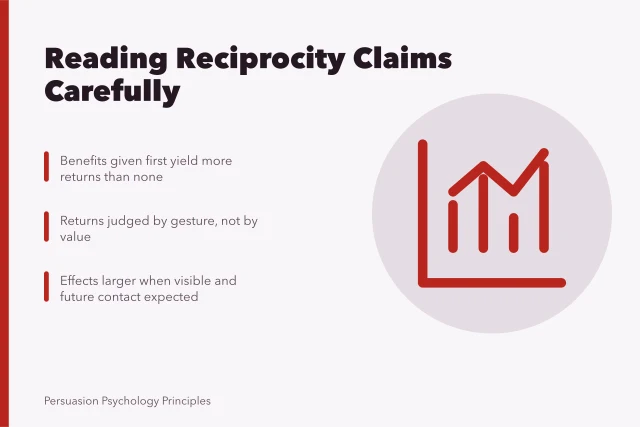
Reciprocity is the tendency to return a benefit. A small, unconditional gift, such as a set of address labels or a research summary, can raise response. Reciprocity research shows the effect depends on the gift feeling voluntary and not like a prepaid purchase. A gift that arrives with an invoice is not reciprocity; it is a bill.
Commitment and consistency is the third technique. A donor who has signed a petition, attended a tour, or volunteered once is more likely to give later. The appeal should name the prior action plainly. "You signed the petition in March; here is the next step" is stronger than a generic ask.
Authority works when the authority is relevant. A medical charity citing a named clinician or a research institution is using authority. The claim must be accurate, and the person cited must have agreed to be named. Borrowed authority from a celebrity with no subject expertise is weaker and riskier.
Scarcity should be used only when true. A matching gift deadline is scarcity. A "limited number of seats" line for an event with open registration is not, and it invites a complaint. The Federal Trade Commission has pursued deceptive urgency claims in commercial settings, and charity appeals are watched by state attorneys general.
Social proof and reciprocity in nonprofit appeals
Social proof in donor appeals usually takes one of four forms: a count of donors, a percentage of a goal, a testimonial, or a norm statement. Each has a different evidence burden. A count is verifiable. A percentage is verifiable if the goal is real. A testimonial needs permission. A norm statement needs a source.
Reading social proof honestly means asking what the number actually measures. "Ten thousand donors" may count gifts, households, or transactions. The appeal should say which. Donors who later learn the number was inflated do not just stop giving; they tell others.
A worked example makes the disclosure duty concrete. Suppose a food bank mails a spring appeal with the line "Last year, 8,400 neighbors gave to this drive." The number came from the donor database and counts households, not gifts. The appeal should say "8,400 households."
If the number includes pledges that were never paid, the count is wrong and should be corrected before the next drop.
The same example shows the reciprocity trap. If the mailing includes a tote bag and a reply envelope, the letter should state the fair market value of the bag and the deductible portion of the gift.
The IRS treats the bag as a premium, and the donor needs the figure. A letter that says "your gift is fully deductible" when a bag is included is inaccurate.
Social proof and reciprocity combine well when the gift is small and the ask is specific. A $10 ask with a bookmark and a line about how many neighbors gave at that level is coherent. A $10,000 ask with a tote bag and a crowd number is not; the donor sees the mismatch.
Normative influence and giving norms in donor messaging
Normative influence is the effect of what a group expects, not just what it does. Descriptive norms describe behavior: "most donors give once a year." Injunctive norms describe approval: "donors in this community believe every child should eat." The two can conflict, and the appeal should not blur them.
Normative influence is strongest when the norm is close to the donor's own group. A neighborhood, a profession, or an alumni class is closer than "Americans." A norm statement about a national population is weak and hard to source. A norm statement about a specific donor segment is stronger and easier to defend.
A common mistake is to publicize the problem as the norm. "Most people do not give" lowers giving when it is read as a descriptive norm.
The appeal should pair the problem with the approved behavior: "Most households in this ZIP code have not yet given, and the ones who have set the pace." The second clause carries the norm.
The U.S. Census Bureau and Pew Research Center publish giving and volunteering figures that can anchor a norm statement. A charity citing such data should name the source and the year in the appeal or in a footnote. A number with no source is a claim, not a norm.
Normative messages should be tested before a full mailing. A small split test with a control group is the standard method, and the disclosure standards for survey research describe how to report methods when results are published. If the charity reports a test result publicly, it should disclose the sample and the question wording.
Where persuasion crosses into prohibited activity
Persuasion crosses into prohibited activity when it trades a private benefit for a gift, when it becomes lobbying beyond the limit, or when it intervenes in a campaign. The IRS rules are the floor, not the ceiling; state law and the FTC Act can add requirements.
Private benefit is the most common failure. A donor who receives a good or service worth more than the gift has received private benefit, and the charity's exemption is at risk if the pattern is substantial. A gala ticket is a common example: the deductible portion is the gift minus the fair market value of the meal and entertainment.
Lobbying is a second boundary. An appeal that asks donors to sign a petition on pending legislation is lobbying. An appeal that reports on a bill without a call to action is generally not. The distinction depends on the words, and the words should be reviewed before the appeal is printed.
Campaign intervention is a third boundary. A charity may not publish a voter guide that favors one candidate. It may publish a guide that covers all candidates on the same issues with the same format. The timing and the framing matter as much as the content.
Deceptive claims are a fourth boundary, and they are policed by state attorneys general and the FTC. A claim that a gift will be matched when no match exists is deceptive. A claim that a program will end without the gift, when it will not, is deceptive.
Social proof ethics is the discipline of checking each number before it goes out.
The AAPOR transparency initiative is a useful model for charities that cite research. It asks organizations to disclose who funded a study, how the sample was drawn, and how the questions were worded. A charity that cites a study without those details is borrowing authority it has not earned.
A compliance checklist for a fundraising appeal
Use this checklist before every appeal. It covers the IRS rules, the persuasion techniques, and the disclosure duties that go with them. Keep a signed copy with the appeal file.
- The appeal states the charity's legal name and EIN.
- The appeal states the deductible portion of any gift that includes goods or services.
- Any social proof number is sourced, dated, and defined (gifts, households, or donors).
- Any reciprocity gift is described with its fair market value.
- Any norm statement names the group and the source.
- No appeal endorses or opposes a candidate for office.
- Any lobbying ask is reviewed against the charity's lobbying limit or 501(h) election.
- State charitable solicitation registration is current for every state in the mailing.
- Testimonials and photographs have written permission.
- A second reviewer has checked every number against the source document.
The Ethical Persuasion Checklist was written for sales teams, but its five questions transfer to donor appeals. Is the claim true, is the source named, is the comparison fair, is the urgency real, and would the donor feel respected after giving.
A short internal review process is enough for most charities. One development staffer drafts, one compliance staffer checks, and one program staffer confirms the facts about the program. The review takes an hour and prevents most complaints.
Common questions
Can a 501(c)(3) use social proof in a fundraising letter? Yes, if the number is accurate, defined, and sourced. A count of donors or households is social proof; a vague claim about "thousands of supporters" is not verifiable and should be avoided.
Is a small gift with an appeal a problem under IRS rules? It is permitted, but the charity must tell the donor the fair market value of the gift and the deductible portion of the contribution. A gift that looks like a purchase can weaken the case for deductibility.
How much lobbying can a charity do? A 501(c)(3) may lobby only as an insubstantial part of its activities, or it may elect the 501(h) expenditure test, which sets a dollar limit based on the charity's budget.
Does a charity need to register in every state where it solicits? Most states require registration before soliciting residents, and the rules vary. A national mailing list can trigger obligations in many states, so check before the drop.
What is the difference between a descriptive and an injunctive norm in donor messaging? A descriptive norm says what people do; an injunctive norm says what people approve of. The two can conflict, and the appeal should state which one it is using.
When should a charity disclose how it measured a persuasion result? When it publishes a test result or cites survey data, it should name the sample, the question wording, and the funder. The AAPOR disclosure standards describe the practice.