Reviews
Part of Reciprocity: telling a gift from a down payment
What reciprocity research can support, and what it cannot
Reciprocity research is contested, and this page explains how to read a claim about it: what the evidence can support, what it cannot, and which questions to ask.
Somebody tells you that a small gift reliably increases compliance by a specific amount. Before you use that, work out what would have had to be true for anyone to know it.
What to take away
- Effect sizes in this area are disputed. Figures that circulate confidently often come from a narrow setting and do not survive being moved.
- The useful skill is not memorizing findings. It is knowing which questions turn a striking claim into a usable one.
- Where a claim cannot answer those questions, treat it as a hypothesis about people in general and a fact about one situation.
Why this literature is hard to read
Reciprocity is measured through behavior in specific settings: a request in a corridor, a donation after an enclosed gift, an offer in a bargaining game. Each setting is real and each one is narrow. Each of those narrow settings is one of the reciprocity examples that shows whether the debt was opened honestly or engineered.
The trouble is that the mechanism is social, so the setting is not a container for the effect: it is part of the effect. Who is asking, whether they will be seen again, what the local expectation is, and how large the benefit felt relative to the person's situation all move the result. Change any of them and the number changes, which means a figure reported without its setting is missing the part that produced it.
This is why sensible people disagree about how strong the effect is, and why the honest summary is a direction rather than a magnitude. Benefits given tend to increase the chance of a return. How much, in your situation, is not something a page can tell you. If you need a number for your own situation, the honest move is to test which reciprocity technique is being used on you.
The questions that make a claim usable
| Question | Why it decides the weight |
|---|---|
| Who was asked, and in what setting? | The setting is part of the mechanism, not a backdrop |
| Was the giver going to be seen again? | Ongoing relationships change the whole calculation |
| What was the alternative to complying? | Compliance is cheap when refusing is awkward |
| Was the benefit requested or imposed? | Unsolicited benefits work differently and are studied less |
| Has anyone repeated it elsewhere? | A single striking result is a lead, not a finding |
The last row is doing the heaviest work. Across behavioral fields generally, a substantial share of striking results have been harder to reproduce than expected, and the arguments about what that means for any individual claim are set out in the Stanford Encyclopedia entry on reproducibility of scientific results. The practical upshot for a reader is modest and firm: treat one memorable result as a reason to look further, never as a settled quantity.
What the evidence can carry
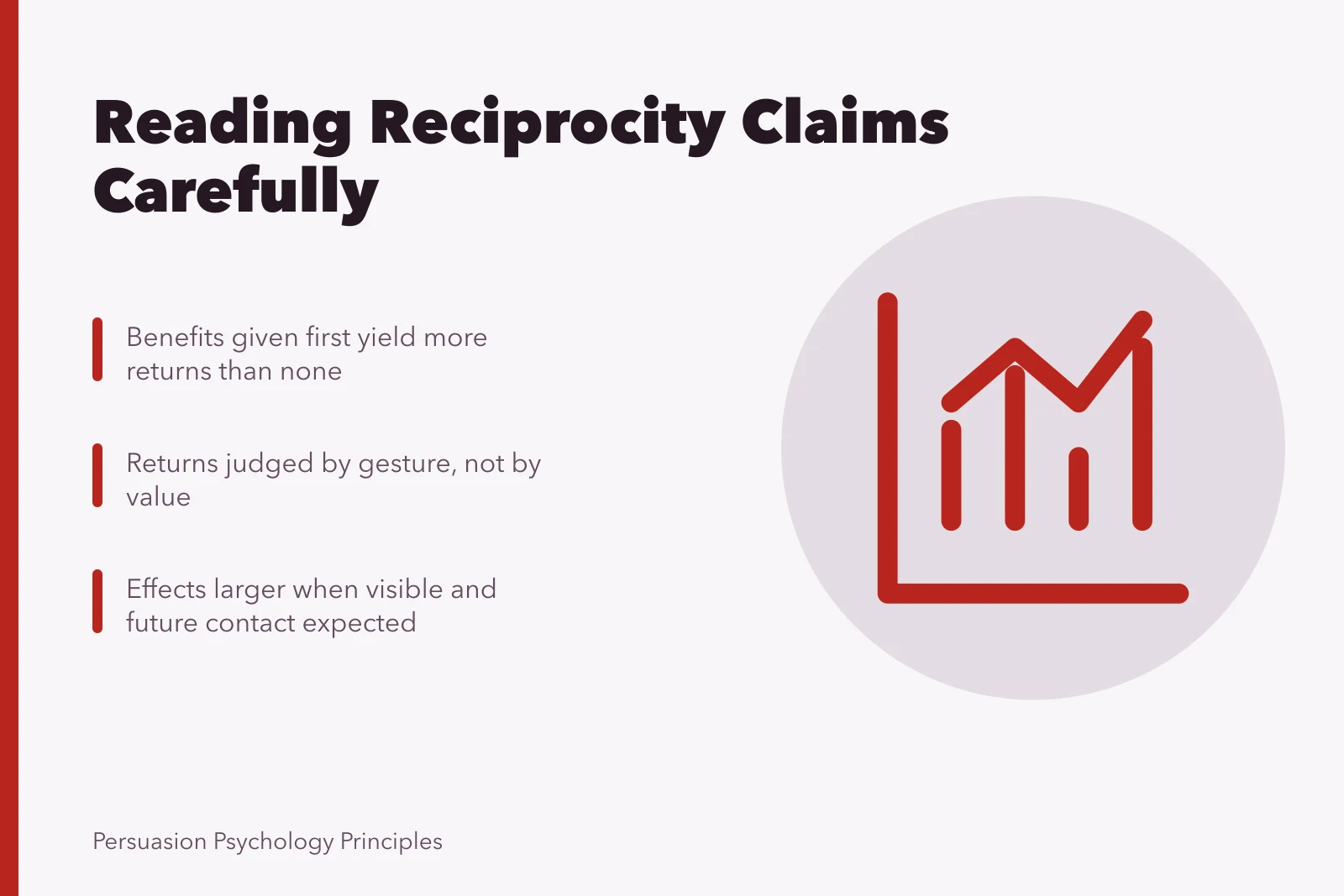
- A direction. Benefits given first are associated with more returns than benefits not given.
- A shape. Returns are often out of proportion to the benefit, judged by gesture rather than value.
- A boundary condition or two. Effects tend to be larger when the exchange is visible to others and when the parties expect further contact.
That is genuinely useful and it is much less than what gets claimed. Notice that none of it licenses a sentence of the form "do X and Y percent will comply". Anyone offering you that number should be asked where it was measured and what happened when somebody tried it somewhere else.
What it cannot carry
It cannot tell you what will happen with your customers, your colleagues, or your particular request. Populations differ, and the differences are not noise around a true value; they are the thing being measured.
It also cannot settle the ethical question, which is separate and prior. A technique that reliably works is not thereby permitted, and the standard this site uses does not depend on effectiveness at all: influence that survives the other person learning how it worked is legitimate, and influence that needs concealment is not. That test is set out under social influence basics and it does not move when the evidence does.
And it cannot be applied backward to diagnose an individual. Knowing that gifts tend to increase compliance tells you nothing reliable about whether a particular gift changed a particular person's mind, including your own. Whether it is even possible to know your own reasons here is an old problem, treated in the Stanford Encyclopedia entry on self-deception.
How to read a claim in practice
Take the claim, strip the number, and see what is left. If what remains is "giving first makes a return more likely", you have something you can use and it needs no citation. If what remains is nothing, the number was the whole content, and the number is the part that travels worst.
Then ask what you would do differently under a strong version of the claim and under a weak one. When the answer is the same, the research question does not matter for your decision, which is the case more often than people expect. The mechanism itself is set out under reciprocity, the honest and dishonest uses under manipulation resistance, and the parallel problem of reading crowd evidence under social proof.
Common questions
Why will this page not give me the famous numbers?
Because a number without its setting is not information, and reproducing figures whose status is contested would give you false confidence in exchange for nothing.
Does disputed evidence mean the effect is not real?
No. Direction and magnitude are different claims. The direction is well supported by ordinary observation; the magnitude is what is contested.
How should I test it in my own situation?
Change one thing at a time and record what happened, with the base rate before the change. That is weak evidence about people in general and strong evidence about your situation, which is the one you have.
Is there a summary source I can trust?
Prefer sources that report the setting and the uncertainty alongside the result. A summary that gives you a clean number and no conditions has removed the part you needed.