Industry
Part of A working test for manipulation resistance you can run today
Manipulation resistance signs and what each one means
Eleven manipulation resistance signs, grouped by whether they show up in the offer, in the pressure or in your own reaction, each with a check you can run.
You will not catch it by reading faces. The reliable signals are in the shape of the offer and in what happens when you slow down.
What to take away
- Group the signs by where they appear. The ones in the offer can be checked; the ones in your own reaction have to be caught with a habit.
- The single most reliable test is the response to a delay. Honest offers survive a night; engineered ones are built to prevent one.
- Three signs together on a decision you cannot easily reverse is a reason to stop. One is ordinary.
Signs in the offer
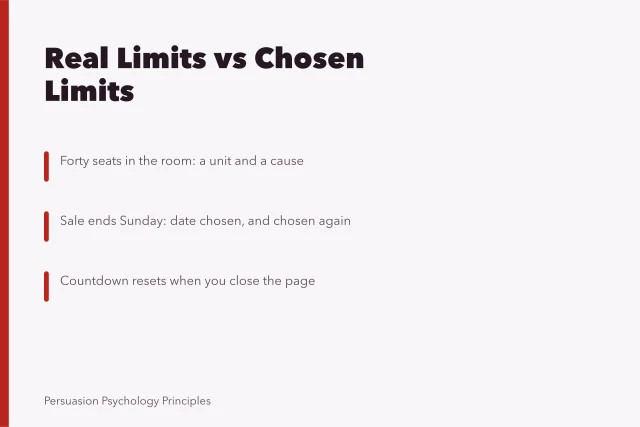
1. The limit has no noun behind it. You are told something is running out and nobody can say what the limit is made of. Real constraints have a unit and a cause, which is the distinction covered under scarcity.
Signs in the offer
- Limit has no noun behind it
- Leaving is harder than joining
- Terms changed after you agreed
- Proof cannot be traced
2. Leaving is harder than joining. Signing up takes a minute and canceling takes a phone call at certain hours. The asymmetry is a design choice, and the family it belongs to is set out in the Federal Trade Commission's staff report Bringing Dark Patterns to Light.
3. The terms changed after you agreed. The price, scope or timetable moves once the decision is made. Each individual change is small, and the position they are made from is a decision you have already taken.
4. The proof cannot be traced. Counts with no denominator, testimonials with no method, credentials with no issuer. A signal you cannot check is a claim about a signal.
Signs in the pressure
5. A benefit arrived that you did not ask for. A gift, a favor, a free consultation, delivered before any request. It produces a felt debt without producing an actual one, which is the mechanism under reciprocity.
Signs in the pressure
- Unsolicited benefit arrived before any request
- First request existed to be refused
- Refusing made into a statement about you
- Exit reframed as a loss
6. The first request existed to be refused. An unreasonable ask followed immediately by a smaller one, so that the retreat pulls a retreat.
7. Refusing has been made into a statement about you. Not "no thanks" but "so you are not the kind of person who". The decision has been converted into an identity question, and identity questions are much harder to reason about.
8. The exit keeps being reframed as a loss. Every attempt to leave is answered with what you would be giving up rather than with an improvement to the offer.
Signs in your own reaction
9. You cannot reconstruct why you agreed. The conclusion is there and the reasoning is not. This is the most common of the eleven and the easiest to prevent, because a sentence written beforehand fixes it permanently. Writing that sentence beforehand is one of the commitment and consistency exercises that keeps a prior reason from being rewritten after the fact.
Signs in your reaction
- Cannot reconstruct why you agreed
- Saying no feels rude, not difficult
- In a hurry and cannot say why
10. Saying no feels rude rather than merely difficult. Difficult is normal. Rude means a social cost has been attached to a commercial decision, and somebody attached it.
11. You are in a hurry and cannot say why. The urgency has no source you can name. Genuine urgency comes from a fact you can state in a sentence.
The checks
| The sign | The check |
|---|---|
| An unexplained limit | What is the limit made of? |
| Hard exit | How would I cancel, and how long does it take? |
| Untraceable proof | Out of how many, and who says so? |
| Unsolicited benefit | Would I want this if it had cost me the retail price? |
| Identity framing | What is the actual proposal, written down without me in it? |
| No reconstructable reason | What did I think before this conversation? |
| Unexplained hurry | What happens tomorrow that does not happen today? |
Every check in that column is a question an honest counterpart answers in a sentence and does not mind being asked. That property is the point of them: you are not accusing anybody, and the reaction to the question is more informative than the answer.
Sign and its check
The sign
- Unexplained limit
- What is the limit made of?
- Hard exit
- How would I cancel, how long?
- Untraceable proof
- Out of how many, who says so?
- Unsolicited benefit
- Would I want it at retail price?
- Identity framing
- What is the proposal, without me?
- No reconstructable reason
- What did I think before this conversation?
- Unexplained hurry
- What happens tomorrow that does not today?
The check
- Unexplained limit
- Hard exit
- Untraceable proof
- Unsolicited benefit
- Identity framing
- No reconstructable reason
- Unexplained hurry
The one test that covers most of them
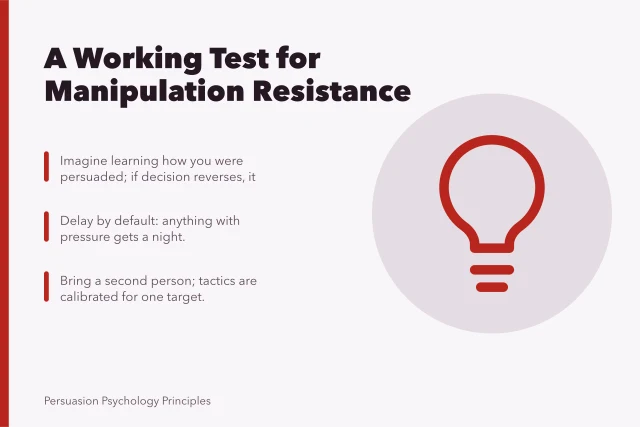
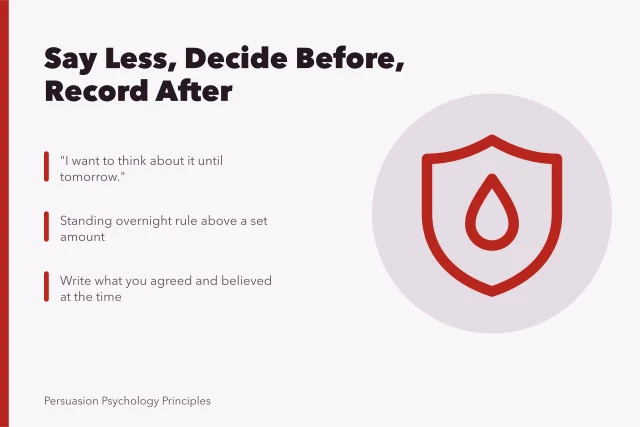
Ask for a night. Not a week, not a negotiation: one night.
Ask for one night
Ask for a night before deciding
honest counterpart mildly inconvenienced
engineered reason why tonight is different
Almost every concealment-dependent technique on this page is built to prevent that specific pause, because the felt debt fades, the urgency dissolves, the identity framing stops working, and the offer has to stand on what it contains. An honest counterpart is mildly inconvenienced. An engineered one produces a reason why tonight is different, and that reason is the finding.
Taking time before deciding is the first item on almost every official list of advice, including the Federal Trade Commission's page on how to avoid a scam, and it is there because it works on the widest range of pressure.
What the signs will not do
They will not identify a manipulator. Several of these appear in ordinary honest commerce, and treating everybody who uses one as an adversary will cost you more than it saves.
They will not stop the technique working on you. Recognizing a mechanism does not switch it off, which is why the structural moves matter more than the detection: a delay, a written prior, a second opinion from someone with nothing at stake.
They will not tell you the offer is bad, and a good product can be sold badly. Separating the two is worth doing, because collapsing them makes you refuse what you wanted and accept what you did not.
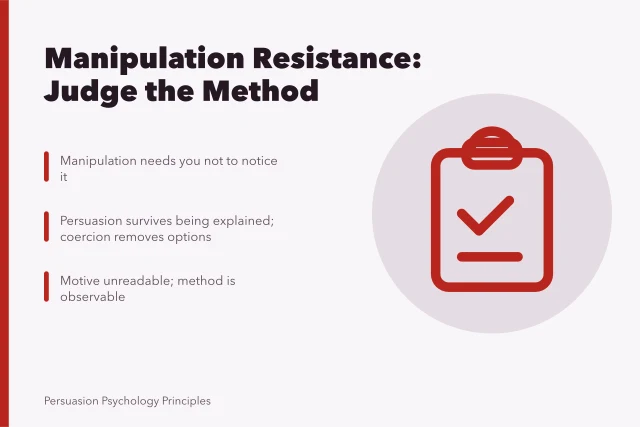
The full field guide is under manipulation resistance. The standard for what belongs on it is under social influence basics, and the pressure from a stated position is under commitment and consistency.
Common questions
How many signs before I walk away?
Three at once on something hard to reverse is a workable rule. Its job is to trigger the pause, not to be a verdict.
What if asking for a night loses me the deal?
Then the deal depended on you not having one, which is the information the question was for. Genuine limits survive a night far more often than people expect.
Are these useful in personal relationships?
Signs seven and eight are, and the rest translate badly. Personal situations need a different frame, and a decision made on a checklist there tends to go wrong in its own way.
Can I use these on somebody else's behalf?
You can ask the questions with them, which works. Diagnosing their situation for them usually produces a defense of the other party rather than a rethink.