Costs
Part of Why scarcity and urgency are two different claims entirely
Scarcity meaning: telling a real limit from a manufactured one
Scarcity meaning, defined against urgency, exclusivity and rationing: what a real limit has that a manufactured one does not, and how to tell them apart.
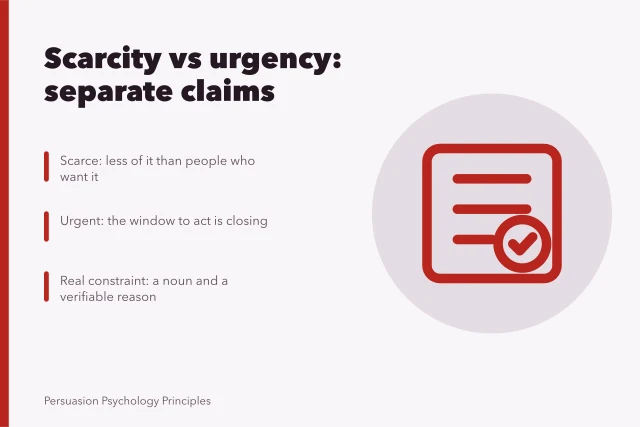
Scarcity is a fact about supply. Urgency is a fact about time. Sellers merge the two because the merged version moves people, and separating them again is most of what this word is for.
What to take away
- A real limit has a noun behind ita number of seats, a quantity of stock, a date fixed by something other than the seller.
- A manufactured limit is a claim about supply made by the only party who can set it, which makes it a decision rather than a constraint.
- Scarcity does not make a thing better. It changes how you feel about losing it, and those are different facts.
The definition, in one sentence
Scarcity is a limit on how much of something is available, and in persuasion it means the use of that limit, real or asserted, as a reason to decide now.
The phrase "real or asserted" is where all the difficulty lives. From outside, a genuine constraint and a manufactured one produce the same sentence, and the only way to separate them is to ask what the limit is made of.
Class and difference
What it shares
- Urgency
- Presses for a decision now
- Exclusivity
- Restricted availability
- Rationing
- A fixed quantity per person
- High demand
- Things running out
- Loss aversion
- Weight given to what is lost
- Artificial scarcity
- A stated limit
How it differs
- Urgency
- It is about a deadline, not about supply
- Exclusivity
- The restriction is by membership, not by quantity
- Rationing
- It is imposed to distribute fairly, not to sell
- High demand
- The limit is produced by buyers rather than announced by sellers
- Loss aversion
- It is a description of how people weigh, not a fact about supply
- Artificial scarcity
- The limit was chosen, and could be lifted at will
Reading down the last column, only two of these are facts about the world. The rest are decisions somebody made, or descriptions of how people respond.
Scarcity vs nearby ideas
Nearby idea
- Urgency
- Presses now
- Exclusivity
- Restricted availability
- Rationing
- Fixed per person
- High demand
- Things running out
- Loss aversion
- Weight given to loss
- Artificial scarcity
- A stated limit
What it shares
- Urgency
- Deadline, not supply
- Exclusivity
- Membership, not quantity
- Rationing
- Fair distribution, not sales
- High demand
- Buyers produce limit
- Loss aversion
- How people weigh
- Artificial scarcity
- Chosen, can be lifted
How it differs
- Urgency
- Exclusivity
- Rationing
- High demand
- Loss aversion
- Artificial scarcity
A sentence about scarcity often holds all three kinds at once, which is why it is hard to answer. The scarcity examples comparison sorts those three kinds apart, one limit at a time.
What a real limit looks like
A genuine constraint can be described without reference to your decision.
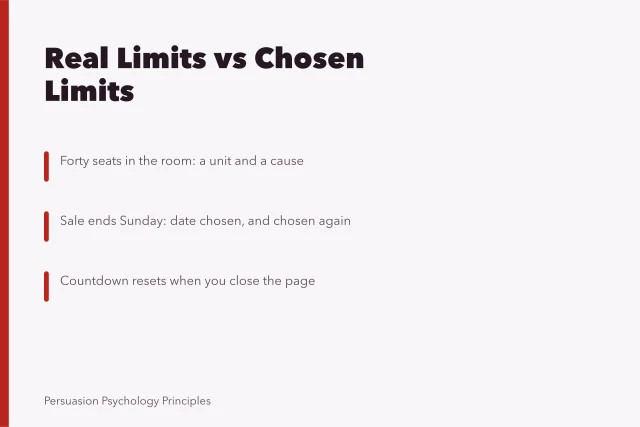
- It has a unit.Forty seats. Eleven remaining. One craftsman who works alone.
- It has a cause.The venue holds that many. The material is no longer made. The date is set by somebody with no interest in your purchase.
- It behaves consistently.A real limit does not reset when you come back tomorrow, and it does not apply to you alone.
- It survives being described.A seller with a genuine constraint can explain it, and explaining it does not weaken the case at all.
Manufactured limits fail the last test in a specific way: the explanation is either unavailable or circular. The offer ends Friday because it ends Friday. Only three left, at this price, for now, in this session.
Why the merged version works
Nobody can tell you the size of this effect honestly. Estimates vary widely between settings and the magnitude is disputed. What is not disputed is the direction: a prospective loss is weighed more heavily than an equivalent gain, and a closing window converts a purchase into a potential loss.
There is a second mechanism worth knowing about, because it points the other way. People push back against restrictions on their freedom to choose, and heavy-handed pressure can produce refusal rather than compliance. This is why aggressive countdowns often fail, and why the honest version of a real limit tends to outperform the theatrical one over time.
The test that separates them
Ask the seller what the limit is made of. A real constraint produces a specific answer in one sentence. A manufactured one produces a change of subject, a repetition, or an answer that would let you check it and does not survive checking.
Is the limit real?
Ask the seller what the limit is made of.
specific answer in one sentence
change of subject or repetition
That is the site's disclosure test in its most concrete form: influence that survives being explained is the legitimate kind, a standard set out under social influence basics. A seller with forty seats loses nothing by saying so. A seller with a counter that resets when you clear your cookies loses everything.
A business is expected to be able to support the claims it puts in front of buyers, availability claims included, which the Federal Trade Commission sets out in plain terms in its advertising guide for small business.
Design tactics built on false or unverifiable limits are cataloged in the FTC staff report Bringing Dark Patterns to Light, and their shape is consistent enough to recognize once you see it described.
When a limit is paired with a crowd number, the two work on different channels. Separate them before answering either. The crowd half is covered under social proof.
What scarcity does not mean
It does not mean valuable. Rarity and quality are independent, and something can be genuinely hard to obtain and not worth obtaining.
It does not mean urgent for you. A real limit sets a deadline for the seller's supply, not for your decision, and the two only coincide if you had already decided to buy.
And it does not mean you are being manipulated. Most limits are ordinary facts about a world with finite things in it. The mechanism, and how to respond when a limit turns out to be real, is set out under scarcity; the field guide for the manufactured cases is under manipulation resistance.
Common questions
How do I check a limit without insulting the seller?
Ask what it is made of, as a plain question. "How many are left, and where does that number come from?" is not an accusation, and an honest business answers it in a sentence.
Is a real deadline ever a good reason to decide quickly?
Yes, if you had already decided the thing was right. A genuine limit is a reason to act on a decision you have made, not a reason to make one.
What about limits I create for myself?
Self-imposed deadlines work on the same mechanism and are usually honest, since you know exactly what they are made of. Whether they should be binding is a separate question worth answering before you set one.
Why does the same tactic sometimes make me refuse?
Because pressure on your freedom to choose produces its own reaction. That pushback is real, and it is worth distinguishing from a judgment about the offer, since it can make you refuse something you actually wanted.