Costs
Part of 5 details of liking principle people miss
Liking principle examples: the separation that keeps warmth from working on you
Liking principle examples showing where warmth moved a decision it should not have, and the one separation that keeps a good relationship from becoming an argument.
You bought from the person, not from the proposal. That is not a character flaw, and it is not a reason to distrust people you like. It is a reason to make the proposal answer for itself.
What to take away
- Liking rarely changes what you believe about the facts. It changes how hard you look for them.
- Every case below has the same correction: write down what the deal is, separately from who is offering it.
- Warmth that is real and warmth that is produced feel identical from inside, and no amount of attention will let you tell them apart in the moment.
Where liking did the deciding
The contractor you got on with. Two quotes, similar numbers, and one of them shook your hand and laughed at the right moment. Almost nobody records the specification carefully after that, and the specification is where the money is.
The colleague whose idea you defended. You backed the proposal in the meeting and would have found the same holes in it if somebody else had brought it. Nothing dishonest happened; the search for problems just did not start.
The salesperson who found the connection. Same town, same team, same first car. The connection is often real. It is also the first thing a trained seller looks for, and the reason it is looked for is that it works. Sellers who hunt for connections are running a liking play, and the social influence basics techniques list marks it as one to spot.
The candidate you enjoyed talking to. An interview that felt easy produces a strong impression, and what it measures is how pleasant the conversation was. That is a genuine signal for some jobs and irrelevant for most, and the trouble is that it arrives feeling like a judgment about competence.
The supplier who remembers your family. Years of small warmth accumulate into a relationship you would not want to damage by pushing on price. The relationship may be entirely genuine and the effect on your negotiating is the same either way.
The person who agreed with you first. Being agreed with is pleasant and it produces liking quickly. Notice how often the agreement comes early in the conversation and about something that costs nothing.
The attractive presentation. Polish, confidence and good design produce warmth toward the thing itself. This is the version with no person in it, and it is the one people least expect to be working on them.
The friend who asked for a favor. Here the liking is real, long-standing and entirely legitimate. The question is still whether the favor is one you would do, and friendship is a reason to help rather than a reason to skip the question. What friends can properly ask of each other is genuinely contested, and the Stanford Encyclopedia entry on friendship is a good account of why.
The referral from someone you like. Warmth transfers along a chain, and the second person inherits credit they have not earned. Recommendations are useful and this transfer is not part of their usefulness.
The person who mirrored you. Matching posture, pace and vocabulary produces ease. Some of this is unconscious and ordinary. Some of it is trained, and the trained version is on the list of things to recognize rather than to use.
What each case has in common
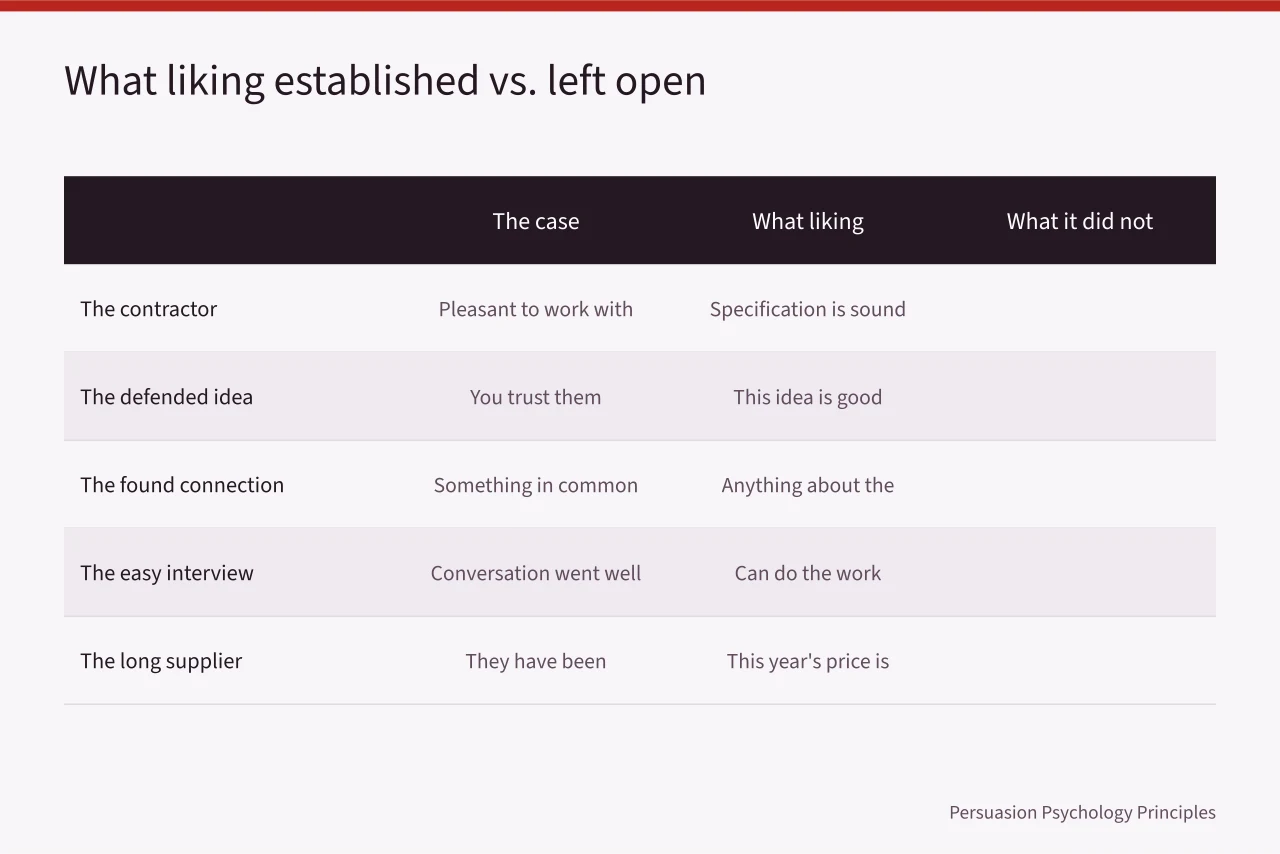
| The case | What liking established | What it did not |
|---|---|---|
| The contractor | Working together will be pleasant | The specification is sound |
| The defended idea | You trust this person's judgment | This particular idea is good |
| The found connection | You have something in common | Anything about the offer |
| The easy interview | The conversation went well | The person can do the work |
| The long supplier relationship | They have been reliable | This year's price is right |
In every row the left-hand fact is real and the right-hand question is unanswered. That is the whole pattern, and it is why the correction is a separation rather than a defense.
The separation
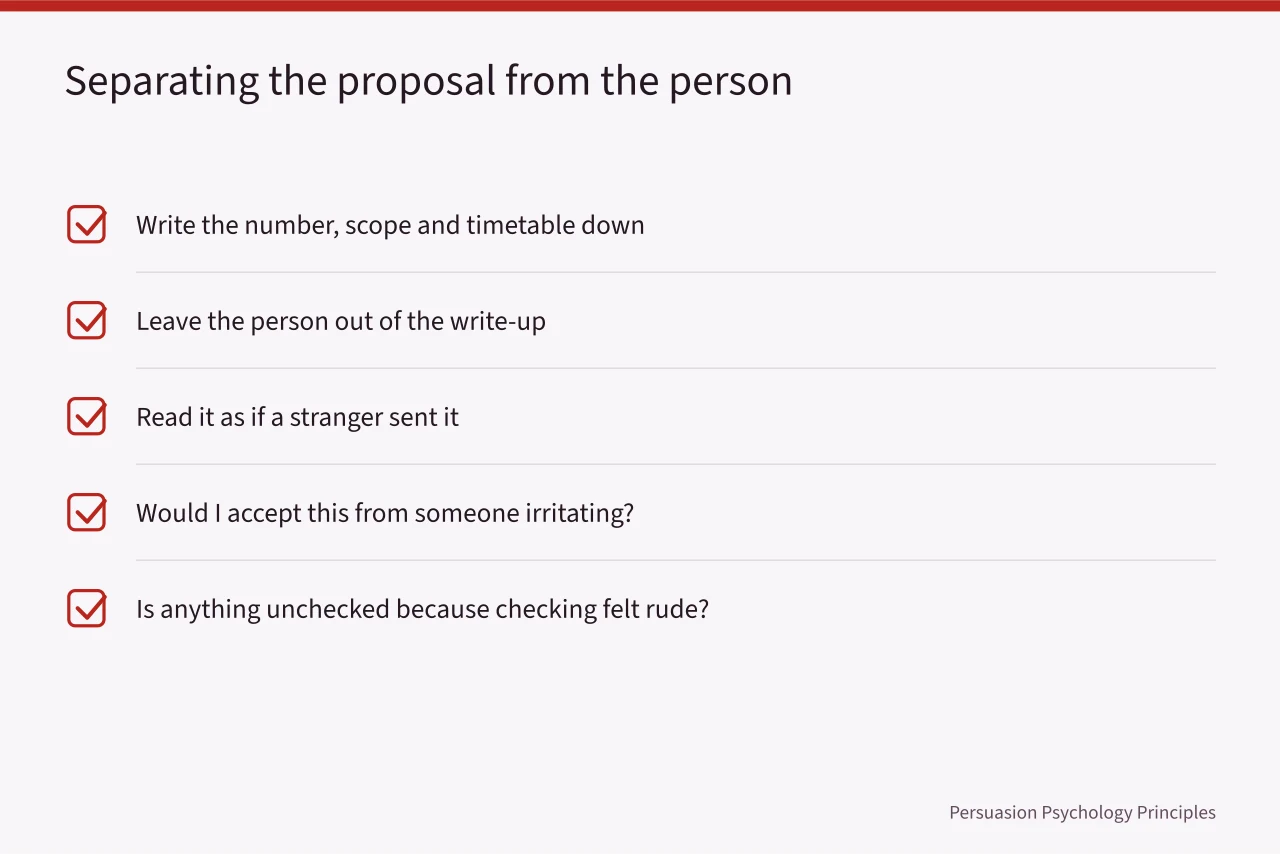
Write the proposal down without the person in it. The number, the scope, the timetable, what happens if it goes wrong. Then read it as though it arrived by post from a stranger.
This takes a few minutes and works better than any attempt to be less affected by people, which does not work at all. It also protects the relationship, since the alternative to separating the two is either overpaying or becoming suspicious of somebody who has done nothing wrong.
Two follow-ups do the rest. Would I accept this from someone I found irritating? And is there anything here I have not checked because checking felt rude? The second question finds most of it, because the real mechanism is not that you believed something false; it is that you stopped looking, and stopping was polite.
A search that ends early is the ordinary condition of human judgment rather than a lapse, which the Stanford Encyclopedia entry on bounded rationality sets out at length. The mechanism is set out under liking principle, and the general standard under social influence basics.
When the warmth was manufactured
Some of it is. Sales training teaches connection-finding, mirroring and agreement-first, and the techniques work whether or not the warmth behind them is real.
You will not detect this reliably in the moment, and trying to is a poor use of attention. What you can do is make the detection unnecessary: if the proposal stands up on paper, it does not matter why you liked the person, and if it does not, the warmth was the argument.
That is the same reason the disclosure test is applied to the technique rather than to the feeling. Where a proposal also arrives with a gift attached, the second mechanism is covered under reciprocity. The field guide for tactics that depend on you not looking is under manipulation resistance.
Common questions
Should I avoid buying from people I like?
No. Preferring to work with people you get on with is sensible, and it is a reason to choose between acceptable options rather than a reason to accept one.
How do I do this with a long-standing supplier?
Price the work independently once a year, without telling anyone, and use it as information rather than as a threat. A relationship that cannot survive you knowing the market price was not a strong one.
Is mirroring dishonest?
Unconscious mirroring is not, and it is most of what happens. Trained mirroring done to produce compliance fails the disclosure test, since nobody says out loud that they are copying your posture to make you agreeable.
What if I dislike someone and their offer is good?
The same separation applies in reverse and people are much worse at this direction. Write down the proposal, read it cold, and notice that the objections you found may have arrived after the dislike rather than before it.