Reviews
Part of 5 details of liking principle people miss
Liking principle signs and what each one means
Eleven liking principle signs that warmth is carrying an offer, split between your own reactions and how the situation was arranged, plus what to do next.
Liking someone makes their arguments feel better than they are. Not because you are gullible, because agreeing with people you like is cheap and pleasant, and disagreeing with them costs something. The tilt is small each time and it adds up.
The signs below are written from the inside. They are not ways to catch a manipulator; most of the time there is nobody to catch, and the warmth is sincere. They are ways to notice that your assessment of a proposal has been partly outsourced to your assessment of a person.
What to take away
- Liking rarely changes what you believe about an offer. It changes how hard you look, and the search stops without announcing itself.
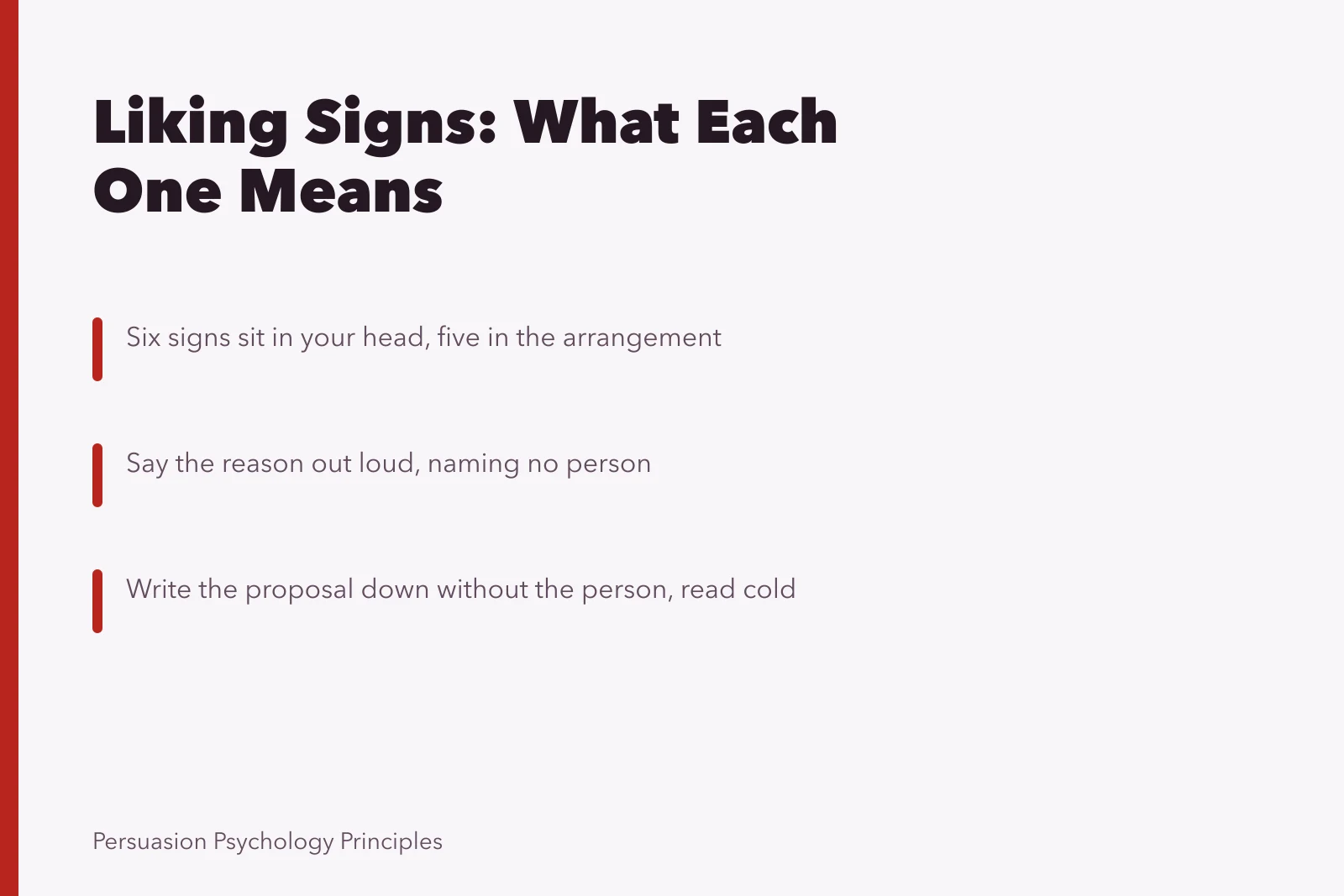
- Six of these signs are in your own head and five are in how the situation was arranged. Only the second group can be checked from outside.
- The correction is a separation rather than a defense: write the proposal down without the person in it and read it cold a day later.
Signs in your own head
1. You can state the conclusion but not the argument. Try saying why out loud. If you produce a summary of who told you rather than what they said, the liking did the work.
2. Your confidence moved when the speaker changed and nothing else did. The same proposal from someone you find abrasive suddenly needs more evidence. That asymmetry is the effect, visible in real time.
3. You find yourself defending the person when someone attacks the claim. These are separate objects. When your instinct merges them, you have stopped evaluating.
4. Disagreeing feels rude rather than merely difficult. Difficult is normal: you have to marshal a case. Rude is a social signal, and it means the relationship has become a cost of the argument.
5. You are anticipating their reaction to your no. Rehearsing how to let someone down is a reliable indication that the decision has drifted from the merits to the friendship.
6. You would not accept this from a stranger with identical information. The cleanest test available. Ask it about anything you are close to signing.
Signs in how the situation was arranged
7. Similarity arrived early and specifically. Shared hometown, same car, same school, a coincidence about your name. Common ground is a real and good thing; it is also the first move in a great deal of sales training. The tell is sequencing: genuine similarity tends to surface as conversations meander, whereas produced similarity arrives in the first two minutes and points somewhere.
8. The effort is one-directional. They have worked hard at being likeable and not at all at understanding what you actually need. Someone genuinely on your side asks awkward questions about your situation. Someone building rapport asks questions that let you talk about yourself.
9. Compliments reliably precede requests. Once you notice the pattern you cannot stop noticing it, and that is the point.
10. The warmth is scoped to the transaction. It arrives with the pitch and leaves with the decision. You can usually feel this in hindsight; the useful skill is registering it while it is happening.
11. You are being invited to like a group rather than a person. "People like us", "our kind of customer", "the sort of person who gets this". This is where liking hands off to normative influence: the appeal is no longer to affection but to membership, and refusing now costs a category as well as a relationship.
The eleventh sign has a written form worth recognizing, and opt-outs worded as "No thanks, I don't care about saving money" turn declining into an admission about your character.
Regulators treat guilt-worded choices as manipulative design practice. The FTC staff report Bringing Dark Patterns to Light surveys the wider family. On a screen it is easy to spot; in conversation it is the same move with better manners.
Liking is not the problem
It would be a bad conclusion to distrust anyone pleasant. Warmth is not a tactic in most human interaction, and treating every kindness as an opening move is a miserable way to live and also a fairly effective way to be badly informed.
The question is narrower: is the warmth load-bearing? A likeable person with a good argument loses nothing when you set the likeability aside. A likeable person whose case collapses without it was relying on it, whether or not they knew they were.
This is where the honest line sits. If someone learns why they said yes, you were friendly, you found common ground, you were pleasant, and the offer was good, nothing is damaged.
If learning the rapport was technique is enough to reverse the decision, that rapport carried weight it had not earned. Influence that cannot survive being explained was never agreement.
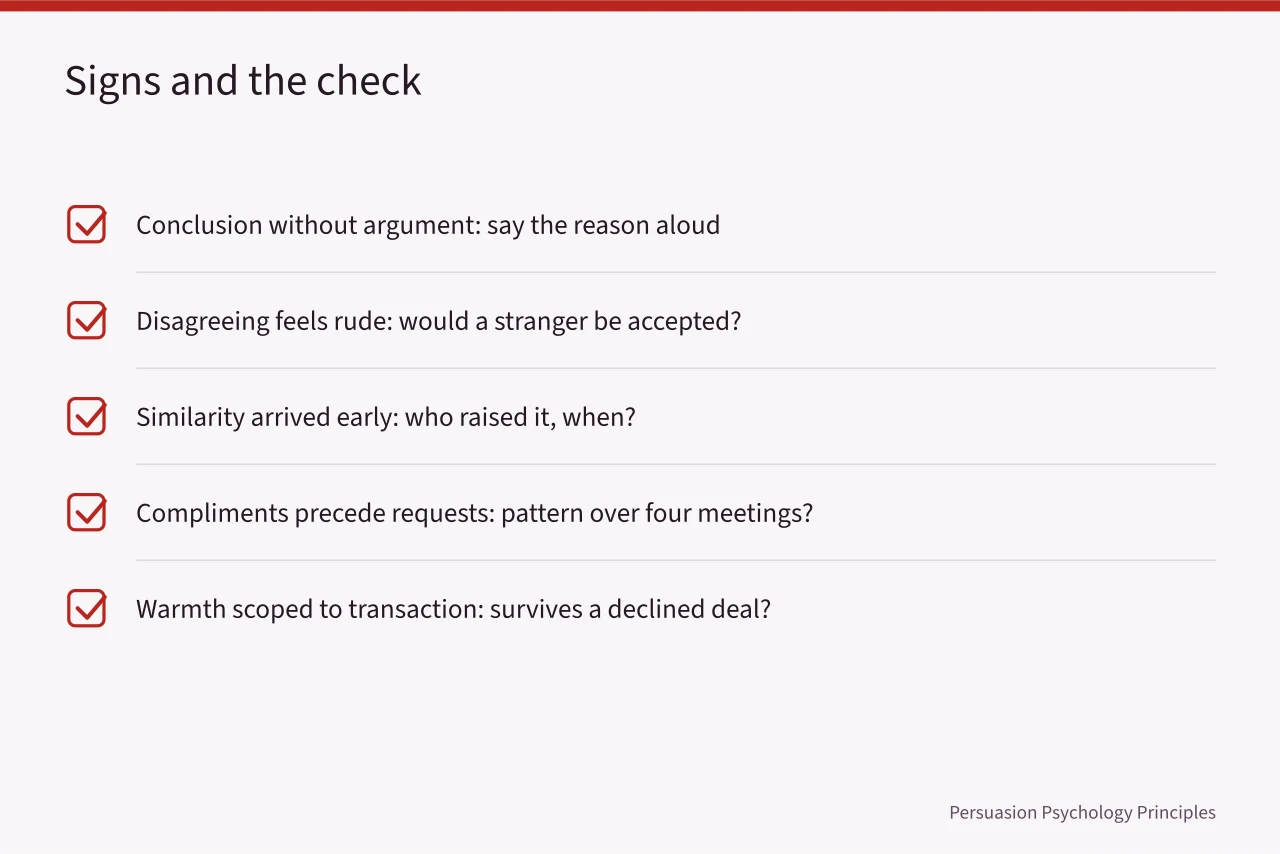
The signs at a glance
| Where it shows up | The sign | The check |
|---|---|---|
| In your head | Conclusion without the argument | Say the reason out loud, naming no person |
| In your head | Disagreeing feels rude | Would I accept this from a stranger? |
| In the arrangement | Similarity arrived early | Who raised it, and when in the conversation? |
| In the arrangement | Compliments precede requests | What has the pattern been over four meetings? |
| In the arrangement | Warmth scoped to the transaction | Does it survive the deal being declined? |
The right-hand column matters more than the count. Every one of those questions
What to do when you spot it
Separate the person from the proposal physically. Write the offer down as bare terms, put it away, and read it a day later without the face attached. Most of the effect does not survive the delay, which tells you how much of it there was.
Say the awkward thing out loud: "I like you, and I want to be sure that is not why I am saying yes." Someone acting in good faith will find this reasonable and often helpful. The reaction is informative.
Bring in someone who dislikes everyone involved. A second reader with no relationship is the cheapest correction available, and the reason organizations use panels, not individuals, for decisions of any size.
What we are entitled to expect of people close to us, and where that shades into a lever, is worked over in the Stanford Encyclopedia entry on friendship. That entry is more careful than any business book.
If you are the likeable one
You will get agreement you did not earn, and you will not be able to tell which agreement that is. A few habits keep your charm from doing argumentative work:
Give the case in writing and in person, so someone can read it without you, and volunteer the strongest objection before they find it.
Make your no cheap: say plainly that turning this down changes nothing between you, then act as if that is true. Be suspicious of a run of easy yeses. Being persuasive and being right feel identical inside, which is the whole difficulty.
More on the mechanics in liking principle techniques, the mechanism itself under liking principle, and the general defense under manipulation resistance. Where the warmth arrives with a gift attached, the second mechanism is covered under reciprocity, and the standard that decides which side of the line a technique falls on is under social influence basics.
Common questions
Should I avoid dealing with people I like?
No. Preferring pleasant counterparts is sensible, and it is a reason to choose between acceptable options rather than a reason to accept one.
How do I raise this without accusing anyone?
Say it about yourself. "I like you, and I want to be sure that is not why I am saying yes" puts the doubt where it belongs and is hard to take badly.
Do these signs work in the other direction, when I dislike someone?
The same separation applies and people are much worse at it. Objections found after a dislike has formed feel exactly like objections found before.
Is trained rapport always dishonest?
The trained version fails the disclosure test, because nobody says out loud that they matched your posture to make you agreeable. Unconscious rapport, which is most of it, is not a technique at all.