Reviews
Part of 5 things that decide commitment and consistency
Reading commitment and consistency exercises with a sceptical eye
Eight drills that separate a position from the actual reason behind it, so you can change your mind without feeling you have lost an argument.
You cannot change your mind mid-argument. You can build a record beforehand that makes changing it cheap, and that costs about a minute a day.
What to take away
- The change condition is the base drillone dated sentence naming what would have to be true for you to drop the position.
- The stranger's read exposes the gap between what you would advise and what you are doing; that gap is your history doing the arguing.
- The small-yes drill counts how often a minor agreement was collected from you rather than requested.
- The exit audit asks how you would leave a recurring commitment, which tells you what the arrangement is designed to do.
- None of these makes being publicly wrong comfortable. They make it noticeable, which is the part you control.
The eight drills
1. The change condition
Take any position that matters and write one sentence before the argument starts: what would have to be true for me to abandon this. Date it.
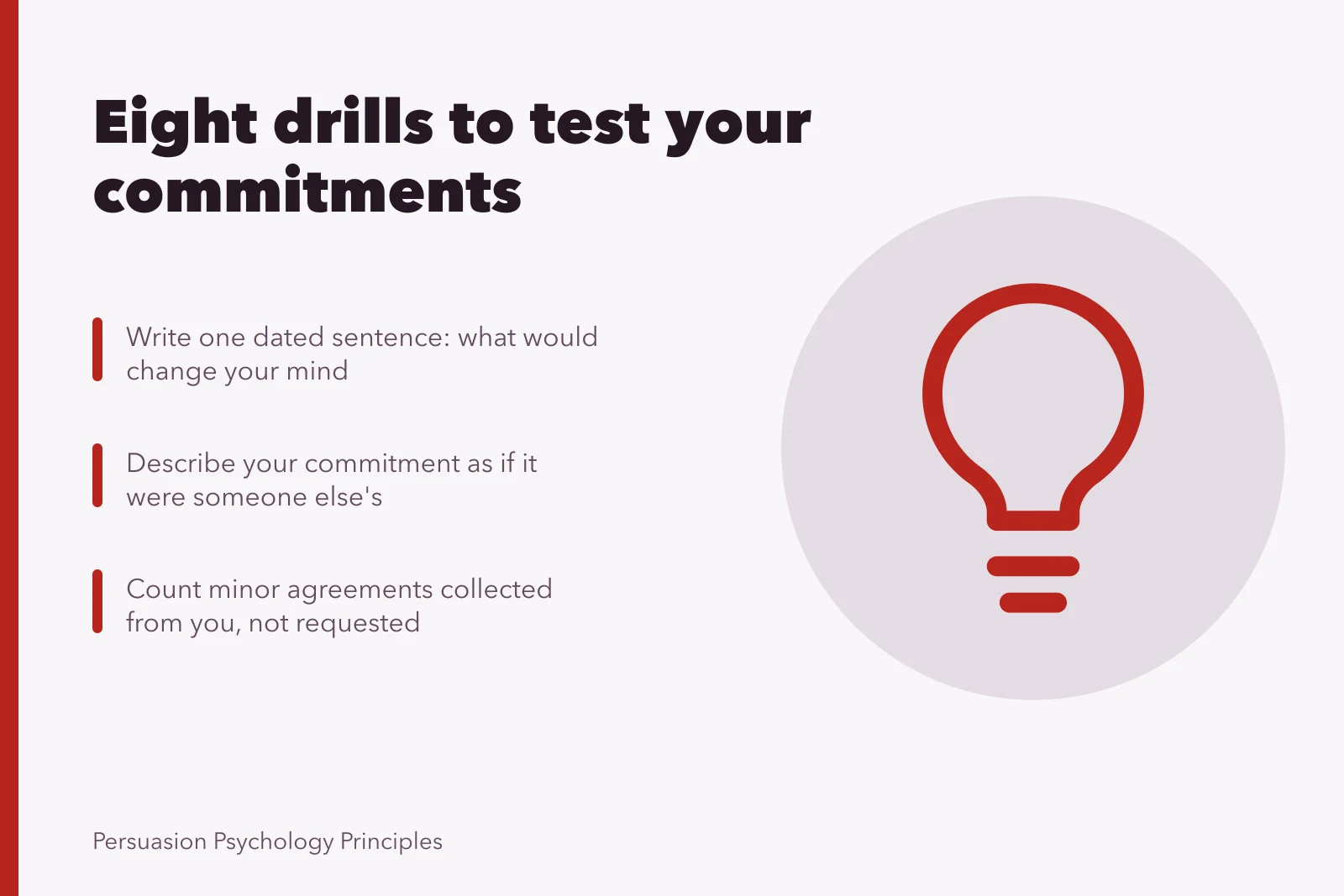
Eight commitment drills
- Change conditionwrite what would change your mind
- Stranger's readdescribe commitment as someone else's
- Restart questionwould you choose it today?
- Small-yes labellingstate what you are agreeing to
Written beforehand it is a test. Written mid-argument it is a defense, and you can feel the difference while your pen moves. Most positions turn out to carry no condition at all, which is the finding.
2. The stranger's read
Describe a commitment you are inside as though it belonged to somebody else. Leave out the history and the explanation of how you arrived.
Then say what you would advise that person. The advice is usually cleaner than your conduct, and the distance between them is the work your past is doing.
3. The restart question
Once a week, on one ongoing commitment, ask whether you would choose it today with nothing spent. Write the answer down even when it is yes.
Repeated yeses are evidence. They mean the commitment is held on its merits, and you now have a record instead of an assumption. The distinction between a commitment you built and one built on you is set out under commitment and consistency.
4. Small-yes labelling
For one week, when you agree to something minor, say what you are and are not agreeing to. "Happy to look at it; I am not taking on the project."
It will feel excessive for about three days. Then it becomes ordinary, and you start noticing how often the small agreement was being banked rather than asked for.
5. Public view change
Once a month, say out loud that you have changed your view on something and name what changed it. Small stakes are fine.
The point is not honesty theater. It is finding out what actually happens, which in most rooms is nothing, and having the sentence ready when the stakes are higher. The same reading applies to social influence basics examples, where each case shows which channel did the moving.
6. The exit audit
For any recurring commitment, work out how you would leave. Not to leave, just to know the route.
Where leaving is far harder than joining, the arrangement is telling you about itself. The design family it belongs to is catalogued in the Federal Trade Commission staff report Bringing Dark Patterns to Light.
7. Reason without position
Write the reason for a view you hold in a sentence that never mentions the conclusion. If you cannot, the position may have swallowed the reason, which is the condition worth knowing about.
8. The consistency check
Find one commitment you defend by pointing at your own past behavior: I have always done it this way. Ask what the reason would be if you had started last month. A commitment that survives the question is held by something other than its age.
A four-week run
| Week | Running | Expected result |
|---|---|---|
| 1 | Change conditions on every new position | A count of how many have none |
| 2 | Add the restart question, one commitment a week | Two or three you would not start today |
| 3 | Add small-yes labelling | A count of agreements that were collected |
| 4 | Public view change, plus an exit audit | Knowing what changing your mind actually costs |
By the end you should hold a short list of positions you keep for reasons and a shorter list you keep because you took them. Work the second list. It is usually shorter than people fear and longer than they expect.
Four-week drill schedule
- Week 1Change conditions on every new position
- Week 2Add the restart question, one commitment a week
- Week 3Add small-yes labelling
- Week 4Public view change, plus an exit audit
What the drills cannot do
They cannot make you willing to be publicly wrong when it is expensive. That willingness comes from what happened the last few times, which is why drill five exists and why it runs at small stakes.
They cannot tell you the position is wrong. A commitment held for weak reasons may still be correct. Noticing that you are defending rather than reasoning is a signal to re-examine, not a verdict.
They cannot be run on somebody else. Asking another person what would change their mind, mid-argument, is a move rather than a question, and it will be heard as one. Answer it about yourself first, out loud. That is a real concession and it tends to come back.
The standard separating a commitment you built from one built on you sits under social influence basics. Tactics that depend on your not noticing are under manipulation resistance. Where the hardening comes from other people having witnessed the position, the channel is normative influence.
How far a past self should bind a present one is a live question, and the Stanford Encyclopedia entry on practical reason is a fair place to see the arguments.
Common questions
Which drill first if I only do one?
The change condition. It costs one sentence, needs nobody else, and every other drill gets more informative once you have a few written down.
Does the restart question just make me quit things?
For most people it does the opposite. The answer is usually yes, and having asked makes the commitment easier to hold without defending it.
Is it weak to change your mind often?
It is weak to change it for no stated reason. Naming what changed turns an inconsistency into reasoning other people can follow, and that reads as strength almost everywhere.
How long until this shows up in real decisions?
The record starts immediately and the behavior lags. Anyone offering a timeline for the second part is guessing. The record is worth having either way.