Industry
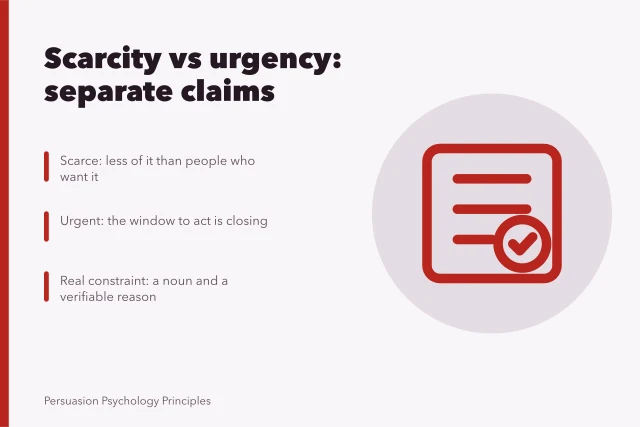
Part of Why scarcity and urgency are two different claims entirely
Scarcity examples compared: which limits are real and which are not
Fifteen scarcity examples sorted by whether the limit has a noun behind it, with what each one really tells you and the question that settles it.
Every limit is either made of something or asserted by somebody. Sorting fifteen ordinary cases that way takes about a minute each and it changes what you do next.
What to take away
- A limit you can describe in physical terms is a fact. A limit set by the party who benefits from your haste is a decision.
- The middle group is the interesting onelimits that are real and have been arranged to feel more binding than they are.
- The question that settles almost every case is what the limit is made of, asked plainly and once.
Limits made of something
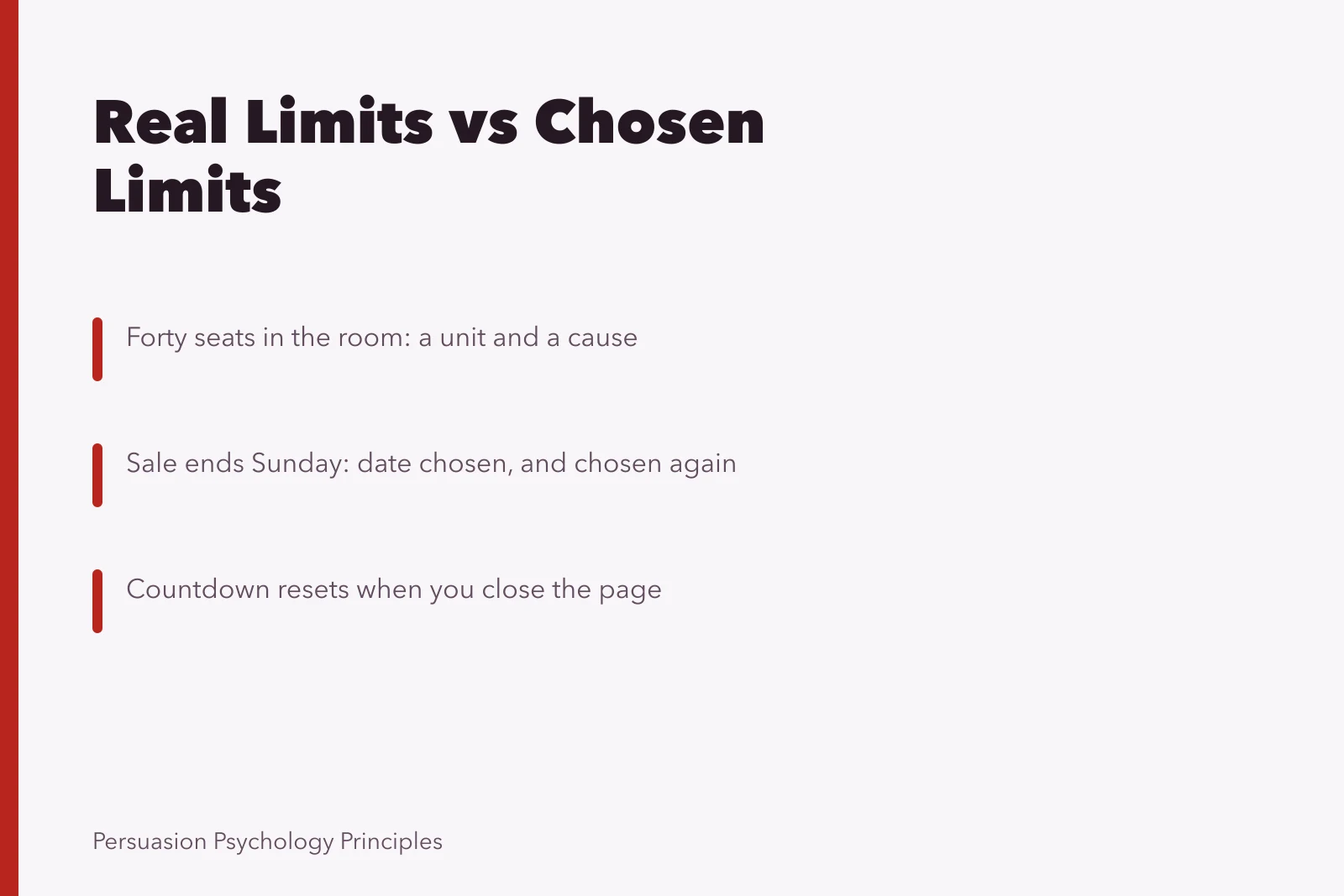
1. Forty seats in the room. The venue holds forty. The constraint has a unit, a cause, and no relationship to whether you buy. This is the honest form and it needs no pressure attached.
2. The last of a discontinued material. A workshop has what it has and no more is being made. Verifiable in principle, and the seller loses nothing by explaining it.
3. One craftsman, a waiting list. Capacity is a person's working hours. The limit is as real as limits get and it will still be there next month.
4. A statutory deadline. A filing date set by a public body. Nobody selling you anything chose it, which is exactly what makes it trustworthy as a deadline.
5. Perishable stock at the end of the day. Bread, flowers, tickets to tonight's show. The limit is time acting on a physical thing.
6. A booking that somebody else can take. The room is either available or it is not, and another buyer really can remove it. The pressure here is genuine and it is also, notably, not created by the seller.
Limits that are real and arranged
7. A sale that ends Sunday. The date is real in the sense that the price will change. It was also chosen, and it will be chosen again next month. Both facts are true, and only the second one tells you what to do.
8. A limited edition of a manufactured thing. The number was picked by the manufacturer. Scarcity here is a product feature, honestly disclosed, and it says nothing whatever about quality.
9. "Only three left in stock." Often a true reading of a warehouse count, and often a threshold set to display at a certain level. From outside these look identical, and the Stanford Encyclopedia entry on assertion is a fair guide to why a claim you cannot check still functions as one.
10. Early-bird pricing. A genuine schedule that rewards early buyers. Honest, useful, and worth checking against what the price does when the deadline passes.
11. Membership caps. A club or a service limits numbers. The cap may serve quality and it may serve demand, and asking which does no harm. A real limit and a manufactured one can use the same words, which is why scarcity meaning deserves its own definition.
12. Seasonal availability. Real in agriculture, chosen in retail, and the same words are used for both.
Limits asserted by the interested party
13. The countdown that resets. Close the page, return, and the timer starts again. Nothing is running out and the display is not reporting anything. This family of design is set out in the Federal Trade Commission's staff report Bringing Dark Patterns to Light.
14. "This price is only available on this call." A limit whose entire function is to prevent you comparing. The tell is that the constraint disappears the moment you say you will call back, which is worth testing once.
15. The number of people viewing this right now. Presented as pressure from other buyers rather than from the seller. It cannot be verified, and where it is generated rather than measured it is a display rather than a fact.
What each group is worth
What the limit tells you
- Made of something
- Supply is genuinely bounded
- Real and arranged
- A price or quantity was chosen
- Asserted by the seller
- Somebody wants speed
What to do
- Made of something
- Decide on the merits, then act on the deadline
- Real and arranged
- Ask what happens after the date, then ignore it
- Asserted by the seller
- Treat the limit as absent
The middle row is where most ordinary commerce sits, and it is not dishonest. A sale that ends Sunday is a real event. The mistake is letting a chosen deadline function as if it were a physical constraint, and the correction is a single question: what happens on Monday?
Scarcity groups compared
Made of something
- What it tells you
- Supply is bounded
- What to do
- Decide, then act
Real and arranged
- What it tells you
- Price or quantity chosen
- What to do
- Ask after date
Asserted by the seller
- What it tells you
- Somebody wants speed
- What to do
- Treat as absent
The question that settles them
What is the limit made of? Ask it once, plainly, and listen to the shape of the answer rather than its content. Genuine constraints produce a specific sentence with a noun in it. Manufactured ones produce a repetition, a change of subject, or an offer to extend the deadline, and that last one answers the question completely.
Everything here follows the site standard: a limit that survives being explained is a fact you can use. A limit that needs you not to ask is doing something else.
The full account is under social influence basics, the mechanism under scarcity, and the tactics that depend on you not checking under manipulation resistance.
Where a limit arrives alongside a crowd number, they are separate claims working on different channels, and the crowd half belongs under social proof.
Common questions
Is it wrong for a seller to set a deadline?
No. Deadlines are ordinary and often useful to both sides. The problem is presenting a chosen deadline as though it were a physical constraint the seller cannot change.
What if I ask what the limit is made of and get a vague answer?
Then you have your answer. A vague response to a specific question about supply is itself the information you were looking for.
Should I ever act quickly on a limit?
Yes, once you have already decided the thing is right for you. A limit is a reason to execute a decision, never a reason to make one.
Does an honest limited edition mean the item is better?
No. Rarity and quality are independent. A limited edition of a mediocre thing is a rarer mediocre thing, and pricing often reflects the rarity rather than the item.