Rules
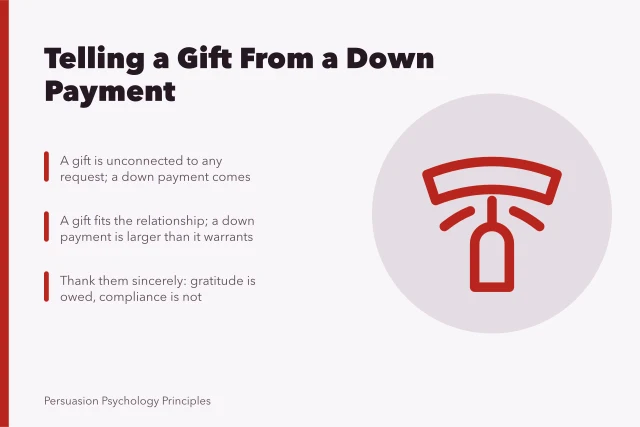
Part of Reciprocity: telling a gift from a down payment
Reciprocity meaning: the practical version
Reciprocity meaning, defined by class and difference: how the felt debt differs from trade, gratitude, obligation and bribery, and where each boundary sits.
Reciprocity is the sense that something received has to be answered. Not repaid, exactly, and not traded. Answered, in a currency and on a timetable that nobody states and everybody feels.
What to take away
- The class is social obligation. The difference is that the debt is created by the giver, not agreed by both parties.
- This is what separates it from trade, where terms are set in advance, and from gratitude, which is a feeling and imposes nothing.
- The mechanism is not a flaw. It is how cooperation runs between people who cannot write contracts, and it goes wrong only when someone starts a ledger you did not open.
The definition, in one sentence
Reciprocity is the tendency to answer a benefit with a benefit, on terms the recipient did not agree to in advance.
Everything interesting is in the last clause. A trade has terms. A gift creates an obligation with no terms at all. That is why the giver decides what counts as settling it, and why that discretion is worth watching. The discretion a giver holds is exactly what the reciprocity techniques catalog names, move by move.
Class and difference
What it shares
- Trade
- Something for something
- Gratitude
- Follows a benefit
- Obligation
- Creates a duty
- Bribery
- A benefit intended to move a decision
- Charity
- One-directional giving
- A promise
- Binds future behavior
How it differs
- Trade
- The terms are agreed before either side moves
- Gratitude
- It is a feeling, and it imposes no debt
- Obligation
- The duty was undertaken, usually explicitly
- Bribery
- The corrupt purpose is the defining part
- Charity
- Nothing is expected back, and nothing is implied
- A promise
- You made it, and the philosophical account of promises turns on that fact
Read down the "how it differs" column and a pattern appears. In every neighboring idea except reciprocity, the person who ends up owing something had a say in whether they owed it. Reciprocity is the case where they did not, and that asymmetry is what makes it both useful and exploitable.
Reciprocity vs nearby ideas
Nearby idea
- Trade
- Something for something
- Gratitude
- Follows a benefit
- Obligation
- Creates a duty
- Bribery
- Benefit moves a decision
- Charity
- One-directional giving
- A promise
- Binds future behavior
What it shares
- Trade
- Terms agreed beforehand
- Gratitude
- A feeling, no debt
- Obligation
- Duty was undertaken explicitly
- Bribery
- Corrupt purpose defines it
- Charity
- Nothing expected back
- A promise
- You made it yourself
How it differs
- Trade
- Gratitude
- Obligation
- Bribery
- Charity
- A promise
Where the word comes from and what it kept
The older sense is anthropological rather than psychological. Societies without contracts or courts run on gift exchange, and the obligation to give, to receive and to return holds them together. That version is about maintaining a relationship over years, not about closing a deal this afternoon.
The persuasion sense is a compressed version of it, and the compression is where the trouble starts. A gift given to open a relationship and a gift given to trigger a return within the hour have the same surface and opposite purposes. The word covers both, and readers of anything written about reciprocity should keep asking which one is meant.
The test that separates the two
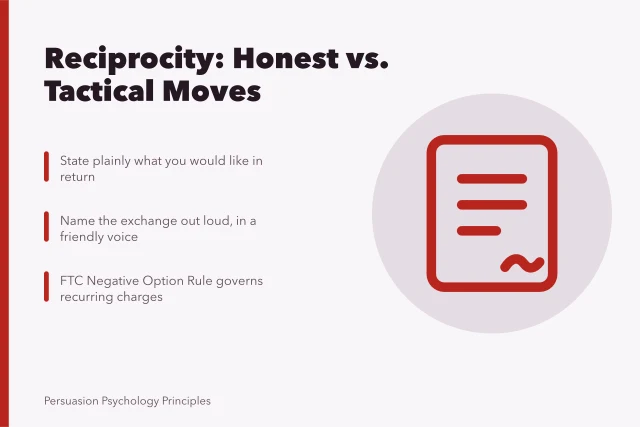
A benefit given to open a relationship survives disclosure. "I helped you because I would like us to work together, and I hope you will help me sometime" is a sentence you can say out loud, and saying it costs nothing.
A benefit given to trigger a return does not survive it. "I gave you this so that you would find it hard to say no" is never said, and it is not said because saying it would defuse the whole thing. That difference is the standard used throughout social influence basics, and here it does more work than any definition.
The four things the debt is made of
- A giver's discretion.Because no terms were set, the giver decides what settles the account, and they will usually decide in their own favor.
- A timetable you did not choose.The call comes when it suits them, and the debt feels most pressing when it is invoked rather than when it was created.
- A currency mismatch.Small gifts are routinely answered with large returns, because the two are compared by feel rather than by value.
- Visibility.Debts witnessed by other people are much harder to leave unpaid, which is why so many are created in public.
Each of these is a place where an honest exchange and an engineered one look identical from inside. Sorting them takes a rule rather than a feeling, and the practical rules are set out under reciprocity. Telling an honest exchange from an engineered one starts with the reciprocity meaning that separates a gift from a down payment.
Four parts of the debt
- Giver's discretionthey decide what settles it
- Timetable you did not chooseinvoked when it suits them
- Currency mismatchsmall gifts answered with large returns
- Visibilitywitnessed debts are harder to leave unpaid
What is not reciprocity
Paying for something is not reciprocity, and neither is doing your job. If terms existed, the account was settled when the terms were met, however strongly the other party talks about goodwill.
Feeling grateful is not reciprocity either. Gratitude is a response to a benefit and it obliges nothing. The obligation is a separate thing that may or may not follow, and confusing the two is how people end up doing favors they did not want to do for someone they were merely pleased with.
Whether the felt duty here is a moral one at all is a live question, and the Stanford Encyclopedia entry on moral epistemology is a reasonable starting point for why philosophers disagree about it.
And a benefit you did not accept creates nothing. A gift arriving unasked, a free sample you did not request, a service performed without your agreement: these can produce a strong feeling of debt and they do not produce a debt.
Recognizing the difference between the feeling and the fact is the single most useful thing this definition gives you, and the wider field guide for it is under manipulation resistance. The related pull of matching what a group does is a separate channel described under normative influence.
Common questions
Is reciprocity a bias or a rule?
It behaves like a social rule that people follow and also feel. Treating it as a bias to be eliminated is a mistake, because the same reflex is what allows strangers to cooperate without paperwork.
Does the size of the gift set the size of the debt?
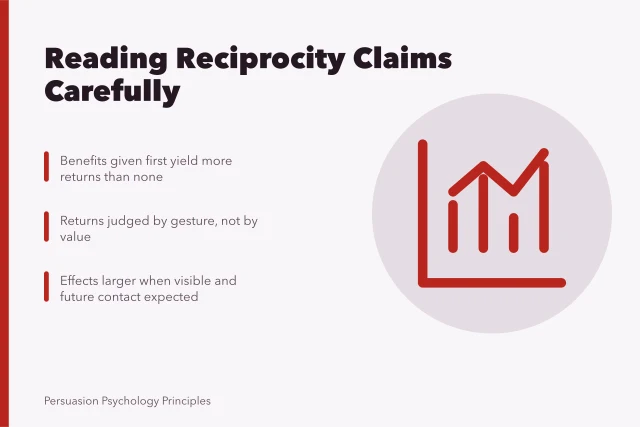
Not reliably. Returns tend to be judged by the gesture rather than by the value, which is why a small unexpected benefit can produce a large answer, and why that mismatch is worth noticing in yourself.
If I did not want the gift, do I owe anything?
No. You may still feel that you do, and the honest move is to say plainly that you are not taking it as an obligation, once, at the time rather than later.
Can reciprocity be used well?
Constantly, and most of it is. Giving first, expecting nothing specific, and saying what you hope for is how most working relationships start. The problems begin when the return is engineered rather than hoped for.