Maintenance
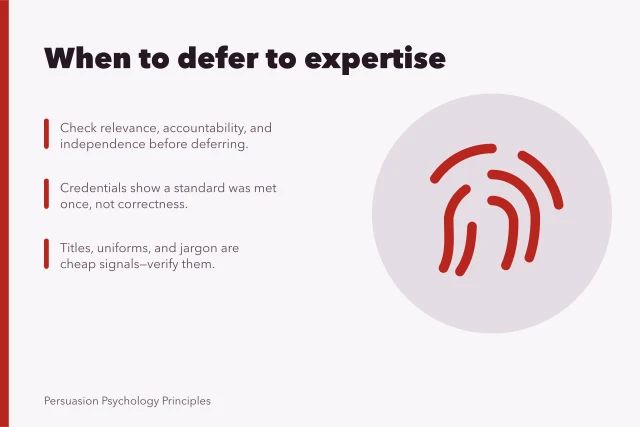
Part of Authority compared with expertise: what actually earns deference
Authority at work: disagreeing upward without starting a fight
Authority at work: five scenes where rank and expertise get confused, how to disagree upward without a fight, and how to get real objections as the boss.
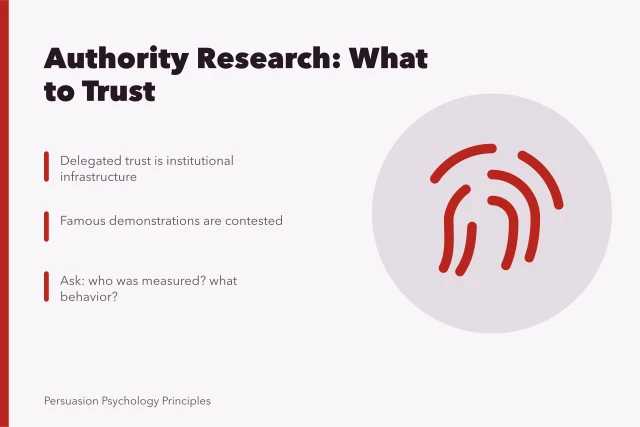
Workplaces run on delegated trust. Nobody can verify everything, so people defer to whoever is supposed to know. In an organization, "supposed to know" and "has power over my review" are frequently the same person. That overlap is what makes authority at work different from authority anywhere else.
Two things get confused whenever this goes wrong: position authority (this is my call) and earned credibility (I have been right about this kind of thing before). They are separate. The difference between a right to decide and a reason to be believed is the same one philosophers draw between authority and expertise.
Someone can have one without the other in either direction. Most workplace friction comes from a decision being argued as though it were the second when it is really the first.
What to take away
- The useful test is whether your influence survives being explained.
- Someone can have one without the other in either direction, and most workplace friction comes from a decision being argued as though it were the second when it is really the first.
Scenes where the two get confused
Each of these is ordinary. None of them involves anybody behaving badly, which is why they are hard to fix by asking people to behave better.
The opinion that ends the discussion
A director offers a technical view in passing. The thread goes quiet. Six weeks later the decision turns out badly and three people say privately they had doubts. Nobody lied and nobody was bullied. The director was simply right often enough that checking felt unnecessary, and the cost of being the person who checks kept rising until nobody paid it.
The fix is procedural, not personal: the most senior person in the room speaks last. It feels artificial for about two meetings and then it feels normal.
The escalation used as an argument
Someone answers an objection with "I will raise this with the VP." That is not a response to the objection.
It may be a legitimate next step, since some decisions belong upstairs, but say it after the argument is answered, not instead. The tell is timing: escalation offered as a first move usually stands in for a reason.
The expert who is out of date
This one is uncomfortable because the credential is real. Someone trained deeply ten or fifteen years ago in a field that has moved. Their instincts still beat a novice's and trail a current practitioner's, and nobody wants to be the one who says so.
What settles it is not seniority but a specific, checkable claim about how the thing works now.
The consultant's report as a tiebreaker
An external report arrives and ends an internal argument, sometimes exactly as it should, but check what the argument was about.
If two teams disagreed about facts, outside expertise helps; if they disagreed about priorities (speed against reliability, cost against risk), no report resolves that.
Using one to close the discussion moves the disagreement underground. Priorities are a decision, not a finding.
"Because that is the policy"
Policy is sometimes a reason: it encodes a constraint you need not re-derive, and departing from it has real consequences. Policy is sometimes a placeholder for a reason nobody remembers.
To tell the difference, ask what the policy protects against. If someone can answer, it is load-bearing. If nobody in the building can, you have found a fossil. Citing it as authority is a mistake, not a shortcut.
Disagreeing upward without it becoming a fight
Most advice here is about tone. Tone matters less than structure. What actually
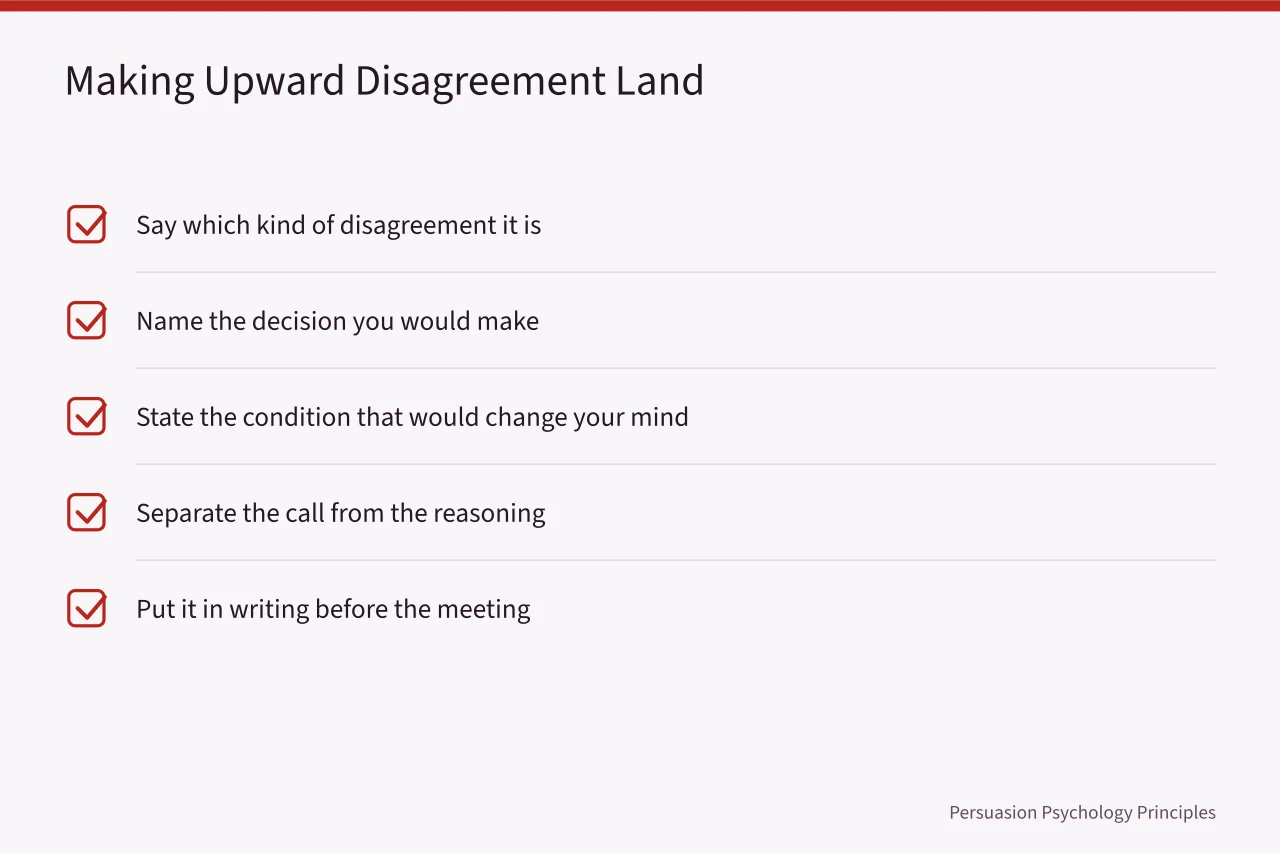
- Say which kind of disagreement it is. "I think this is wrong" and "I think this is risky and here is the specific way it fails" are different conversations. The second one is much easier to answer and much harder to dismiss.
- Name the decision you would make, not just the flaw. Objections without an alternative get filed as friction.
- State the condition that would change your mind. This does two things: it shows you are reasoning rather than resisting, and it invites the same disclosure back.
- Separate the call from the reasoning. "It is your call and I will back it : I want the concern on record" is not a threat, and it lets a manager accept the information without accepting a challenge to their authority.
- Put it in writing before the meeting when you can. Written objections are read without a room watching, which removes most of the social cost from both sides.
Getting real objections when the authority is you
If you run a team, your problem is the inverse: you receive a filtered signal
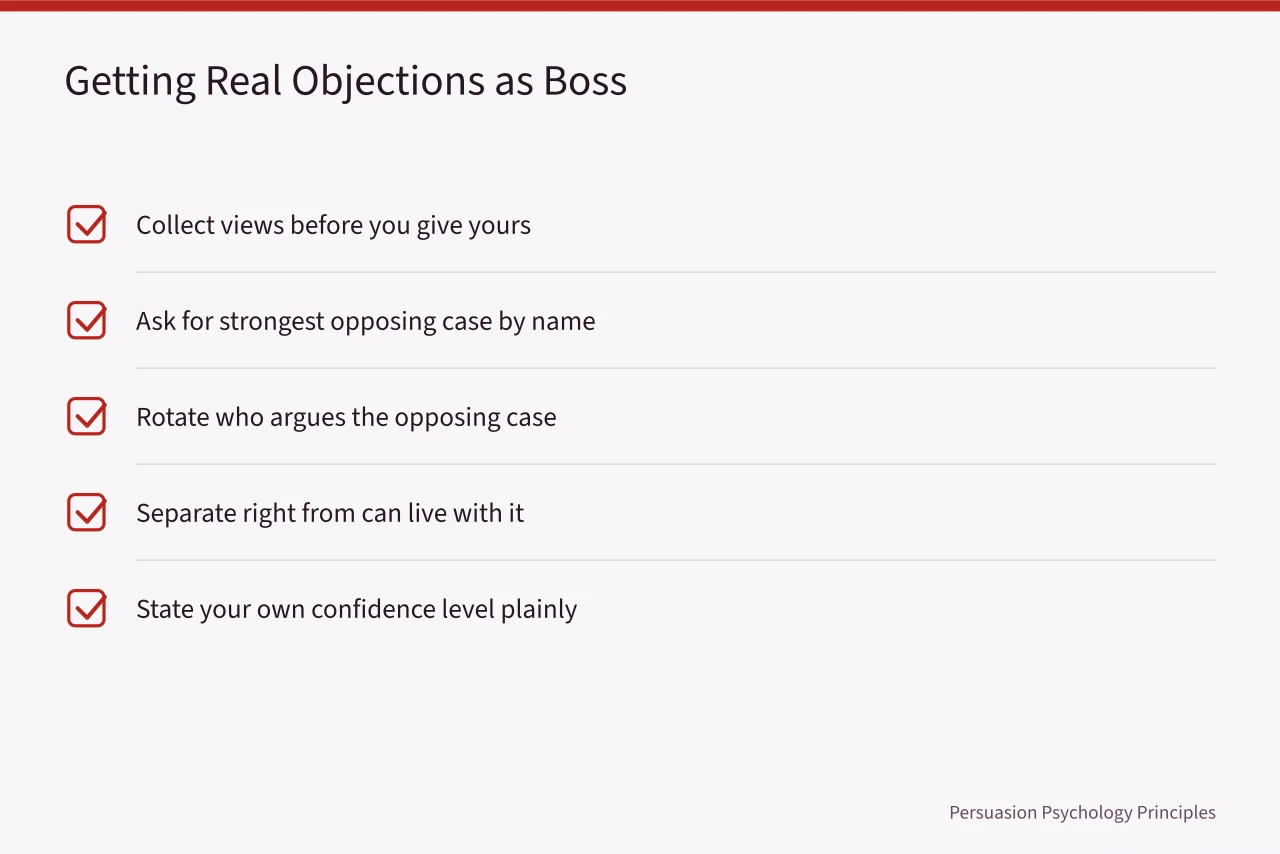
Collect views before you give yours: in writing if the group is large enough that speaking order matters. Ask for the strongest version of the opposing case and give it to someone by name, rotating who gets the job so it never becomes one person's identity.
Distinguish "who thinks this is right" from "who can live with it", because those get merged into a single nod otherwise. Say your own confidence level plainly; a team that cannot tell your hunches from your convictions will treat both as instructions.
None of this is soft. A team that only agrees with you because you are senior has given you compliance, and compliance stops working the moment you are not looking. Agreement keeps working when you are on holiday.
Position authority needs to be justified, not merely held. The Stanford Encyclopedia entry on political legitimacy treats that as the standing question, and it applies to a team with little loss.
Rank tells people who decides, but says nothing about who is right. A manager who keeps those two claims separate in their own speech will find the team does too.
The line worth holding
The useful test is whether your influence survives being explained. If you told your team exactly why they went along with you: you outrank them, you were confident, you had the room: would the decision still stand?
When the honest answer is yes, because the reasoning was available and they checked it, you had authority. When it is no, you held them and it did the work quietly. That hold is sometimes legitimate, since a decision does have to get made.
Still, know which one you used, because you will need to know what your agreement is worth when the plan meets something you did not predict.
These failure modes appear elsewhere. Authority mistakes covers the general versions. normative influence covers going along to belong rather than being convinced.
The conditions that make deference sound are set out under authority. You update because somebody genuinely knows more under informational influence. The test itself is under social influence basics.
Common questions
How do I disagree with my manager without it becoming a problem?
Disagree about the decision and not about the right to make it. "I think this is wrong, and it is your call" separates the two claims and lets the other person take the objection without also having to defend their standing.
What if I am asked for my view after the senior person has given theirs?
Say so, once. Asking to write views down before discussion is a process request rather than a challenge, and it is much easier to make in advance than in the moment.
Does a manager have to justify every decision?
No, and pretending otherwise wastes everyone's time. What they owe is a clear statement of which kind of decision it is, so that a call made on authority is not presented as a call made on evidence.
How do I tell whether my team actually agrees with me?
Look at whether anyone has disagreed with you recently and what happened to them afterward. That single example sets the price of dissent for months, and your team is reading it more carefully than they read anything you say about openness.