Guides
Part of A working test for manipulation resistance you can run today
Notes on manipulation resistance research from the field
Manipulation resistance research is thinner than it sounds: what the evidence supports, why effect sizes are disputed, and how to read the next study you are shown.
Somebody tells you that a short training session makes people meaningfully harder to mislead. Before you build anything on that, work out what would have to be true for it to be known.
What to take away
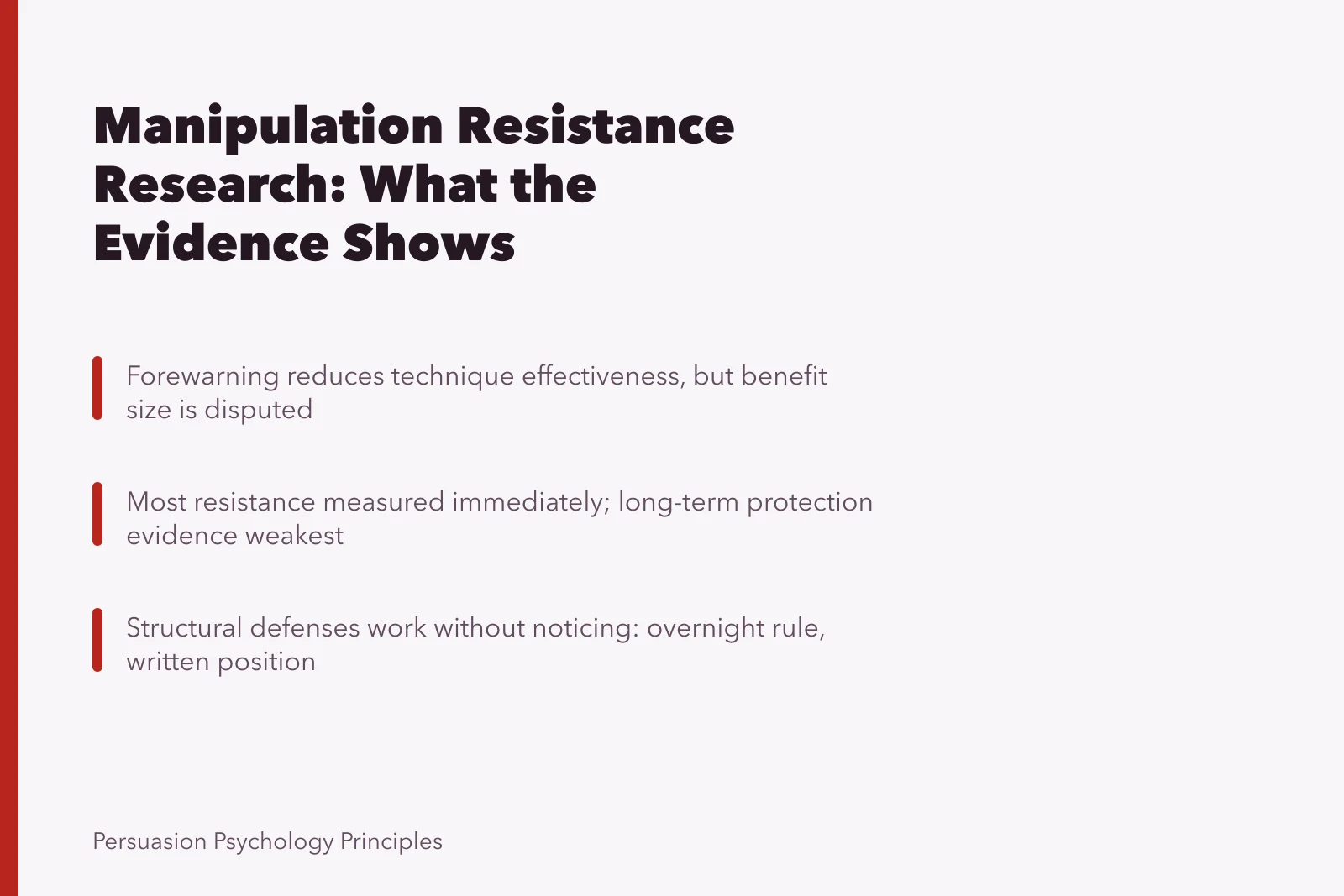
- The direction has supportwarning people in advance about a technique tends to reduce how well it works. The size of that benefit is disputed and varies widely by setting.
- Almost all of it is measured immediately. How long any protection lasts is the weakest part of the evidence and the part that matters most.
- The findings that transfer best are structural, and they say the same thing: the defenses that work do not depend on you noticing anything.
What is reasonably well supported
Forewarning helps. People told in advance that an attempt is coming, and roughly what shape it will take, are somewhat less moved by it. This is the area's best supported idea and the least surprising.
A warning only works if you know what counts as a sign. That is why the list of manipulation resistance signs matters.
Explanation helps more than a warning alone. Being shown how a technique works, rather than simply told to be careful, appears to do more, presumably because it gives you something to recognize rather than a general instruction to be alert.
Practice with a weak version helps. Encountering a mild form of an argument and working out what is wrong with it seems to prepare people better than being told the conclusion. This is the idea behind the various inoculation approaches, and it is the one most often oversold.
What is genuinely disputed
| The question | Why it is unsettled |
|---|---|
| How large the effect is | Estimates vary widely by setting, population and how resistance was measured |
| How long it lasts | Most measurements are taken immediately; longer follow-ups are rarer and weaker |
| Whether it generalizes | Training against one technique may or may not help against another |
| Whether it works under real pressure | Laboratory conditions lack the urgency, the money and the relationship |
| What is actually being measured | Reported resistance, measured behavior and later regret are three different outcomes |
Anyone who gives one clean number across all of that has compressed a live argument into decoration. Across behavioral fields generally, a substantial share of memorable results have proved harder to reproduce than expected.
What that means for any individual claim is itself argued over, as the Stanford Encyclopedia entry on reproducibility of scientific results sets out.
A catalog is a good picture of what this literature actually offers. It will tell you what has been looked at and where to find it. It will not tell you which entry is true, and treating the existence of a card as a finding is the error this page is about.
How to read the next study you are shown
Five questions for a study
- What did resistance mean?
- When was it measured?
- What could participants lose?
- Was it repeated elsewhere?
- Would you act differently?
How to read the next study
- Ask what resistance meant in the measurement. Saying you were not persuaded and behaving differently are not the same outcome, and the first is much easier to produce. People are not reliable narrators of their own reasons, which is the standing difficulty treated in the Stanford Encyclopedia entry on self-deception.
- Ask when it was measured. Immediately after training is the standard, and it is the weakest useful moment.
- Ask what the participants could lose. A choice with nothing at stake tells you little about a choice with a month's income at stake.
- Ask whether anyone repeated it elsewhere, with different people. One striking result is a lead.
- Then ask whether you would act differently under a strong version of the claim and a weak one. Often you would not, which settles it for your purposes.
What follows for you in practice
The evidence supports a modest and useful conclusion: knowing the shape of a technique in advance helps somewhat, and the help fades. That argues for structures rather than for training alone.
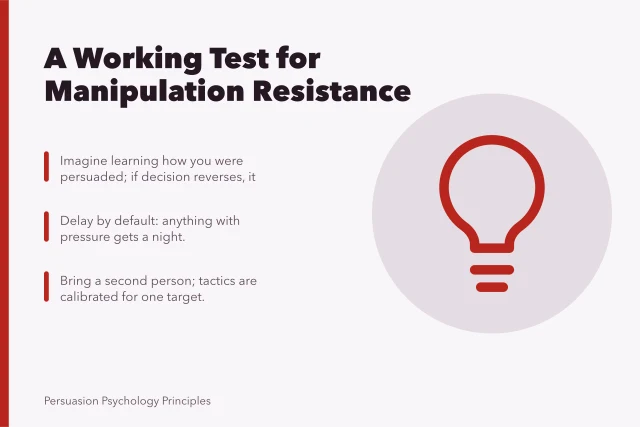
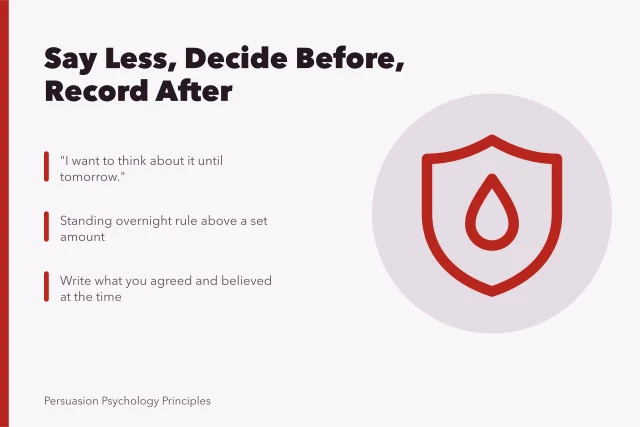
An overnight rule does not decay. A written position taken before a conversation does not decay. A second opinion from somebody with nothing at stake does not decay. These work whether or not you remember what you read, which is precisely the property the training studies have trouble demonstrating, and they are set out under manipulation resistance.
It also argues against a common misreading. Learning about a mechanism does not switch it off, in the same way that knowing about an optical illusion does not stop you seeing it. The realistic gain is that you can name what is happening and decide separately, which is a smaller claim and a defensible one.
None of it settles the ethical question, which is separate and prior. Whether a technique goes around a person's judgment instead of through it does not depend on effectiveness.
This site's standard tests method, not effectiveness, and it is set out under social influence basics, with the individual mechanisms under reciprocity, scarcity, and commitment and consistency.
Common questions
Why does this page not name the studies?
Because a result without its setting is not usable here, and naming a small number of memorable ones would give you a false sense of how settled the area is.
Does disputed evidence mean the training does not work?
No. Direction and magnitude are separate claims, and the direction has reasonable support. What is unclear is how much, for how long, and for whom.
Is there any protection that does not fade?
Structural ones, because they do not rely on memory or attention. A rule you set in advance is doing the work when your alertness is not.
How should I judge a course or program that claims to build resistance?
Ask what it measures, when, and whether anyone independent has checked. A program that reports only immediate self-reported confidence is measuring the thing that is easiest to move.